
Your EBITDA Is Strong. But Is Your Business Sellable?
Strong EBITDA is necessary but not sufficient to sell a business — buyers scrutinize the quality and durability of earnings, not just the headline number.
A company with $13M in revenue and $5M in EBITDA failed to sell after a year on the market because two structural risks — 45% revenue dependence on a single distribution channel and 16% revenue from one customer — triggered valuation disputes, and the deal fell apart during due diligence.
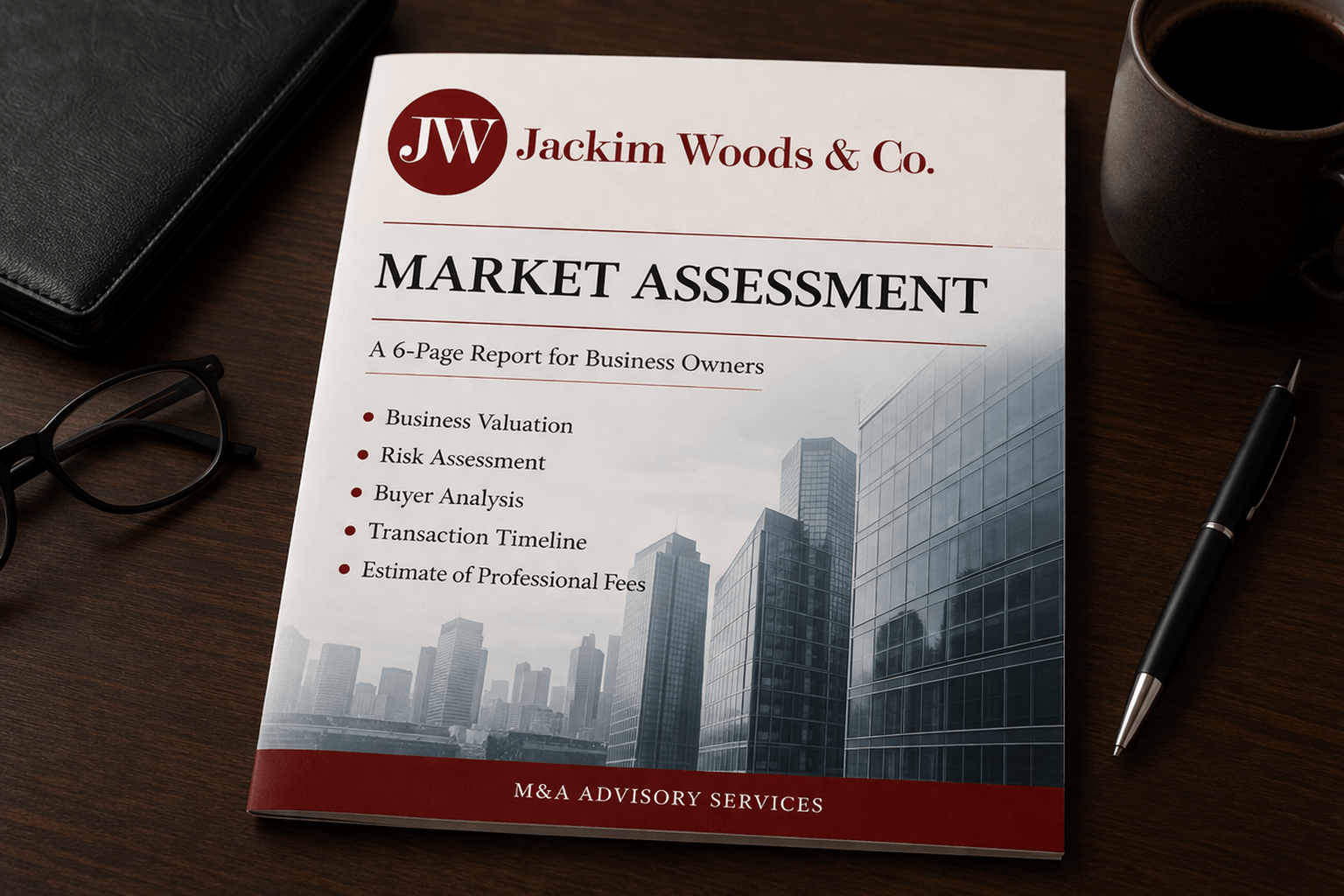
A concentrated revenue base, even at strong margins, creates deal risk that sophisticated buyers will find and price against. Businesses where any single customer accounts for 5% or more of revenue, where revenue flows through a single channel or relationship, or where recurring revenue is minimal , face a high likelihood of a buyer wanting to renegotiate the deal during due diligence. A professional market assessment — reviewing financials, revenue composition, customer concentration, and competitive positioning — is the critical first step before going to market, and is the most reliable way to avoid surprises that kill deals.
— Rich Jackim, Jackim Woods & Co.
Your EBITDA Is Strong. But Is Your Business Sellable?
Every business owner considering selling their business deserves a clear-eyed assessment of one foundational truth: EBITDA is a critical metric, but it does not tell the complete story. Owners who discover this after months of trying to sell their business — or after a deal fails during due diligence — will have wasted a lot of time and money.
The following is a situation we have seen multiple times in our practice. The details have been modified for confidentiality, but the dynamics are real—and offer important insights for any owner thinking about an exit.

A Business That Looked Great on Paper
Last year, we spoke with the owner of a business services company who had spent twenty years building his business. Now 65, he was ready to retire and sell the company. The financial profile was attractive: approximately $13 million in revenue with $5 million in EBITDA – strong margins that would get buyers’ attention.
Early in the process, the owner’s CPA reviewed the financials and told the owner the company was probably worth $25 million – exactly what the owner wanted to hear. The CPA explained that the EBITDA was there, and in his experience, companies like this one sold for 5x EBITDA. The owner felt confident, so he hired an M&A advisor to sell the business. After a year on the market, two buyers had withdrawn their offers during due diligence, and the business was still not sold.
Strong EBITDA opens doors. But what buyers find when they look inside determines whether a deal actually closes.
What the Financial Analysis Revealed
When buyers started their due diligence, they discovered the company’s revenue composition contained concentration risks that ultimately derailed the deal:
45%Revenue from One Distribution Channel |
16%Revenue from a Single Customer |
61%Revenue Concentration Risk |
Revenue channel concentration: 45% of total revenue was generated through a single distribution channel, a key salesperson, who was the same age as the business owner. While that salesperson had performed reliably for years, the fact that the company depended on someone so close to retirement age was a structural dependency that concerned sophisticated buyers.
Customer concentration: 16% of revenue was attributable to one customer, a large manufacturer with multiple locations. This indicated a customer concentration issue that affected lending eligibility and the buyer’s financing options, which in turn affected the overall risk profile of the deal.
These were not deal killing factors individually. But collectively, they represented risks that sophisticated buyers identified in due diligence, and in one case, used to try to negotiate a huge valuation adjustment (50%) — or in the other case, as grounds to exit the process entirely.
When Market Conditions Validated a Buyer’s Analysis
What ultimately killed the deal was during due diligence, an external event occurred that demonstrated precisely why concentration risk demands early attention.
The company received formal notification that its largest customer — representing 16% of annual revenue — had been acquired by a direct competitor. As part of the acquirer’s vendor consolidation strategy, they provided notice that they would be scaling back their purchase orders over the next six months, with the goal of consolidating all purchase orders with the new parent company’s vendors.
The impact was immediate and material. Sixteen percent of the company’s revenue had just disappeared and could not easily be replaced. The seller’s valuation and negotiating position was now fundamentally changed by a single event outside of their control. This is exactly what buyers feared, and it had come true.
The Strategic Lesson for Owners Selling Their Businesses
Advisors who do not earn success fees when a transaction closes have limited incentive to tell clients the hard honest truth about their client’s business. The result is that business owners often try to sell their business without a clear understanding of how buyers will evaluate their company — and without the opportunity to fix those risk factors before they become deal killers.
As the above example demonstrates, EBITDA matters a lot. But experienced buyers will also be looking at the quality and durability of those earnings:
- Does any single customer represent more than 5% of a company’s revenue?
- Is revenue dependent on a single channel, platform, or relationship that could be disrupted?
- Is revenue generated from one product or service, or diversified over a wide range of products and services?
- Is there industry concentration risk with services or products serving only one industry?
- How much of the revenue base is genuinely recurring, contracted, or relationship-protected versus transactional?
- How is the business positioned relative to industry transformation — as an adopter or as a laggard?
- How would EBITDA be affected if the single largest customer or channel relationship were impaired?
These are the questions that determine whether reported EBITDA represents durable, transferable earnings—or a business that will be systematically discounted during the diligence and negotiation process.
 The Question Every Owner Should Ask Before Selling Your Business
It is not simply “What is my EBITDA?”
The more important question is: “Do my revenue and EBITDA accurately reflect the risk-adjusted financial performance of my business?”
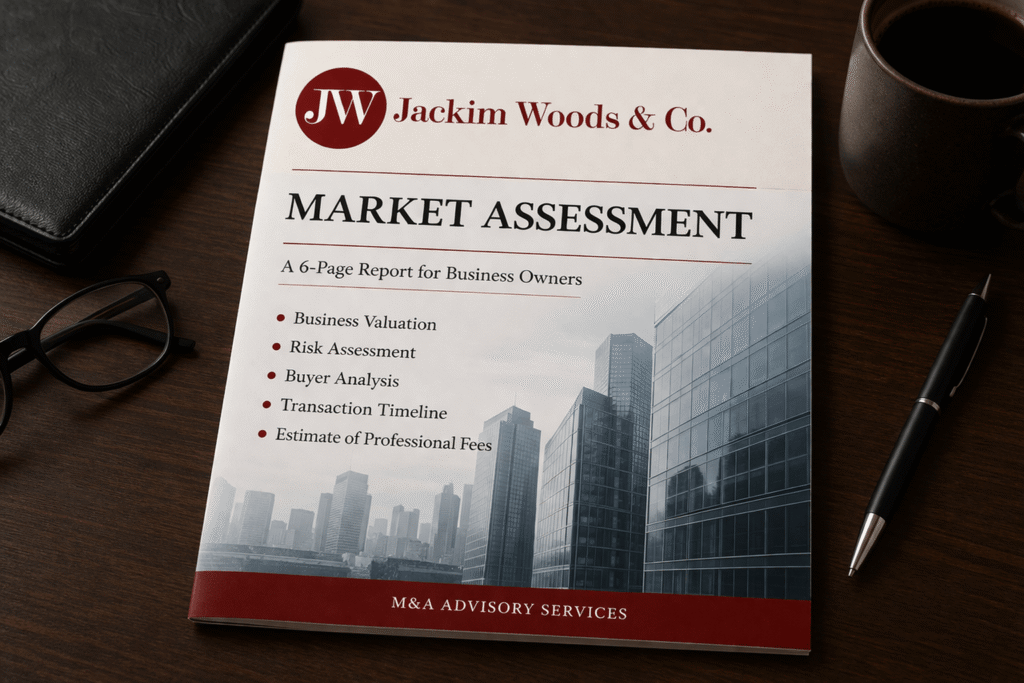
That is precisely what a professional market assessment and business valuation is designed to answer. Not to produce an optimistic number, but to give you the honest, complete picture that enables you to maximize transaction value and approach the market from a position of knowledge rather than a host of assumptions.
Why a Free Market Assessment Increases Your Options when Selling Your Business
At Jackim Woods & Co., our complimentary market assessments are designed to give business owners the analytical foundation they need before making one of the most consequential financial decisions of their lives.
We review of your financials, revenue composition, customer and channel concentration, competitive positioning, and provide you with the realistic range of values a qualified buyer would assign to your business. It means identifying the factors that could affect a transaction — and giving you to option to address them before you go to market.
Business owners who understand their true market value make better decisions: about timing, about preparation, about which buyer profiles to target, and how to position the company’s story. They do not spend months pursuing a process that was unlikely to succeed. And they are not surprised by what buyers find.
If you are considering a sale — even if your timeline is one to three years out — an objective assessment of where your business stands today is the most valuable step you can take.
Please note: Because of the time and effort that goes into to preparing a market assessment, free market assessments are only available for businesses generating at least $5 million in revenue or $1 million in EBITDA.
About Jackim Woods & Co.
 Rich Jackim is an investment banker, entrepreneur, and former mergers and acquisitions attorney.
For the last 25 years, Rich has been providing boutique investment banking services to small and lower middle-market companies in a wide range of industries across the United States and Canada.
Rich also founded a successful training and certification company called the Exit Planning Institute, which he sold to a private equity group in 2012.
Rich is also the author of the critically acclaimed book, The $10 Trillion Dollar Opportunity: Designing Successful Exit Strategies for Middle Market Businesses.
Jackim Woods & Co offers skilled mergers and acquisitions advisory services to privately companies in both sell-side and buy-side transactions. Jackim Woods & Co has arranged over 120 successful transactions, ranging from one million to more than eighty million dollars in value.
If you own a business and are interested in exploring your options, I would welcome an opportunity to speak with you.
Feel free to contact me at 224-513-5142 or rjackim@jackimwoods.com.
Read More
America’s $5 Trillion Business Ownership Crisis
America is facing a business ownership crisis: 6 million small businesses will need new owners by 2035, and according to a McKinsey study titled The Great Ownership Transfer, 92% will simply close rather than sell.
The businesses most at risk have revenues between $1 million and $10 million — owner-operated firms spanning business services, regional manufacturing, and B2B specialties that are too small for institutional private equity and too complex for Main Street brokers. Together, they represent up to $5 trillion in enterprise value that will largely disappear unless buyers and sellers find each other in time. Rich Jackim predicted this wave in 2007 and co-founded the Exit Planning Institute to address it, training over 9,000 Certified Exit Planning Advisors — yet the majority of business owners still exit without a plan. For sellers, the window to transact at full value is narrowing every year; for buyers, the opportunity to acquire profitable, established businesses at reasonable prices has never been larger.
— Rich Jackim, Jackim Woods & Co.
McKinsey & Company just published a study that deserves attention from every business owner and serious business buyer in the country. The study, titled The Great Ownership Transfer, puts hard numbers to something I’ve been saying for nearly two decades: America is approaching a massive, largely unaddressed transition of business ownership — and most business owners aren’t ready for it.
The headline finding: 6 million small businesses will need new owners by 2035 as Baby Boomers retire. The sad news is that, according to McKinsey, 92% of these will not be sold and will simply shut their doors. The good news is that this means at least 1 million are viable acquisition targets, representing up to $5 trillion in enterprise value.
I Saw This Coming in 2007
 When I wrote the critically acclaimed book, The $10 Trillion Opportunity, this demographic wave was already clearly on the horizon. The math was never complicated: the largest generation of entrepreneurs in American history, the Baby Boomers, would eventually retire, and the buyer infrastructure to acquire these lower-middle-market businesses was not well developed.
That book led me to co-found the Exit Planning Institute, and to create the Certified Exit Planning Advisor (CEPA) designation — a program that has now trained more than 9,000 graduates and helped establish exit planning as a recognized professional discipline. Entire conferences, curricula, and consulting practices have been built around it.
And yet — despite all of that progress — the majority of business owners still exit without a plan in place. The McKinsey data makes that painfully clear: 92% of small business exits or sales today will end in closure. Not sale. Not succession. Closure. Let that sink in.
Profitable companies with real customers, trained employees, and decades of hard-earned reputation — simply shutting their doors because no qualified buyer stepped forward in time.
The Forgotten Core of the American Economy
The businesses most exposed to this risk share a common profile: revenues between $1 million and $10 million, spanning business service providers, regional manufacturers, and B2B specialists. These are owner-operated firms that have quietly powered local economies and supply chains for decades.
They’re too small to attract institutional private equity. Too complex for Main Street business brokers. And too often overlooked by the buyers who could give them a real future. It’s a structural gap hiding in plain sight — and it’s where the closure problem is most acute.
What This Means for Buyers & Sellers
Here’s the other side of the equation that doesn’t get discussed enough.
We talk with a lot of prospective buyers every day. And while well-run businesses with strong fundamentals cross our desk regularly, most buyers aren’t in the market for a good company. They’re searching for the right one — the one that checks all the boxes, including the right combination of timing, fundamentals, and transformative upside.
The challenge is that “right” means different things to different buyers. The right fit depends on the buyer’s background, industry experience, capital structure, growth thesis, and risk tolerance. That means if you are buyer, finding your right acquisition or isn’t a passive exercise. The same applies if you are a seller. It requires extensive, targeted research and outreach — two things we do every day.
The Bottom Line
This is precisely the space that Jackim Woods & Co. was built to serve. Paul, Jim, and I have spent years developing the relationships, the methodology, and the market intelligence to move these businesses from owner-operated to professionally transitioned — without watching them quietly disappear.The Great Ownership Transfer is not a future event. It’s happening now. Every year that passes without a transaction plan is a year closer to a closure that didn’t have to happen.
If you’re a business owner thinking about your exit — whether in two years or ten — the time to start the conversation is now, before urgency forces your hand.
Contact us at Jackim Woods & Co. We’re happy to help you explore your options, help you develop a plan, and help you find the right buyer for your business. Reach us at jackimwoods.com or contact Rich directly to start the conversation.
Read More
The Skills Gap Crisis: Why Small Colleges Must Act Now or Risk Obsolescence
The Enrollment Cliff Is Here—And It’s Accelerating
Small colleges across America are facing an existential crisis. Enrollment at institutions with fewer than 2,000 students has plummeted by an average of 35% since 2010, with some schools losing more than half their student body. The reasons are stark: declining birth rates, soaring tuition costs, and perhaps most critically, a fundamental shift in how students and employers view the value of traditional liberal arts education.
 But here’s the uncomfortable truth that most college presidents and board members are reluctant to acknowledge: students aren’t just leaving because college is expensive—they’re leaving because traditional degrees no longer guarantee career outcomes.
In 2024, 94% of students said they wanted micro-credentials and industry certifications to count toward their degrees, up from just 55% the year before. Meanwhile, 85% of employers now say they’re more likely to hire candidates with specific vocational credentials than those with only traditional liberal arts degrees. The message is clear: the market has spoken, and it’s demanding skills-based education.
For small colleges still operating under the old playbook, this represents an adapt-or-die moment. But for those willing to act strategically, it also represents the greatest growth opportunity in higher education today.
The Liberal Arts Paradox: Essential Skills, Unemployable Graduates
Don’t misunderstand—the core value proposition of liberal arts education remains powerful. Critical thinking, communication, analytical reasoning, and cultural literacy are more important than ever in our complex global economy. The problem isn’t that these skills are worthless; it’s that they’ve become invisible to employers who lack the time or framework to recognize them.
When a hiring manager sees a resume with a philosophy degree, they don’t automatically think “excellent analytical thinker who can solve complex problems.” They think “unemployable idealist who can’t contribute to the bottom line.” This perception gap has created a vicious cycle: students avoid liberal arts programs because they fear unemployment, employers continue to overlook liberal arts graduates because they see so few of them, and colleges respond by desperately trying to make their programs more “practical”, often in superficial ways that satisfy no one.
The solution isn’t to abandon liberal arts education. It’s to combine it with immediately recognizable, market-validated credentials that make those essential liberal arts skills visible and valuable to employers.
The Vocational Micro-Credentials Revolution: A $1.9 Billion Opportunity
The vocational micro-credentials market is exploding, projected to reach $1.9 billion by 2029. But this isn’t just about digital badges or online certificates, it’s about a fundamental restructuring of how education creates value.
Here’s what’s driving this transformation:
Students want stackable credentials that prove they have job-ready skills. Students are no longer willing to commit four years and six figures to a degree that might not lead to a career of their choice. They want to see career progress year by year, with credentials they can use immediately while building toward a full degree, and ultimately, lots of career options.
Employers are willing to pay for skills-based training. Companies now spend billions of dollars a year on workforce development, and they’re increasingly eager to partner with educational institutions that can deliver job-ready skills at scale.
Credit recognition is becoming universal. More than 30 professional certificates now carry formal credit recommendations from accreditation bodies, making them truly stackable toward traditional liberal arts degrees.
For small colleges, this represents a massive opportunity—but only if they act quickly and strategically.
The Acquisition Imperative: Why Organic Growth Isn’t Enough
Most small colleges are approaching the skills gap crisis through partnerships with platforms like Coursera or by adding a few “practical” courses to their existing curriculum. This is “too little, too late” and will prove fatal for many institutions.
Platform partnerships sound appealing because they require minimal upfront investment, but they’re actually a trap. When students enroll in a Google certificate through Coursera, Google gets the brand recognition and career outcome credit, not your college. You become a facilitator in someone else’s ecosystem, competing on price rather than value, with no control over the student experience or employer relationships.
Organic program development is equally problematic. Small colleges lack industry connections, employer relationships, and specialized faculty needed to create truly job-relevant programs. By the time you’ve developed new curricula, hired qualified instructors, and built employer partnerships, market demand will have shifted to new skills.
The optimal strategy is to acquire an established for-profit vocational school.
 The Strategic Acquisition Model: Liberal Arts + Vocational Training
The most successful higher education institutions of the next decade will be those that combine the depth and breadth of liberal arts education with the immediate market relevance of vocational training. This isn’t about creating a “vocational track” within your existing college, it’s about acquiring an established vocational college and integrating it strategically.
Here’s why acquisition makes sense:
Immediate Market Access
For-profit vocational schools already have employer relationships, industry partnerships, and job placement networks that take traditional colleges years to develop. When you acquire a vocational school, you’re not just buying facilities and equipment, you’re buying market access.
Proven Revenue Models
Successful vocational schools operate on fundamentally different economics than traditional colleges. They charge premium prices for in-demand programs, maintain high job placement rates, and often have waiting lists for enrollment. This cash flow can stabilize your institution while you integrate programs.
Complementary Student Populations
Vocational schools serve students who might never consider traditional four-year programs—working adults, career changers, first-generation college students. By combining liberal arts and vocational programs, you can serve both populations while creating pathways between them.
Stackable Credential Architecture
The most powerful integration model allows students to earn industry credentials as they progress through liberal arts programs, or to add liberal arts depth to vocational training. A traditional biology major could graduate with a Bachelor of Science degree and a certificate in diagnostic medical sonography. A traditional business major could graduate with a Bachelor’s in Business and technical certifications in cybersecurity. Think of the career opportunities these kinds of students have over traditional students.
Case Study: Successful Liberal Arts + Vocational Integration
Hilbert College, a small, private, non-profit Catholic college, recently acquired Valley College, a for-profit vocational school with campuses in Ohio and West Virginia. This move allows Hilbert to expand its online offerings and potentially increase enrollment by tapping into Valley College’s existing student base. It also allows liberal arts students to graduate with certificates or diplomas as practical nurses, medical clinical assistants, veterinary assistants, or veterinary technicians. It also enabled Hilbert to offer over a dozen online vocational programs in business, cybersecurity, healthcare, and IT to students in 49 states, greatly expanding Hilbert’s traditional reach, At the same time, the merger allows Valley College’s vocational school students to continue their education by earning an Associates or Bachelor’s degree at Hilbert with programs in over 50 different subject areas.
The Integration Playbook: Making the Marriage Work
Acquiring a vocational school is only the first step. Success requires thoughtful integration that preserves the strengths of both institutions while creating new value. Based on our experience advising higher education M&A transactions, here are the critical success factors:
Preserve Distinct Brand Identities Initially
Don’t rush to rebrand everything under one umbrella. Vocational schools often have strong employer relationships built around their specific brand and reputation. Maintain these relationships while gradually introducing the liberal arts value proposition.
Create Clear Pathways, Not Forced Integration
Students should be able to move between programs naturally, but don’t force artificial combinations. A welding student might benefit from business communication training but probably doesn’t need art history. Focus on complementary skills that enhance career outcomes.
Leverage Cross-Faculty Collaboration
Your liberal arts faculty can provide valuable perspective on critical thinking, communication, and ethics to vocational programs. Meanwhile, vocational instructors can ground theoretical liberal arts concepts in real-world applications.
Maintain Employer Relationships as Strategic Assets
The vocational school’s employer partnerships are among your most valuable acquired assets. Nurture these relationships and gradually introduce the expanded capabilities of your combined institution.
Financial Modeling: The Economics of Educational Transformation

Map of Private Non-profit College Closures
The financial case for strategic acquisition is compelling, but it requires sophisticated modeling that accounts for multiple revenue streams and integration costs. Key considerations include:
Revenue Synergies: Combined institutions can command premium pricing for integrated programs, serve broader student populations, and access new funding sources including employer partnerships and workforce development grants.
Cost Efficiencies: Shared administrative functions, facilities optimization, and combined marketing can reduce per-student costs significantly.
Risk Mitigation: Diversified revenue streams reduce dependence on traditional enrollment, providing stability during demographic transitions.
Growth Capital: Improved cash flow from vocational programs can fund expansion of liberal arts offerings or acquisition of additional specialized schools.
Contact our team for a confidential consultation regarding detailed financial modeling for your institution’s specific situation.
Case Study: A Student’s Portfolio
One of Jackim Woods & Co’s clients, a very successful, fast growing vocational school in Pennsylvania, is a model for colleges of the future. This for-profit, degree granting institution has 17 programs leading to Associates degrees. As a student move through their two year program, they complete their general education classes and vocational classes at the same time. As they learn job-ready skills they earn certifications that go into the student’s portfolio, or “brag book” as the students call it. Here’s how it works. A student studying in one of the school’s allied healthcare programs might earn a third-party certificate in CPR and basic life support, then a certificate in phlebotomy, then a certificate in healthcare terminology, and then a certificate in electric healthcare record keeping. When they graduate, each student’s brag book will contain their diploma, an official transcript, and a dozen or more skill-based certificates. Students have a 90%+ placement rate upon graduation. The school has a board of local employers who help them decide which certificates are important to include in each program. The cost of these tests and certificates are built into the school’s tuition so there is no extra cost to students. This creates a seamless connection between the school, student, and employer needs.
The Competitive Landscape: First-Mover Advantages
The window for strategic acquisition of quality vocational schools is narrowing rapidly. As more traditional colleges recognize this opportunity, competition for the best targets will intensify, driving up valuations and reducing availability.
Early movers have significant advantages:
- Better acquisition targets are available now at reasonable valuations
- Less competition for quality vocational schools
- More time to execute integration before market pressures intensify
- Stronger market positioning as education evolves
Colleges that wait will find themselves choosing from less attractive targets at higher prices, or worse, competing directly with institutions that have already completed successful integrations.
Beyond Survival: Building Tomorrow’s Educational Powerhouses
This isn’t just about saving colleges, it’s about building the educational institutions that will dominate the next generation of higher education. The colleges that combine liberal arts depth with vocational relevance will enjoy:
- Premium pricing power for differentiated offerings
- Diverse revenue streams, reducing enrollment risk
- Strong employer relationships driving job placement and reputation
- Broader student appeal across demographic and economic segments
- Strategic flexibility to adapt to changing market demands
The question isn’t whether higher education will evolve—it’s whether your institution will lead that evolution or be left behind.
The Path Forward: Strategic Planning for Educational Transformation
College presidents and board members who recognize the urgency of this moment have a clear path forward:
- Assess your current position honestly, including enrollment trends, financial stability, and competitive positioning
- Identify strategic acquisition targets that complement your liberal arts mission while providing immediate market relevance
- Develop integration planning that preserves institutional strengths while creating new value
- Secure stakeholder buy-in from faculty, alumni, and community partners
- Execute with experienced guidance to ensure a successful transaction and integration
- Engage an Expert M&A Advisor to help you objectively assess and address each of these points.
The institutions that act decisively now will not survive—they will thrive for decades to come.
Take Action: Your Institution’s Future Depends on It
The data is clear, the trends are accelerating, and the window to take action is narrowing. Small colleges that fail to adapt to the skills-based education revolution will continue to lose students, struggle with finances, and ultimately face closure.
But those willing to act boldly have an unprecedented opportunity to transform their institutions into thriving, market-relevant educational powerhouses that serve students, employers, and communities better than ever before.
At Jackim Woods & Co., we’ve helped dozens of higher education institutions navigate strategic transformations through carefully planned mergers and acquisitions. As one of the most active and creative financial and M&A advisors to higher education institutions, we understand both the urgency of your situation and the opportunities available to forward-thinking leaders.
Rich Jackim and Jackim Woods & Co.
 Rich Jackim is an education industry investment banker, education industry entrepreneur, and former mergers and acquisitions attorney.
For the last 25 years, Rich has been providing boutique investment banking services to middle-market companies in the education sector.
Rich also founded a successful training and certification company called the Exit Planning Institute, which he sold to a private equity group in 2012. Rich created the Certified Exit Planning Advisor (CEPA) designation and the executive MBA-style CEPA training program.
Rich is also the author of the critically acclaimed book, The $10 Trillion Dollar Opportunity: Designing Successful Exit Strategies for Middle Market Businesses, as well as dozens of articles on mergers and acquisitions, business valuation, and exit planning.
Jackim Woods & Co offers skilled mergers and acquisitions advisory services to privately owned schools, colleges, and EdTech companies in both sell-side and buy-side transactions. Jackim Woods & Co has arranged over 100 successful transactions, ranging from less than one million to more than eighty million dollars in value.
If you own an education-related business and are interested in exploring your options, I would welcome an opportunity to speak with you. Feel free to contact me at 224-513-5142 or rjackim@jackimwoods.com.
Other Articles by Rich Jackim That You Might Enjoy
Acquisitions in the Education & EdTech Sector in 2025
Acquisitions in the Education and Edtech Sectors in 2024
Acquisitions in the Education and EdTech Sector in 2023
Read More
Jackim Woods & Co. Sells Chemical Maintenance, Inc. to Area Distributors
Champaign-based janitorial supplies distributor finds perfect buyer through strategic sale process
Deal Highlights
Jackim Woods & Co. is proud to announce the sale of Chemical Maintenance, Inc. (CMI), a leading janitorial supplies distributor in Champaign, Illinois, to Area Distributors of Quincy, Illinois. This strategic acquisition creates value for both companies while ensuring continuity for CMI’s employees and customers.

The CMI Success Story
CMI represents true entrepreneurial success. Betsy Parks started as a salesperson after college and worked her way up over 20 years to eventually buy the company from the founder’s family. Along with her husband Brad, she grew CMI into a thriving regional distributor, even acquiring a local competitor to strengthen their market position.
When the Parks family decided to retire and spend more time with family, they chose Jackim Woods & Co. to handle the sale.
A Competitive Sale Process
Our comprehensive marketing strategy reached buyers across the janitorial supplies industry, generating exceptional interest:
- 50+ qualified buyers signed NDAs and received detailed information
- Nearly a dozen formal offers demonstrated strong market demand
- Area Distributors emerged as the ideal strategic partner
Why This Deal Works
The acquisition creates compelling benefits for both companies:
For Area Distributors:
- Geographic expansion into an attractive adjacent new market
- Enhanced purchasing power through increased scale
- Access to CMI’s prestigious customers (universities, hospitals, hotels)
- Operational synergies with a well-run organization
For CMI:
- Continuity under experienced ownership
- Cultural alignment with similar values
- Foundation for continued growth
“We are elated to connect with the Area Distributors group going forward. They will maintain our company culture for our customers, employees, and valued suppliers. We really have a lot of similarities, and it is important to me that the whole team will remain intact in Champaign.”– Betsy Parks, Former Owner, CMI
Industry Expertise Drives Results
This successful transaction highlights Jackim Woods & Co’s deep expertise in the janitorial supplies sector. Our understanding of industry dynamics, buyer networks, and deal structures helps clients achieve optimal outcomes.
The Jan/San sector continues to show resilience and consolidation opportunities as companies expand geographically and seek operational efficiencies through strategic partnerships.
About Jackim Woods & Co.
Jackim Woods & Co. is a specialized investment banking firm focused on middle-market transactions across distribution, manufacturing, and service sectors. We provide comprehensive M&A advisory services, helping business owners achieve their strategic and financial objectives.
Ready to explore your options? Contact Rich Jackim, Managing Partner, to learn more about our Jan/San sector expertise.
About the Author and Jackim Woods & Co.
 Rich Jackim is an investment banker, entrepreneur, and former mergers and acquisitions attorney.
For the last 25 years, Rich has been providing boutique investment banking services to middle-market companies in a wide range of industries, including the janitorial supply sector.
Rich also founded a successful training and certification company called the Exit Planning Institute, which he sold to a private equity group in 2012.
Rich is also the author of the critically acclaimed book, The $10 Trillion Dollar Opportunity: Designing Successful Exit Strategies for Middle Market Businesses.
Jackim Woods & Co offers skilled mergers and acquisitions advisory services to privately owned janitorial supply companies in both sell-side and buy-side transactions. Jackim Woods & Co has arranged over 100 successful transactions, ranging from less than one million to more than eighty million dollars in value.
If you own a janitorial supply company and are interested in exploring your options, I would welcome an opportunity to speak with you.
Feel free to contact me at 224-513-5142 or rjackim@jackimwoods.com.
This article is also available on LinkedIn.
Read More
Expert M&A Advisors: Flexible Solutions for Complex Transactions
In today’s dynamic mergers and acquisitions landscape, businesses need experienced advisors who can provide targeted expertise without the rigid structure of traditional full-service engagements. Our boutique M&A advisory firm offers flexible, hourly consulting services that give you access to senior-level expertise precisely when you need them.
Strategic Advisory Services Tailored to Your Transaction
Whether you’re preparing for a sale, evaluating an acquisition opportunity, or navigating complex negotiations, our experienced team provides comprehensive support across all critical aspects of M&A transactions. Our hourly consulting model allows you to leverage our expertise efficiently while maintaining control of your process and budget.
While we still offer clients the option of working with us under the traditional retainer and success fee or commission model, more and more clients are opting for the hourly consulting approach. Here’s why.
Strategic Financial Planning and Analysis
Our seasoned advisors work alongside your executive team to strengthen your financial narrative and strategic positioning. We assist CEOs and CFOs in developing compelling financial presentations that highlight your company’s value drivers and growth potential. Our services include:
- Strategic financial analysis and report preparation
- Custom financial modeling and projections
- Valuation analysis and benchmarking
- Scenario planning and sensitivity analysis
Professional Transaction Management
Successfully navigating an M&A transaction requires meticulous attention to detail and deep market knowledge. Our team provides comprehensive support throughout the entire process:
- Data room preparation and management
- Professional presentation development
- Process mapping and milestone planning
- Timeline management and coordination
Expert Transaction Guidance and Negotiation Support
Leverage our extensive transaction experience to optimize your outcomes. Our advisors provide:
- Market intelligence on current terms and conditions
- Strategic negotiation support
- Term sheet and LOI guidance
- Deal structure optimization
- Purchase agreement consultation
Our Expert Team
Our firm brings together a diverse team of M&A professionals, each contributing specialized expertise to your transaction. Our team includes:
- Investment Bankers with decades of deal experience across various industries
- Financial Analysts who excel at modeling, valuation, and detailed financial analysis
- Project Managers who ensure smooth process execution and milestone achievement
Every team member is carefully selected for their transaction expertise and commitment to client success. This combination of skills ensures you receive comprehensive, professional support throughout your M&A journey.
Cost-Effective Advisory Services
Our innovative hourly consulting model represents a significant departure from traditional M&A advisory fee structures. By eliminating the standard success fee that most investment banks and M&A advisors charge, we can deliver substantial cost savings to our clients while providing the same high-quality expertise and service.
Significant Cost Savings
Traditional M&A advisory fees typically include a substantial success fee ranging from 1% to 5% or more of the transaction value. For mid-market transactions, this can translate to fees between $100,000 and $500,000 or more. Our hourly model eliminates these success fees, potentially saving clients hundreds of thousands of dollars while still maintaining access to top-tier advisory services.
| Fee Component | Retainer & Success Fee | Hourly Approach |
|---|---|---|
| Non-refundable Retainer | $20,000 | $5,000 |
| Success Fee | $300,000 | $0 |
| Professional Hours | 250 | 250 |
| Average Hourly Rate | $0 | $400 |
| Total Advisory Fees | $320,000 | $105,000 |
Flexible Engagement Model
Our hourly consulting approach allows you to access senior-level expertise without committing to a full-service engagement. This approach provides:
- Cost-effective access to expert guidance
- Flexibility to scale services up or down as needed
- Ability to supplement internal resources strategically
- Professional support throughout the transaction lifecycle
Senior-Level Expertise
Every engagement is staffed with experienced M&A professionals who bring:
- Decades of transaction experience
- Deep industry knowledge
- Proven negotiation expertise
- Strategic insight and practical guidance
Client-Centric Approach
We focus on delivering value through:
- Tailored solutions for your specific needs
- Direct access to senior advisors
- Clear, actionable guidance
- Efficient resource utilization
- Avoidance of any conflict of interest that is possible when a success fee is involved
To see if an hourly consulting or success fee engagement is best for you, please read our related article about the pros and cons of each approach.
Partner with Experienced M&A Advisors
In today’s complex M&A environment, having the right advisor can make the difference between a good deal and a great one. Our hourly consulting services provide the flexibility and expertise you need to navigate your transaction successfully while potentially saving hundreds of thousands in traditional success fees.
Contact us today to learn how our experienced M&A advisors can help you achieve your transaction objectives.
About the Author and Jackim Woods & Co
Rich Jackim is an attorney, investment banker, and entrepreneur. For the last 30 years, Rich and his team have been providing boutique investment banking services to small and middle-market companies in over 30 industries.
In addition to running a successful M&A advisory firm, Rich founded a successful training and certification company called the Exit Planning Institute, which he sold to a private family office in 2012.
Rich is also the author of the critically acclaimed book, The $10 Trillion Dollar Opportunity: Designing Successful Exit Strategies for Middle Market Businesses. It became an Amazon best-seller in the business consulting category the year it was published.
If you own a business and are interested in exploring your options, I would welcome an opportunity to speak with you. There is no cost or obligation to you and all discussions are completely confidential.
Feel free to contact me at 224-513-5142 or rjackim@jackimwoods.com.
Read More
An Innovative Approach to Business Brokerage and M&A Fees
Working with a business broker or M&A advisor can significantly enhance your results when selling your business. At our firm, we recognize the distinct needs of each client and offer an innovative alternative to the conventional business broker fee structure. In addition to the traditional full-service commission or success-fee model, Jackim Woods & Co provides clients with the option to engage us as consultants and pay on an hourly basis, offering a more personalized approach tailored to your requirements.
Our innovative hourly billing option allows you to access our expert services as needed, ensuring you only pay for the specific assistance you need, resulting in significant cost savings. Regardless of the fee model chosen, we are committed to providing exceptional services and outcomes aligned with your unique objectives.
Deciding Between Fee Structures
Success-Fee Basis
PROS:
- Aligned Interests: Our fee is contingent upon the successful sale, aligning our interests with yours and motivating us to get the highest price for you.
- Minimal Upfront Costs: With only a small retainer upfront, you can minimize initial expenses.
- Confidence in Broker’s Ability: Our willingness to work on a success-fee basis reflects our confidence our ability to sell your business.
- Risk Mitigation: If the deal falls through, you incur no financial obligation other than the initial retainer, thereby reducing your financial risk.
CONS:
- Higher Overall Cost: The success fee, a percentage of the sale price, will usually result in higher costs compared to hourly billing.
- Focus on Larger Deals: Brokers may prioritize larger deals due to their compensation being tied to deal size.
- Possible Rush to Close: There’s a risk of prioritizing closing the deal over negotiating optimal terms for you.
Hourly Basis
PROS:
- Cost Control: Hourly billing offers predictability and manageability, especially for smaller transactions or prolonged processes, ensuring you pay only for the services you need.
- Flexibility: You can tailor our services to your needs, from brief consultations to having us run a comprehensive sell-side process for you.
- Objective Advice: Our fee structure ensures impartial advice focused on your best interests rather than simply closing the deal.
- Transparency: Transparent billing simplifies expense tracking and comprehension.
CONS:
- Upfront and Ongoing Costs: The hourly fee is due whether the deal closes or not, so the cost to you may be higher than the initial retainer under the success fee based approach.
- Less Incentive to Close Quickly: Because we are solely focused on providing you with impartial, objective advice, it could potentially prolonging the process.
Case Study
Recently, we assisted the owner of a medium-sized court reporting firm in California. With a business valued at $1M, she sought our expertise in navigating a sale. She had already been approached by several buyers, so she just needed our help determining what her firm was worth, analyzing each buyer’s offer, providing assistance in negotiations and counterproposals, and help responding to the buyer’s due diligence requests. Since she didn’t need us to run a full sell-side process, the consulting model was ideal for her. Typically, brokers charge an 8-10% success fee, translating to $80,000 in this case. Opting for our hourly consulting model, she saved a substantial amount. With 40 hours of consulting time spent, including valuation, negotiation, and due diligence assistance, her total fee amounted to $15,800, saving her $64,200 compared to the traditional business broker commission model.
Conclusion
Recognizing the uniqueness of each client’s needs, we offer both traditional commission and consulting fee models. Whether engaged using a success-fee arrangement or hourly billing, our commitment remains steadfast to providing top-tier service tailored to your objectives.
About the Author and Jackim Woods & Co
Rich Jackim is an attorney, investment banker, and entrepreneur. For the last 25 years, Rich has been providing boutique investment banking services to small and middle-market companies in over 30 industries.
In addition to running a successful M&A advisory firm, Rich founded a successful training and certification company called the Exit Planning Institute, which he sold to a private family office in 2012.
Rich is also the author of the critically acclaimed book, The $10 Trillion Dollar Opportunity: Designing Successful Exit Strategies for Middle Market Businesses. It became an Amazon best-seller in the business consulting category the year it was published.
If you own a business and are interested in exploring your options, I would welcome an opportunity to speak with you. There is no cost or obligation to you and all discussions are completely confidential.
Feel free to contact me at 224-513-5142 or rjackim@jackimwoods.com.
Read More
The M&A Market Is Back. Buyers Are Targeting These Industries.
M&A deal activity has recovered from its 9-month pandemic-related dip. Based on the overall strength of the stock market, we expect continued strong mergers and acquisitions activity for 2021 as well.
The total dollar value of mergers and acquisitions announced in the U.S. fell to roughly $20 billion in March as the pandemic set in, according to data from Barrons. That was a sharp drop-off—from about $180 billion in January. Yet the recovery has been equally sharp. Deal volumes reached approximately $205 billion in October according to Barron’s data.
Looking forward, Rich Jackim, managing partner at Jackim Woods & Company said, “low-interest rates, optimism about a COVID vaccine, record-breaking fundraising by Special Purpose Acquisition Companies (SPACs), and even a less contentious global trade policy will all contribute to continued strong M&A activity in 2021.”
Interest rates are currently at historic lows, reducing the cost of funding acquisitions. In addition, the good news about several COVID vaccines provides a light at the end of the tunnel and the assurance that buyers need to make a purchase.
And SPACS—special purpose acquisition corporations that raise money through an initial public offering in order to buy other companies—have raised more than $64 billion this year. SPACs raised just $13 billion in all of 2019, suggesting that SPACs will be the new driver of middle-market M&A activity in 2021.
“The M&A wave is regaining momentum and should continue for the next 12-18 months,” Jackim says. He believes the following industries will see an uptick in M&A activity in 2021.
2021 will be a year of recovery as retail and restaurant workers displaced by COVID-related closures seek other careers and gainful employment. As a result, Jackim believes the vocational/technical training and education sector will of interest to buyers and investors. The US has been suffering from a shortage of skilled workers for over a decade, so there are plenty of high paying jobs available for people with the right skills. Enrollment in vocational programs tends to rise as unemployment rises, so we expect 2021 to build on the strong results that the technical education industry saw in 2020, and to attract renewed interest from both financial and strategic buyers and investors.
The energy industry is another industry where we expect to see a lot of M&A activity in 2021. The price of crude oil has dropped to just above $40 a barrel since early summer, nowhere near the $63 a barrel price at the beginning of the year. At the same time, the rise of clean energy and potential regulation are threatening companies that focus on traditional fossil fuels. As the fossil fuel industry shifts toward a lower-growth model, exploration and production companies will be looking to generate returns through acquisitions that would yield economies of scale and other benefits, or diversify their product or service offerings away from fossil fuels.

The Evolving Impact of COVID-19 on Business Sales and M&A Activity
The rapidly evolving impact of the COVID-19 virus is being felt everywhere—in the healthcare system, employment, politics, and the economy. This is certainly a time of uncertainty in our lives and businesses. The closest thing I can compare it to is the tremendous uncertainty everyone felt in October 2008 as the financial crisis was unfolding.

Then, like now, business owners are seeing the values of their business plummet. Smaller businesses are naturally more vulnerable in an economic downturn, but everyone is affected in one way or another. Strategic and financial buyers, sellers, business owners, and M&A advisors are all paying attention right now and trying to understand how this will impact them, and how they can mitigate the negative consequences.
Reflecting on the financial crisis of 2008-2009, however, helped me identify a few things that are likely as we deal with the impact of COVID-19 on the M&A market and business sales.
Like in 2008 and 2009, M&A activity will most likely contract significantly in the near future as the volatility in the stock market will likely put the M&A market on hold. For deals in the early stages, there will be a lot of anxiety on the part of sellers and a lot of caution on the part of buyers. As a result, we expect that many buyers and sellers will press the pause button to wait and see how the situation unfolds over the next few months.
But there are a lot of indicators that when the COVID-19 scare is behind us, the M&A market will rebound with gusto. Right now, strategic buyers and private equity groups are flush with capital. Not only are PE firms ‘open for business’ but many of them are accelerating efforts to close in-process deals, and even to scale future investing activities.
“I’m bullish on the outlook for M&A activity in the medium and long term once the financial markets adjust to the ‘new normal’. There is an unprecedented amount of capital that needs to be deployed, interest rates are at record lows, and the federal government’s stimulus package should make borrowing even easier. At the same time, the record high valuations that we’ve seen over the last year or two are likely to decrease, which will make financing acquisitions less risky and fuel a strong increase in M&A activity.”
Richard Jackim, Managing Partner, Jackim Woods & Co.
If you are a business owner thinking about selling, what does all this mean to you? First and foremost, it’s important to remember that while the next few months may be painful, the fundamental value of your business is likely still intact. There is no doubt that if you were waiting for the market to peak before you sell you missed the window. But that doesn’t mean your business is unsaleable or that it has no value. The value is still there because buyers buy companies for the future cash flow that business will generate. That means buyers take a long-term perspective. If your business is fundamentally sound, it is very likely that its value will rebound once the economy returns to the new normal.
Many of the business owners I’ve spoken to in the last few weeks believe that the current market conditions will scare away buyers. It is true that undercapitalized buyers will sit on the sidelines and wait for the dust to settle, but stronger financial and strategic buyers will recognize the short-term nature of the crisis and see this as a good opportunity to buy a good business at a lower multiple of EBITDA than last year.
If you’re thinking of selling your business it’s important to work with someone who understands the dynamics and changing motivations of sellers and buyers to advise you during these uncertain times. Below are our recommendations for business owners to take over the next 2-3 months if you are thinking about selling in the next few years.
- Focus on Exit Planning (talk with us about our formal process that can use this time to help you and your business get prepared for sale)
- Get an evaluation of your business (so you understand how much your business is worth)
- Understand what you can do to improve the value of your business and make it more attractive to potential buyers
- Talk to your financial advisor to understand how much you need to retire
- Work with an M&A advisor or business broker to begin putting together a data room and formal marketing materials so you can hit the ground running when the market recovers.
Our team is comprised of experienced investment bankers and M&A professionals who literally wrote the book on exit planning. We helped over three dozen companies between 2008 and 2010 help get ready for sale and then sold them for top dollar when the market recovered. We will provide you with a value-focused, hands-on approach to help you and your business develop a strategic exit plan that allows you to exit your business on your terms and for its highest possible value.
If you are interested in selling in the next three years and would like to talk to a licensed business broker and M&A professional about how this crisis affects your options, please feel free to contact Rich Jackim for a FREE, confidential conversation at rjackim@jackimwood.com or at (224) 513-5142.
Read More
Selecting the Right Valuation Expert for Your Case
Selecting the right valuation or damages expert can make or break your case. Knowing how to pick the right expert is key to obtaining a successful outcome.
Choosing the right expert for a litigation matter goes beyond just checking that the person has the right credentials to act as an expert on financial damages. It is equally important that the expert can connect with the judge or jury, and educate them about how the available data and other information supports your client’s position.
Know What Skills Your Expert Witness Must Have
Expert witnesses are often referred from one attorney to another, however, when you need an expert with a very specific skill set, like expertise in business valuation and mergers and acquisitions issues related to buying and selling private companies, clients and law firms do research to identify potential experts.
 When picking an expert witness it is critical that you and your attorney know exactly what skills you want your expert witness to have. Richard Jackim, the Managing Partner at Jackim Woods & co, is a former mergers & acquisitions attorney and an experienced investment banker who has been involved in over 75 mergers and acquisitions in over 20 different industries, has performed over 290 business valuations, and has represented both buyers and sellers. Jackim earned his law degree with honors from Cornell University Law School and his Master of Business Administration with honors from the Kellogg Graduate School of Management at Northwestern University. Rich also developed and taught the Certified Exit Planning Advisor program offered through the Booth School of Business at the University of Chicago. A copy of his expert witness curriculum vitae is available here.
Communication Skills Are Key
In addition to the right credentials, an effective expert witness must be able to communicate in a clear, concise, and articulate manner. He must come across as knowledgeable, accessible and self-assured, but not condescending. The ability to build rapport with the judge and jury is essential; and when both sides present a strong, technically sound case, a jury often favors the side whose expert was able to communicate the issues more clearly or convincingly. To that end, we offer clients and their attorney’s a free, one-hour initial assessment of their claims so they can determine if our approach and communication style meets their needs.
Richard Jackim is a personable and knowledgeable expert and has a unique ability to present complicated issues in a clear and concise manner that connects with judges and juries.
Credibility Is A Must
An expert must also be polished and unflappable in the face of tough, sometimes seemingly stupid questions from opposing counsel. An expert witness must be able to answer questions about his background and experience to withstand a Daubert challenge. It’s critical for the attorney to have an upfront conversation with the expert to ensure they are of good character; have worked for both plaintiff and defendant; learned of any positions they may have taken that are adverse to the position taken in this case, whether through testimony or through publications of an article; and whether they have been Dauberted.
Richard Jackim’s top-tier academic credentials, plus his 30 years of business experience including practicing mergers & acquisitions law, and leadership positions at several leading investment banking firms, provides him with unique qualifications as an expert witness. His opinions are based on market realities and actual transactions, not just financial theories. As a result, he can speak to industry best practices and what is “market”.
An Expert’s Experience Wins Cases
 It’s also important that you select an expert witness who has experience testifying in a courtroom or providing deposition testimony. This experience enables them to have a clear understanding of the moving parts of a case, gives them an advantage by being able to understand how litigation and depositions work, allows them to anticipate the kinds of questions opposing counsel might ask, and helps you and your attorney understand the key weaknesses in the opposing expert’s presentation.
Jackim has consulted on over thirty-two different litigation matters, testified in six depositions, and provided expert witness testimony in two trials. His experience as an industry expert and as an expert witness helped the parties settle thirty matters without going to trial. On the two matters that did go to trial, Jackim’s clients won both matters on the merits, with the judge stating in one case that Jackim’s testimony was clear and convincing and could not be refuted by the opposing expert witness.
Areas of Expertise
- Business Valuations
- Financial Damages (lost revenues & profits)
- Purchase Price Allocation
- Valuation of Personal Goodwill
- Earnout Disputes
- Lender or Creditor Disputes
- Shareholder Disputes
- Divorce
- Buyer & Seller Disputes
- Phantom equity and other employee incentive plans
- ESOP disputes
- Business broker & investment banker fee disputes
Engage An Expert Witness as Early as Possible
For these reasons, we encourage clients and their attorneys to contact us as early as possible. Early collaboration provides us with an opportunity to help you and your attorney to discuss strategy. Ideally, we would be engaged early enough to assist in formulating requests for discovery. As a well-versed damages expert, Jackim knows what information is needed to ensure a thorough and supportable analysis. In addition, engaging us early in the process allows time to think through the issues and help you and your attorney develop the most cost-effective strategy to present your case.
In the event we find we cannot support your position based on the information provided, knowing this early on can give you time to either revise your strategy or find a different expert. Remember, unlike attorneys who are advocates for their clients, your expert witness should be a neutral, third party whose opinion is objective and unbiased. Jackim has built an impeccable reputation by providing clients with honest, objective, advice based on the available facts and his years of industry experience.
As an experienced damages expert, Jackim is familiar with recent case law in the subject area, as well as the best business practices in mergers and acquisitions and business brokerage firms. He knows his role and can be the deciding factor in your case if you choose to use his knowledge, experience, and credentials. For a free initial consultation, please contact Richard Jackim at rjackim@jackimwoods.com or at 224-513-5142.
Read More
The Best Ways to Create an Attention-Grabbing Ad to Sell Your Business While Protecting Your Privacy
A big part of selling your business is getting the word out. The more people who know your business is for sale, the more interest you’ll receive. However, the trick is to write a great attention-grabbing ad that helps you attract buyers while protecting your privacy at the same time.
Spreading the Word
At Jackim Woods & Co, we understand the importance of creating a quality and compelling advertisement. We also understand that you need to use all the technology available today to get the word out so people view the add. As a result, we use business brokerage websites like BizBuySell, BizQuest, MergerNetwork, Axial Network, DealSteam, and about a dozen others to get the word out to potential buyers. We also send emails to the buyers in our proprietary database and to the attorneys, CPAs, financial advisors, and consultants who are part of our network.
Top Tips to Generate More Interest
Over the last 25 years, we’ve discovered that there are five key things in a listing that help attract more prospective buyers.
1. Details Sell
First, the listing should be as descriptive as possible, without revealing any information that would enable a buyer to identify your business. The sales listing should provide an excellent description of your business and its unique features, including a summary of its financial performance, the opportunities for growth, and your reason for selling. As Richard Jackim, Managing Partner at Jackim Woods & Co points out, you want to “engage the buyer early.” That means, now is not the time to be vague or secretive. You want potential buyers to have a very clear idea of what kind of business you have so they can determine if it’s the right fit for them.
2. Headlines Count
Second, every listing needs a great headline. Buyers skim the Internet looking for something that catches their eye. As a result, a good listing ad should have an engaging and descriptive headline. You want to capture a buyer’s attention. We start by determining what your business’s best features are and then emphasizing one or two of those features in the headline.
3. Incorporate High-Quality Images
Third, everyone knows a picture is worth a thousand words and this is especially true on the Internet. Interesting and compelling pictures do a much better job capturing attention than a great headline. If you don’t have high-quality professional photos of your business or its products, we have access to a wide range of high-quality stock photos that we can use to create a professional image for your business.
4. Include Your Financials
Fourth, your listing post should include a summary of key financial information. The first question any serious buyer will have is what your financial results have been. Providing as much information as possible upfront about your business’s revenue, expenses, and cash flow is a good idea since most potential buyers screen their business searches based on key financial metrics.
5. Proof-read, Proof-read, Proof-read
Finally, it is essential that you proofread anything you put on the Internet very carefully. At Jackim Woods & Co, we understand that we only get one chance to make a good first impression, so we proof-read and double proof-read every posting that we put online. We realize that clients are trusting us to present them to the world of prospective buyers and we realize that buyers are discerning and detailed focused, so a listing with simple grammar or spelling mistakes will turn potential buyers off and creates the wrong impression from the start.
Creating a great listing posting is both an art and a science. The best way to ensure that you have a great listing posting is to work with an experienced business broker who understands what issues to emphasize about your business to attract the largest number of potential buyers. At Jackim Woods & Co we know what buyers are looking for, and as experienced marketing professionals, we can help you present your business to buyers in the best light possible.
Image Credit: Goodluz/BigStock.com
Read More