

Your EBITDA Is Strong. But Is Your Business Sellable?
Strong EBITDA is necessary but not sufficient to sell a business — buyers scrutinize the quality and durability of earnings, not just the headline number.
A company with $13M in revenue and $5M in EBITDA failed to sell after a year on the market because two structural risks — 45% revenue dependence on a single distribution channel and 16% revenue from one customer — triggered valuation disputes, and the deal fell apart during due diligence.
A concentrated revenue base, even at strong margins, creates deal risk that sophisticated buyers will find and price against. Businesses where any single customer accounts for 5% or more of revenue, where revenue flows through a single channel or relationship, or where recurring revenue is minimal , face a high likelihood of a buyer wanting to renegotiate the deal during due diligence. A professional market assessment — reviewing financials, revenue composition, customer concentration, and competitive positioning — is the critical first step before going to market, and is the most reliable way to avoid surprises that kill deals.
— Rich Jackim, Jackim Woods & Co.
Your EBITDA Is Strong. But Is Your Business Sellable?
Every business owner considering selling their business deserves a clear-eyed assessment of one foundational truth: EBITDA is a critical metric, but it does not tell the complete story. Owners who discover this after months of trying to sell their business — or after a deal fails during due diligence — will have wasted a lot of time and money.
The following is a situation we have seen multiple times in our practice. The details have been modified for confidentiality, but the dynamics are real—and offer important insights for any owner thinking about an exit.

A Business That Looked Great on Paper
Last year, we spoke with the owner of a business services company who had spent twenty years building his business. Now 65, he was ready to retire and sell the company. The financial profile was attractive: approximately $13 million in revenue with $5 million in EBITDA – strong margins that would get buyers’ attention.
Early in the process, the owner’s CPA reviewed the financials and told the owner the company was probably worth $25 million – exactly what the owner wanted to hear. The CPA explained that the EBITDA was there, and in his experience, companies like this one sold for 5x EBITDA. The owner felt confident, so he hired an M&A advisor to sell the business. After a year on the market, two buyers had withdrawn their offers during due diligence, and the business was still not sold.
Strong EBITDA opens doors. But what buyers find when they look inside determines whether a deal actually closes.
What the Financial Analysis Revealed
When buyers started their due diligence, they discovered the company’s revenue composition contained concentration risks that ultimately derailed the deal:
45%Revenue from One Distribution Channel |
16%Revenue from a Single Customer |
61%Revenue Concentration Risk |
Revenue channel concentration: 45% of total revenue was generated through a single distribution channel, a key salesperson, who was the same age as the business owner. While that salesperson had performed reliably for years, the fact that the company depended on someone so close to retirement age was a structural dependency that concerned sophisticated buyers.
Customer concentration: 16% of revenue was attributable to one customer, a large manufacturer with multiple locations. This indicated a customer concentration issue that affected lending eligibility and the buyer’s financing options, which in turn affected the overall risk profile of the deal.
These were not deal killing factors individually. But collectively, they represented risks that sophisticated buyers identified in due diligence, and in one case, used to try to negotiate a huge valuation adjustment (50%) — or in the other case, as grounds to exit the process entirely.
When Market Conditions Validated a Buyer’s Analysis
What ultimately killed the deal was during due diligence, an external event occurred that demonstrated precisely why concentration risk demands early attention.
The company received formal notification that its largest customer — representing 16% of annual revenue — had been acquired by a direct competitor. As part of the acquirer’s vendor consolidation strategy, they provided notice that they would be scaling back their purchase orders over the next six months, with the goal of consolidating all purchase orders with the new parent company’s vendors.
The impact was immediate and material. Sixteen percent of the company’s revenue had just disappeared and could not easily be replaced. The seller’s valuation and negotiating position was now fundamentally changed by a single event outside of their control. This is exactly what buyers feared, and it had come true.
The Strategic Lesson for Owners Selling Their Businesses
Advisors who do not earn success fees when a transaction closes have limited incentive to tell clients the hard honest truth about their client’s business. The result is that business owners often try to sell their business without a clear understanding of how buyers will evaluate their company — and without the opportunity to fix those risk factors before they become deal killers.
As the above example demonstrates, EBITDA matters a lot. But experienced buyers will also be looking at the quality and durability of those earnings:
- Does any single customer represent more than 5% of a company’s revenue?
- Is revenue dependent on a single channel, platform, or relationship that could be disrupted?
- Is revenue generated from one product or service, or diversified over a wide range of products and services?
- Is there industry concentration risk with services or products serving only one industry?
- How much of the revenue base is genuinely recurring, contracted, or relationship-protected versus transactional?
- How is the business positioned relative to industry transformation — as an adopter or as a laggard?
- How would EBITDA be affected if the single largest customer or channel relationship were impaired?
These are the questions that determine whether reported EBITDA represents durable, transferable earnings—or a business that will be systematically discounted during the diligence and negotiation process.
 The Question Every Owner Should Ask Before Selling Your Business
It is not simply “What is my EBITDA?”
The more important question is: “Do my revenue and EBITDA accurately reflect the risk-adjusted financial performance of my business?”
That is precisely what a professional market assessment and business valuation is designed to answer. Not to produce an optimistic number, but to give you the honest, complete picture that enables you to maximize transaction value and approach the market from a position of knowledge rather than a host of assumptions.
Why a Free Market Assessment Increases Your Options when Selling Your Business
At Jackim Woods & Co., our complimentary market assessments are designed to give business owners the analytical foundation they need before making one of the most consequential financial decisions of their lives.
We review of your financials, revenue composition, customer and channel concentration, competitive positioning, and provide you with the realistic range of values a qualified buyer would assign to your business. It means identifying the factors that could affect a transaction — and giving you to option to address them before you go to market.
Business owners who understand their true market value make better decisions: about timing, about preparation, about which buyer profiles to target, and how to position the company’s story. They do not spend months pursuing a process that was unlikely to succeed. And they are not surprised by what buyers find.
If you are considering a sale — even if your timeline is one to three years out — an objective assessment of where your business stands today is the most valuable step you can take.
Please note: Because of the time and effort that goes into to preparing a market assessment, free market assessments are only available for businesses generating at least $5 million in revenue or $1 million in EBITDA.
About Jackim Woods & Co.
 Rich Jackim is an investment banker, entrepreneur, and former mergers and acquisitions attorney.
For the last 25 years, Rich has been providing boutique investment banking services to small and lower middle-market companies in a wide range of industries across the United States and Canada.
Rich also founded a successful training and certification company called the Exit Planning Institute, which he sold to a private equity group in 2012.
Rich is also the author of the critically acclaimed book, The $10 Trillion Dollar Opportunity: Designing Successful Exit Strategies for Middle Market Businesses.
Jackim Woods & Co offers skilled mergers and acquisitions advisory services to privately companies in both sell-side and buy-side transactions. Jackim Woods & Co has arranged over 120 successful transactions, ranging from one million to more than eighty million dollars in value.
If you own a business and are interested in exploring your options, I would welcome an opportunity to speak with you.
Feel free to contact me at 224-513-5142 or rjackim@jackimwoods.com.
Read More
America’s $5 Trillion Business Ownership Crisis
America is facing a business ownership crisis: 6 million small businesses will need new owners by 2035, and according to a McKinsey study titled The Great Ownership Transfer, 92% will simply close rather than sell.
The businesses most at risk have revenues between $1 million and $10 million — owner-operated firms spanning business services, regional manufacturing, and B2B specialties that are too small for institutional private equity and too complex for Main Street brokers. Together, they represent up to $5 trillion in enterprise value that will largely disappear unless buyers and sellers find each other in time. Rich Jackim predicted this wave in 2007 and co-founded the Exit Planning Institute to address it, training over 9,000 Certified Exit Planning Advisors — yet the majority of business owners still exit without a plan. For sellers, the window to transact at full value is narrowing every year; for buyers, the opportunity to acquire profitable, established businesses at reasonable prices has never been larger.
— Rich Jackim, Jackim Woods & Co.
McKinsey & Company just published a study that deserves attention from every business owner and serious business buyer in the country. The study, titled The Great Ownership Transfer, puts hard numbers to something I’ve been saying for nearly two decades: America is approaching a massive, largely unaddressed transition of business ownership — and most business owners aren’t ready for it.
The headline finding: 6 million small businesses will need new owners by 2035 as Baby Boomers retire. The sad news is that, according to McKinsey, 92% of these will not be sold and will simply shut their doors. The good news is that this means at least 1 million are viable acquisition targets, representing up to $5 trillion in enterprise value.
I Saw This Coming in 2007
 When I wrote the critically acclaimed book, The $10 Trillion Opportunity, this demographic wave was already clearly on the horizon. The math was never complicated: the largest generation of entrepreneurs in American history, the Baby Boomers, would eventually retire, and the buyer infrastructure to acquire these lower-middle-market businesses was not well developed.
That book led me to co-found the Exit Planning Institute, and to create the Certified Exit Planning Advisor (CEPA) designation — a program that has now trained more than 9,000 graduates and helped establish exit planning as a recognized professional discipline. Entire conferences, curricula, and consulting practices have been built around it.
And yet — despite all of that progress — the majority of business owners still exit without a plan in place. The McKinsey data makes that painfully clear: 92% of small business exits or sales today will end in closure. Not sale. Not succession. Closure. Let that sink in.
Profitable companies with real customers, trained employees, and decades of hard-earned reputation — simply shutting their doors because no qualified buyer stepped forward in time.
The Forgotten Core of the American Economy
The businesses most exposed to this risk share a common profile: revenues between $1 million and $10 million, spanning business service providers, regional manufacturers, and B2B specialists. These are owner-operated firms that have quietly powered local economies and supply chains for decades.
They’re too small to attract institutional private equity. Too complex for Main Street business brokers. And too often overlooked by the buyers who could give them a real future. It’s a structural gap hiding in plain sight — and it’s where the closure problem is most acute.
What This Means for Buyers & Sellers
Here’s the other side of the equation that doesn’t get discussed enough.
We talk with a lot of prospective buyers every day. And while well-run businesses with strong fundamentals cross our desk regularly, most buyers aren’t in the market for a good company. They’re searching for the right one — the one that checks all the boxes, including the right combination of timing, fundamentals, and transformative upside.
The challenge is that “right” means different things to different buyers. The right fit depends on the buyer’s background, industry experience, capital structure, growth thesis, and risk tolerance. That means if you are buyer, finding your right acquisition or isn’t a passive exercise. The same applies if you are a seller. It requires extensive, targeted research and outreach — two things we do every day.
The Bottom Line
This is precisely the space that Jackim Woods & Co. was built to serve. Paul, Jim, and I have spent years developing the relationships, the methodology, and the market intelligence to move these businesses from owner-operated to professionally transitioned — without watching them quietly disappear.The Great Ownership Transfer is not a future event. It’s happening now. Every year that passes without a transaction plan is a year closer to a closure that didn’t have to happen.
If you’re a business owner thinking about your exit — whether in two years or ten — the time to start the conversation is now, before urgency forces your hand.
Contact us at Jackim Woods & Co. We’re happy to help you explore your options, help you develop a plan, and help you find the right buyer for your business. Reach us at jackimwoods.com or contact Rich directly to start the conversation.
Read More
2025 M&A Market Overview: What Business Buyers and Sellers Need to Know
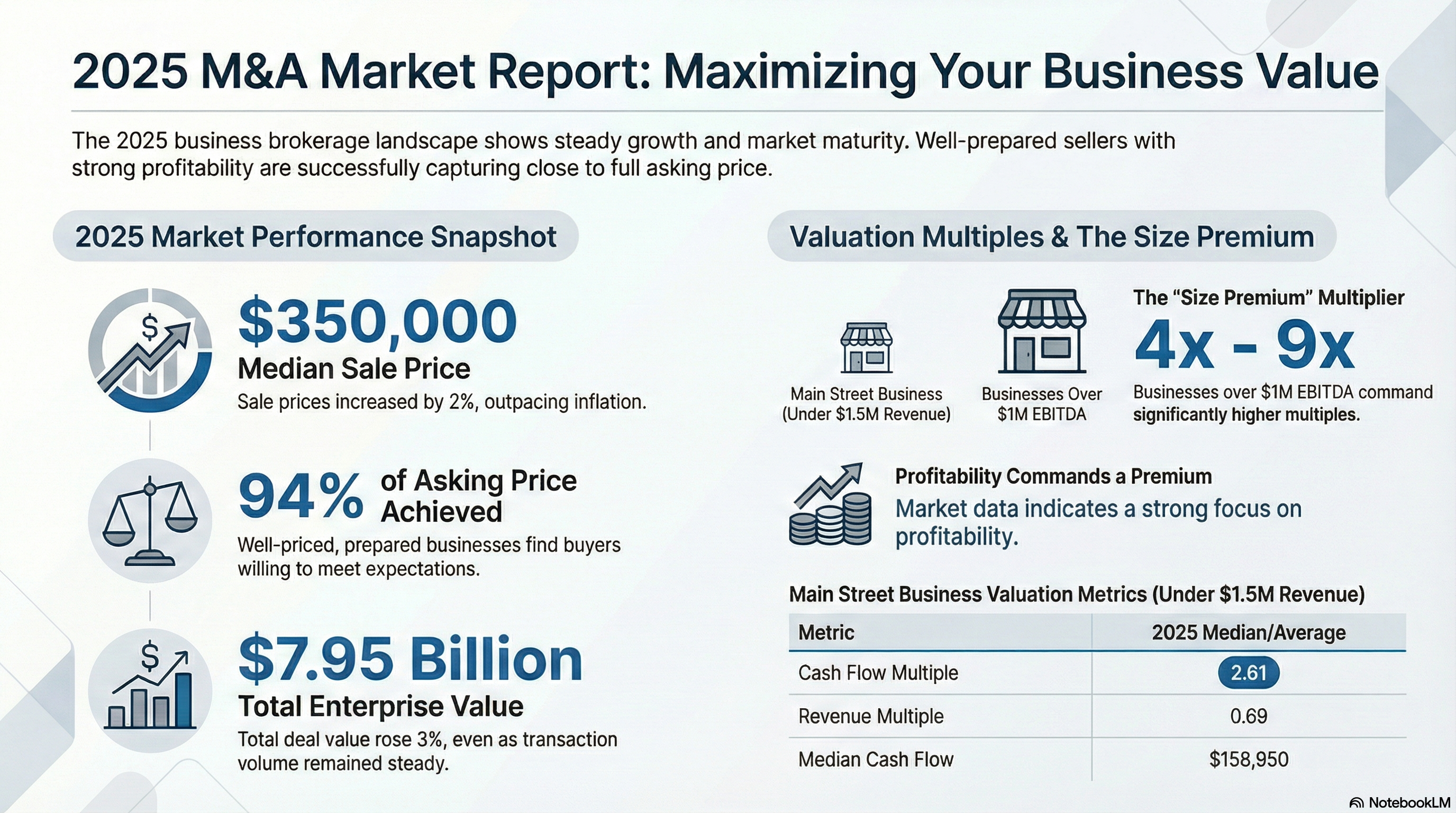
The business brokerage landscape in 2025 tells a story of steady growth and selective optimism. After analyzing nearly 10,000 closed transactions representing nearly $8 billion in enterprise value, our research reveals a market that’s maturing with purpose—where buyers are more discerning, and sellers who prepare properly are being well rewarded.
A Market Finding Its Footing
This past year saw 9,586 transactions close, a modest but meaningful 0.4% increase from 2024. While that growth rate might seem incremental, it signals something important: stability, which is crucial amid market disruptions stemming from Trump’s tariffs and immigration enforcement policies, which have caused tremendous uncertainty across our economy.
Another important indicator is that the total enterprise value of $7.95 billion is up 3% year-over-year, demonstrating that deal sizes are expanding even as transaction volume holds relatively steady.
For sellers, the headline number is encouraging: the median sale price reached $350,000, a 2% increase that outpaced inflation in many sectors. More telling is that businesses are selling at an average of 94% of their asking price, suggesting that well-priced, well-prepared businesses marketed by professional business brokers are finding buyers willing to meet them close to their expectations.
The Valuation Story: Cash Flow Still Commands a Premium
Our research relies heavily on closed transaction data from the BizBuySell and our own internal database of closed transaction, which tends to focus on smaller, “main street” types of businesses, with revenues of less than $2 million. For these small companies, valuation multiples reveal where buyer confidence truly lies.
The average cash flow multiple climbed to 2.61—a 1% increase that may seem small but represents real dollars when applied to six-figure earnings. With median cash flow of $158,950 (up 3%), sellers with strong, documented profitability are in the driver’s seat.
Revenue multiples also ticked up to 0.69, a 2% gain, while median revenue reached $703,000. This suggests buyers are willing to pay more for top-line growth, but the stronger appreciation in cash flow multiples confirms what savvy sellers already know: profit matters more than revenue when it comes to valuation.
Size Premium: It is important to note that larger companies sell for higher multiples of EBITDA and Revenue due to a size premium. Buyers view larger companies as much less risky then smaller companies so if your business is generating more than $5M in revenue and more than $1M in EBITDA, you can expect your company to be valued at between 4x and 9x EBITDA, depending on the type of business you have and the industry you operate in.
Where the Action Is
Geography continues to play a decisive role in market velocity. Florida led all states in transaction demand, followed by California, Texas, Arizona, and New York.
These aren’t just population centers—they’re business hubs with favorable demographics and diverse economies that create both buyer pools and acquisition targets.
Sector Spotlight: The Reliable and the Rising
Service businesses dominated the closed deal landscape, claiming the top spot ahead of retail, restaurants, and manufacturing. The prevalence of service businesses reflects their scalability, lower capital requirements, and often more predictable cash flows—qualities that resonate in an environment where buyers are prioritizing stability.
But the real story lies in the rising business types that are capturing increasing buyer attention.
- Financial services
- Technology services
- Cafe and coffee retailers
- Beauty and personal care businesses
These sectors share common threads: recurring revenue potential, demographic tailwinds, and business models that have proven resilient through recent economic uncertainty.
What This Means for Sellers
If you’re considering an exit in the next 12 to 24 months, this data offers a roadmap. Buyers are active, valuations are holding, and well-run businesses in the right sectors are commanding strong multiples. The key is preparation: clean financials, documented cash flow, and a clear growth story will position you to capture that 94% (or better) of asking price.
The market rewards businesses that can demonstrate consistent performance, particularly in cash flow. With multiples trending upward, even incremental improvements in profitability can translate to meaningful differences in your final sale price.
What This Means for Buyers
For buyers, the landscape demands strategic discipline. With sale prices hovering near asking prices, there’s less room for bargain hunting, but opportunities exist for those who can move decisively on quality businesses. The rise in cash flow multiples means you’ll need to justify higher purchase prices with clear paths to growth or operational improvements.
The emerging sectors—financial services, technology, specialty retail like coffee shops, and beauty services—represent areas where market momentum may create additional upside beyond the acquisition.
Looking Ahead
The 2025 market isn’t about explosive growth or dramatic shifts. It’s about a maturing marketplace where quality businesses find quality buyers, where valuations reflect realistic expectations, and where the fundamentals—profitability, documentation, and preparation—determine outcomes.
At Jackim Woods & Co., we help clients navigate this landscape with clarity and purpose. Whether you’re building toward an exit or searching for the right acquisition, understanding these market realities is where successful transactions begin.
The data speaks. The question is: are you ready to act on it?
About the Author and Jackim Woods & Co.
 Rich Jackim is an investment banker, entrepreneur, and former mergers and acquisitions attorney.
For the last 25 years, Rich has been providing boutique investment banking services to small and lower middle-market companies in a wide range of industries across the United States and Canada.
Rich also founded a successful training and certification company called the Exit Planning Institute, which he sold to a private equity group in 2012.
Rich is also the author of the critically acclaimed book, The $10 Trillion Dollar Opportunity: Designing Successful Exit Strategies for Middle Market Businesses.
Jackim Woods & Co offers skilled mergers and acquisitions advisory services to privately companies in both sell-side and buy-side transactions. Jackim Woods & Co has arranged over 120 successful transactions, ranging from less than one million to more than eighty million dollars in value.
If you own a business and are interested in exploring your options, I would welcome an opportunity to speak with you.
Feel free to contact me at 224-513-5142 or rjackim@jackimwoods.com.
Read More
Jackim Woods & Co. Leads Buy-Side Roll-Up in the CDL Training Sector
When a large Title IV vocational college set out to acquire multiple commercial-driver-license (CDL) training schools, they turned to Jackim Woods & Co. for a focused, results-driven buy-side campaign — and we delivered. Below is how we helped them navigate complexity, act with speed, and close acquisitions that strengthen their national footprint.
What the Mandate Was
Our client’s objective was to acquire one or more high-quality CDL training providers in key U.S. states, to build scale quickly as part of a national roll-up strategy. Their criteria were strict: geographic location, size, proximity to major airports (for future logistics), and the potential for seamless integration into a growing national CDL division.
Our client had a regulatory and strategic mandate to close by end of 2025, and to hit a combined CDL-division revenue target of at least $6 million. By working swiftly and eliminating unnecessary delays, we met those targets, positioning our client for full compliance — and for accelerated growth.
Our role at Jackim Woods & Co. was to represent the buyer, source targets, and manage the acquisition process from first outreach through closing.
The first CDL acquisition we helped them close was CL Driving Academy — a premier commercial driver training center located in Charlotte, NC. Three months later, we helped them acquire Apex Technical Institute, a leading CDL school in Kansas City, KS.
How We Worked: Our Value-Added Buy-Side Process
- Highly Targeted & Data-Driven Deal Sourcing
We began with a broad universe — roughly 693 potential CDL school targets — then filtered that down to around 300 that met our client’s criteria (geography, size, infrastructure, airport proximity, and more). This data-driven screening ensured that we spent the client’s time on only the most promising candidates. - Proactive Outreach & Seller Engagement
Using a mix of personalized emails and phone outreach, we contacted each owner/operator in the filtered target list. That initial campaign produced 15 schools interested in further discussion.
We then conducted introductory calls with 12, arranged six conference calls between our client and potential sellers — and helped formulate offers on two schools - Fast, Focused Execution & Negotiation
In the case of CL Driving Academy, our campaign from first contact to closing wrapped up in just 92 days.For Apex Technical Institute, the process took 184 days — a slightly longer timeline because we needed to negotiate a post-closing employment contract with the owner to assume a leadership role and manage our client’s multi-state CDL division.
- Strategic Integration Planning (Owner-Operator Retention)
Recognizing the importance of leadership continuity in a roll-up, we helped our client identify a strategic leader who could help them manage their growing CDL division. negotiate a deal structure that retained the prior owner of Apex Technical Institute — bringing him in as Divisional Vice President for the new national CDL business. This eased transition, preserved institutional knowledge, and boosted the credibility of the combined enterprise.
Outcome & What It Means
Thanks to our buy-side advisory, our client successfully acquired two high-quality CDL training schools, giving them an immediate multi-state presence in a consolidating industry. More importantly, they gained not just assets — but operational leadership and a scalable platform for future acquisitions.
From a strategic perspective, this gives them:
- A streamlined path to national scale in the fragmented CDL training market.
- Operational leverage via back-office and administrative consolidation.
- Enhanced negotiating power with large carriers or employers seeking to hire CDL-trained graduates.
- A foundation to continue roll-up efforts — strengthened by credibility, cash capital, and a proven acquisition process.
Why Jackim Woods & Co. Was the Right Partner
Our success hinged on combining deep domain expertise with disciplined process execution:
- We know the vocational education and CDL-training sector — enabling us to build immediate credibility with school owners.
- We executed a comprehensive, data-driven target search — not a scattershot approach.
- We engaged directly and persistently with owners, building trust and opening doors for negotiation.
- We drove speed without sacrificing due diligence or post-closing strategy.
If you’re a buyer seeking to acquire assets in a fragmented sector — whether education, vocational training, logistics, or other specialized services — we offer a proven, structured buy-side process that gets results.
Meet the Dealmaker Behind the Strategy
Richard Jackim is founder of Jackim Woods & Co and the head of our education group. A former Wall Street attorney and bulge-bracket investment banker, Richard has advised on over 120 transactions totaling more than $2.3 billion in market value. Since he founded the Exit Planning Institute and sold it in 2012, he has focused on privately-held small and mid-sized companies in the education sector — including vocational schools, training and certification providers, edtech companies, and niche educational assets. He is a frequent author of white papers on education M&A and has spoken at industry summits.
Contact us to Learn More
If you represent a private equity firm, vocational college, or strategic buyer — and considering making an acquisition in education, training, or other specialized sectors — reach out. We’ll build a tailored buy-side acquisition campaign designed to move with speed, discretion, and strategic clarity. Contact: Rich Jackim at rjackim@jackimwoods.com
Read More
FedEx Linehaul Carriers: A Complete Guide to Opportunities, Risks, and Valuation
Introduction: Understanding FedEx Linehaul Acquisition Opportunities
The logistics sector has experienced unprecedented growth, driven by e-commerce expansion and changing consumer behaviors. Within this landscape, FedEx linehaul carriers represent a unique investment opportunity that combines the stability of the FedEx brand with the entrepreneurial potential of independent operations. For investors and business buyers considering this sector, understanding the intricacies of linehaul operations is crucial for making informed decisions.
Unlike traditional pickup and delivery (P&D) routes that serve local markets, linehaul carriers operate the backbone of FedEx’s transportation network, moving packages between major distribution centers across interstate corridors. This comprehensive analysis examines the investment merits, risks, and valuation considerations for prospective buyers in this specialized market segment.
What Are FedEx Linehaul Carriers?
FedEx linehaul carriers are independent service providers (ISPs) that contract with FedEx Ground to provide interstate transportation services. These operations involve moving trailers loaded with packages between FedEx facilities, typically during overnight hours when traffic congestion is minimal and highway capacity is optimized.
 Key Operational Characteristics
Linehaul operations differ significantly from local delivery routes in several fundamental ways:
Transportation Method: Linehaul carriers utilize tractor-trailers rather than delivery trucks, requiring commercial driver’s licenses (CDL) and specialized equipment.
Operating Schedule: Most linehaul routes operate during evening and overnight hours, maximizing highway efficiency and supporting FedEx’s next-day delivery commitments.
Geographic Scope: Routes typically cover hundreds of miles between major metropolitan areas, creating predictable, high-volume transportation corridors.
Service Model: Rather than interacting with end customers, linehaul carriers focus purely on transportation logistics between FedEx facilities.
The Investment Case: Advantages of FedEx Linehaul Carriers
-
Premium Revenue Generation
Linehaul operations typically generate higher revenue per mile compared to local delivery routes. The interstate nature of these operations, combined with the specialized equipment and CDL requirements, commands premium pricing from FedEx Ground.
-
Operational Efficiency
The point-to-point nature of linehaul routes creates several efficiency advantages:
- Predictable Routes: Consistent origin and destination points eliminate route planning complexity
- Economies of Scale: Large trailer capacity maximizes revenue per trip
- Reduced Customer Interface: Minimal customer service requirements compared to delivery operations
-
Brand Leverage and Market Position
Operating under the FedEx Ground umbrella provides immediate credibility and market access. The FedEx brand recognition eliminates customer acquisition costs and provides access to one of the world’s largest logistics networks.
-
Contractual Revenue Stability
FedEx linehaul contracts typically offer multiple payment structures that provide revenue predictability:
- Annual Fixed Fees: Guaranteed base revenue regardless of volume fluctuations
- Per-Mile Compensation: Variable payments based on actual miles driven
- Performance Incentives: Additional compensation for meeting safety and service standards
- Market Growth Tailwinds
The continued growth of e-commerce and supply chain complexity supports long-term demand for linehaul transportation services. FedEx’s market position and network expansion provide natural growth opportunities for contractors.
 Investment Risks and Challenges
-
Significant Capital Requirements
Linehaul operations demand substantial upfront investment across multiple categories:
Equipment Costs: Tractor-trailers represent major capital expenditures, with new equipment costing $150,000-$200,000 per unit. Even used equipment requires significant investment and ongoing maintenance.
Working Capital: Fuel costs, insurance, and employee expenses create substantial working capital requirements before revenue generation begins.
-
Regulatory and Compliance Complexity
Interstate transportation involves extensive regulatory oversight:
DOT Compliance: Department of Transportation regulations require comprehensive safety programs, driver qualification standards, and vehicle maintenance protocols.
Hours of Service: Federal regulations strictly limit driver hours, creating scheduling complexity and potential capacity constraints.
Insurance Requirements: Commercial vehicle insurance costs can be substantial, particularly for newer operations without established safety records.
-
Operational Risks
Several operational factors can significantly impact profitability:
Driver Shortage: The nationwide CDL driver shortage creates recruitment challenges and wage inflation pressure.
Fuel Volatility: Diesel fuel represents a major variable cost, with price fluctuations directly impacting margins.
Equipment Downtime: Mechanical failures can disrupt operations and create expensive emergency repairs or equipment substitution costs.
-
Market Dependency
Linehaul carriers face inherent risks from their dependency on FedEx Ground:
Contract Renewal: ISP agreements require periodic renewal, creating potential business continuity risks.
Route Changes: FedEx retains the right to modify routes or service requirements, potentially impacting operational efficiency.
Volume Fluctuations: Economic downturns or changes in shipping patterns can reduce package volumes and corresponding revenue.
Valuation Guidelines for FedEx Linehaul Carriers
Standard Valuation Multiples
Based on recent market transactions, FedEx route businesses typically trade within established multiple ranges:
Seller’s Discretionary Earnings (SDE) Multiple: 2.9x – 3.5x
- Most commonly used metric for smaller operations
- Includes owner salary and discretionary expenses
- Provides direct comparison for owner-operator situations
EBITDA Multiple: 3.60x – 4.2x
- Preferred for larger operations with professional management
- Normalized metric allowing better comparative analysis
- More relevant for institutional investors
Revenue Multiple: 0.60x – 0.91x
- Useful for initial screening and market comparison
- Less precise but helpful for quick valuation estimates
FedEx Market Multiples as of August 2025
| Company | Date | Selling Price (EV) | Revenue | EBITDA | EV/Revenue | EV/EBITDA |
| FedEx 17 Truck P&D Company outside San Antonio | 5/19/2025 | $1,675,000 | $1,867,329 | $535,059 | 90% | 3.1 |
| Established FedEx P&D Operation with Routes | 12/14/2023 | $615,000 | $887,682 | $174,818 | 69% | 3.5 |
| Profitable Linehaul Operator-Owner Absentee | 10/28/2021 | $1,500,000 | $2,015,314 | $275,183 | 74% | 5.5 |
| Fedex P&D with 11 Trucks DFW | 10/13/2021 | $950,000 | $1,098,898 | $276,836 | 86% | 3.4 |
| Fedex Linehaul- Dedicated – SBA Approved | 8/11/2021 | $1,390,000 | $1,609,616 | $358,042 | 86% | 3.9 |
| FedEx 16 Truck P&D opportunity in San Antonio | 5/19/2021 | $1,575,000 | $1,827,329 | $525,059 | 86% | 3.0 |
| FedEx Linehaul & P&D 14 truck operation | 3/10/2021 | $1,350,000 | $1,302,967 | $335,998 | 104% | 4.0 |
| TX- Absentee Fedex Line-Haul routes | 8/17/2020 | $1,500,000 | $1,600,000 | $340,000 | 94% | 4.4 |
| Fedex HD Net $348k – Under $1.1 million | 2/4/2020 | $1,045,000 | $1,199,998 | $348,000 | 87% | 3.0 |
| 2 FedEx Linehaul Runs + P&D Spots – Dallas | 11/25/2019 | $475,000 | $491,443 | $115,070 | 97% | 4.1 |
| FedEx Ground Opportunity-Financing Available | 8/6/2019 | $1,325,000 | $1,465,307 | $411,225 | 90% | 3.2 |
| Dallas FedEx Routes – 100% Overlap | 11/21/2018 | $900,000 | $900,318 | $220,493 | 100% | 4.1 |
| FedEx Average | $1,100,000 | $1,251,246 | $301,214 | 82% | 3.5 |
Source: BrokerWorks and Jackim Woods Research
Valuation Adjustments for Linehaul Operations
FedEx linehaul carriers typically warrant premium valuations compared to standard P&D routes due to several factors:
- Higher Barriers to Entry: CDL requirements and equipment costs limit competition and support pricing power.
- Scalability Advantages: Route density and equipment utilization create operational leverage opportunities.
- Reduced Labor Intensity: Fewer employees per dollar of revenue compared to delivery-intensive operations.
 Key Valuation Factors
When assessing the potential value of a FedEx linehaul carrier examine the following characteristics carefully:
- Revenue Quality: Analyze the mix between fixed fees and variable compensation to assess revenue stability.
- Route Characteristics: Premium routes with favorable distances, timing, and facilities access command higher multiples.
- Equipment Condition: Well-maintained, newer equipment reduces capital expenditure requirements and supports higher valuations.
- Driver Retention: Low turnover rates indicate operational stability and reduced recruitment costs.
- Safety Record: Clean DOT safety scores and insurance claims history support premium valuations.
- Contract Terms: Remaining contract length and renewal probability significantly impact investment value.
Due Diligence Considerations
Financial Analysis
As part of your due diligence of a possible FedEx carrier, your comprehensive financial review should include:
- Three-year financial statements including profit and loss, balance sheets, and cash flow statements
- Tax returns for verification of reported income
- Route-level profitability analysis for multi-route operations
- Working capital requirements and seasonal variations
Operational Assessment
You should also include the following critical operational factors:
- Equipment maintenance records and replacement schedules
- Driver qualification and retention statistics
- Safety compliance history and DOT inspection records
- Insurance claims history and current coverage adequacy
Market Position Analysis
Understanding competitive position requires evaluation of:
- Route exclusivity and territorial protection
- Service performance metrics versus FedEx standards
- Growth opportunities within existing territory
- Competitive threats from other transportation providers
Deal Structure Considerations
Financing Options
Linehaul carrier acquisitions typically utilize multiple financing sources:
- Seller Financing: Often available for 10-30% of purchase price, providing favorable terms and demonstrating seller confidence.
- SBA Loans: Government-backed lending can provide attractive rates and long repayment terms for qualified buyers.
- Equipment Financing: Separate financing for vehicles and equipment can optimize overall capital structure.
Ownership Structure
Consider optimal ownership structures for tax efficiency and operational flexibility:
Corporate Structure: Required for FedEx ISP agreements, typically S-Corporation or LLC election.
Asset vs. Stock Purchase: Asset purchases often preferred for tax benefits and liability limitation.
Market Outlook and Investment Timing
Industry Growth Drivers
Several long-term trends support continued growth in linehaul transportation:
- E-commerce Expansion: Online retail growth drives package volume increases
- Supply Chain Reshoring: Domestic manufacturing trends increase interstate transportation demand
- Last-Mile Delivery Growth: Hub-and-spoke networks require increased linehaul capacity
Competitive Landscape
FedEx Ground’s market position provides defensive characteristics:
- Network Effects: Comprehensive coverage creates competitive moats
- Brand Recognition: Consumer preference for reliable delivery services
- Operational Excellence: Sophisticated logistics capabilities are difficult to replicate
Conclusion: Strategic Investment Considerations
FedEx linehaul carriers represent a compelling acquisition opportunity for buyers seeking exposure to the growing logistics sector while benefiting from established brand recognition and operational infrastructure. The combination of premium revenue generation, operational efficiency, and market growth drivers creates an attractive investment profile.
However, success requires careful attention to the substantial capital requirements, regulatory complexity, and operational risks inherent in interstate transportation. Prospective investors should work with a mergers and acquisitions advisors who had experience in the sector to value each opportunity correctly, structure a deal properly, conduct comprehensive due diligence, and secure appropriate financing before committing to this sector.
The valuation multiples and financial characteristics outlined in this analysis provide a framework for evaluating opportunities, but each investment should be assessed based on its unique operational characteristics, market position, and growth prospects. With proper planning and execution, FedEx linehaul carriers can provide stable cash flow and attractive returns for well-capitalized investors with transportation industry expertise.
If you are looking to buy or sell a FedEx linehaul or P&D route operation, we would welcome an opportunity to speak with you and share our expertise. There is no cost or obligation for an initial consultation and all conversations are strictly confidential.
About the Author and Jackim Woods & Co.
Rich Jackim is a trucking industry investment banker, entrepreneur, and former mergers and acquisitions attorney.
For the last 25 years, Rich has been providing boutique investment banking services to middle-market companies in a wide range of industries. He began focusing on the trucking and transportation sector in 1997 and wrote the Guide to Value Your Trucking Company, published by the American Trucking Association from 1998-2004.
Based on his successful career and unique way of working with clients, Rich wrote the critically acclaimed book, The $10 Trillion Dollar Opportunity: Designing Successful Exit Strategies for Middle Market Businesses.
This book led Rich to founded a training and certification company called the Exit Planning Institute, which he sold to a private equity group in 2012.
Rich and his team at Jackim Woods & Co offers skilled mergers and acquisitions advisory services to privately owned trucking and transportation companies in both sell-side and buy-side transactions. Jackim Woods & Co has arranged over 120 successful transactions, ranging from less than one million to more than eighty million dollars in value.
If you own a trucking or transportation company and are interested in exploring your options, I would welcome an opportunity to speak with you.
Feel free to contact me at 224-513-5142 or rjackim@jackimwoods.com.
Read More
The New SBA Landscape in 2025: How Recent Policy Changes Are Reshaping Business Acquisitions
The Small Business Administration’s recent policy overhaul has fundamentally altered the business acquisition financing landscape, creating new challenges and opportunities requiring strategic adaptation from buyers and sellers.
The Policy Shift: From Flexibility to Financial Discipline
In April 2025, the SBA implemented sweeping changes, reversing the previous administration’s “Do What You Do” underwriting standards that had been in place since 2021. These changes came in response to a critical financial situation: the 7(a) loan program recorded its first negative cash flow in 13 years, with losses reaching $397 million in fiscal year 2024.
The new Standard Operating Procedure (SOP 50.10.8), effective June 1, 2025, represents a return to the stricter underwriting criteria that previously kept the program financially stable and self-sustaining through lender fees.
Key Changes Impacting Business Acquisitions
Enhanced Underwriting Requirements
The updated rules have restored rigorous credit analysis processes, requiring lenders to apply the same scrutiny to SBA-guaranteed loans as they would to conventional commercial lending. This includes enhanced citizenship and ownership verification requirements, stricter debt service coverage ratios, and more comprehensive financial documentation.
 Seller Financing Restrictions Create New Challenges
Perhaps the most significant impact on business sales involves the new limitations on seller financing arrangements. Under the current rules, seller notes can now cover only 50% of the required buyer equity injection, typically 10% of the total project cost. This effectively means seller financing can represent just 5% of the transaction value.
More restrictively, qualifying seller notes must remain on “full standby” throughout the entire SBA loan term—often 10 years—with no principal or interest payments. This arrangement essentially converts seller financing into an unsecured, zero-interest loan, significantly reducing its attractiveness to business owners.
Personal Guarantee Requirements Intensify Risk
Any seller retaining even minimal equity ownership must now personally guarantee the entire SBA loan for a minimum of two years. This provision closes previous loopholes and ensures all parties maintain substantial financial exposure in the transaction. This will make it very unattractive for sellers to retain any equity in the businesses they are selling. This seems counterproductive, since the traditional view has always been that a seller retaining equity helps ensure the success of the business and the buyer, which helps ensure repayment of the SBA loan, and therefore benefits everyone. But this rule change effectively eliminates that option.
Structural Requirements Shift Tax Implications
All partial ownership transfers must now be structured as stock sales rather than asset sales, introducing new tax considerations and liability implications that require careful legal and tax planning.
Market Impact: The Numbers Tell the Story
The effects of these changes are already measurable in the marketplace. Recent industry surveys reveal that 41% of business brokers report transaction delays directly attributable to the new SBA policies. Supporting this trend, the average time to close business sales increased by 30 days year-over-year in the second quarter.
This creates a challenging environment given the existing disconnect between buyer expectations and seller expectations. While 62% of buyers expect seller financing as part of their acquisition strategy, only 23% of sellers are willing to offer it under the new restrictive terms.
Perhaps most concerning for market participants: while 68% of surveyed buyers are considering SBA financing for their acquisitions, more than half (55%) remain unaware of these significant regulatory changes.
Strategic Recommendations for Buyers and Sellers
For Business Sellers
Working with experienced advisors has never been more critical. Sellers should understand that certain structuring approaches can mitigate some restrictions. For instance, seller financing provided in addition to (rather than as part of) the buyer’s equity injection may not be subject to the same standby requirements, potentially allowing for more favorable terms.
Realistic pricing becomes essential in this environment. As financing options become more constrained, businesses must be competitively priced to attract serious buyers who can meet the enhanced equity requirements.
For Business Buyers
Preparation and financial readiness are paramount. The days of relying heavily on seller financing to bridge equity gaps have ended. Successful buyers in this environment will need to demonstrate substantial capital availability and obtain pre-qualification from SBA lenders before entering the market.
The ability to move quickly when opportunities arise has become a competitive advantage. Buyers who can present proof of available cash and pre-approved financing will have significant advantages in negotiations.
Industry Expert Perspective
Rich Jackim of Jackim Woods & Co. says these changes emphasize the importance of buyer preparedness: “There is a great deal of demand for solid, performing businesses—those that are profitable, have experienced employees, are not owner dependent, and are reasonably priced. Don’t start your conversation with the seller or his broker by asking, ‘Will the seller provide any seller financing?’ Ninety percent of the time, the answer will be ‘no,’ and you lose credibility as a qualified buyer.”
Jackim continues, “To improve your chances of winning the deal, get your financing in order before you start your search, so when you find a great business you can include proof that you have the financing lined up to close a deal. This immediately proves to a seller that you are serious, qualified, and have a high probability of closing, which in turn increases your negotiating leverage.”
Looking Forward: Adaptation and Opportunity
While these changes create immediate challenges, they also represent a return to financial discipline that should strengthen the long-term viability of the SBA lending program. The restrictions, though stringent, aim to protect taxpayers while maintaining access to capital for qualified small business acquisitions.
Success in this new environment requires understanding that deal structure has become more critical than ever. Both buyers and sellers must work closely with experienced advisors who understand the nuances of the updated regulations and can identify creative solutions within the new framework.
The market will likely adapt, with pricing and expectations adjusting to reflect the new financing realities. Those who prepare early and understand the new rules will be best positioned to capitalize on opportunities in this evolving landscape.
About the Author and Jackim Woods & Co.
 Rich Jackim is an investment banker, entrepreneur, and former mergers and acquisitions attorney.
For the last 25 years, Rich has been providing boutique investment banking services to middle-market companies in a wide range of industries across the United States and Canada.
Rich also founded a successful training and certification company called the Exit Planning Institute, which he sold to a private equity group in 2012.
Rich is also the author of the critically acclaimed book, The $10 Trillion Dollar Opportunity: Designing Successful Exit Strategies for Middle Market Businesses.
Jackim Woods & Co offers skilled mergers and acquisitions advisory services to privately companies in both sell-side and buy-side transactions. Jackim Woods & Co has arranged over 120 successful transactions, ranging from less than one million to more than eighty million dollars in value.
If you own a business and are interested in exploring your options, I would welcome an opportunity to speak with you.
Feel free to contact me at 224-513-5142 or rjackim@jackimwoods.com.
This article is also available on LinkedIn.
Read More
Expert M&A Advisors: Flexible Solutions for Complex Transactions
In today’s dynamic mergers and acquisitions landscape, businesses need experienced advisors who can provide targeted expertise without the rigid structure of traditional full-service engagements. Our boutique M&A advisory firm offers flexible, hourly consulting services that give you access to senior-level expertise precisely when you need them.
Strategic Advisory Services Tailored to Your Transaction
Whether you’re preparing for a sale, evaluating an acquisition opportunity, or navigating complex negotiations, our experienced team provides comprehensive support across all critical aspects of M&A transactions. Our hourly consulting model allows you to leverage our expertise efficiently while maintaining control of your process and budget.
While we still offer clients the option of working with us under the traditional retainer and success fee or commission model, more and more clients are opting for the hourly consulting approach. Here’s why.
Strategic Financial Planning and Analysis
Our seasoned advisors work alongside your executive team to strengthen your financial narrative and strategic positioning. We assist CEOs and CFOs in developing compelling financial presentations that highlight your company’s value drivers and growth potential. Our services include:
- Strategic financial analysis and report preparation
- Custom financial modeling and projections
- Valuation analysis and benchmarking
- Scenario planning and sensitivity analysis
Professional Transaction Management
Successfully navigating an M&A transaction requires meticulous attention to detail and deep market knowledge. Our team provides comprehensive support throughout the entire process:
- Data room preparation and management
- Professional presentation development
- Process mapping and milestone planning
- Timeline management and coordination
Expert Transaction Guidance and Negotiation Support
Leverage our extensive transaction experience to optimize your outcomes. Our advisors provide:
- Market intelligence on current terms and conditions
- Strategic negotiation support
- Term sheet and LOI guidance
- Deal structure optimization
- Purchase agreement consultation
Our Expert Team
Our firm brings together a diverse team of M&A professionals, each contributing specialized expertise to your transaction. Our team includes:
- Investment Bankers with decades of deal experience across various industries
- Financial Analysts who excel at modeling, valuation, and detailed financial analysis
- Project Managers who ensure smooth process execution and milestone achievement
Every team member is carefully selected for their transaction expertise and commitment to client success. This combination of skills ensures you receive comprehensive, professional support throughout your M&A journey.
Cost-Effective Advisory Services
Our innovative hourly consulting model represents a significant departure from traditional M&A advisory fee structures. By eliminating the standard success fee that most investment banks and M&A advisors charge, we can deliver substantial cost savings to our clients while providing the same high-quality expertise and service.
Significant Cost Savings
Traditional M&A advisory fees typically include a substantial success fee ranging from 1% to 5% or more of the transaction value. For mid-market transactions, this can translate to fees between $100,000 and $500,000 or more. Our hourly model eliminates these success fees, potentially saving clients hundreds of thousands of dollars while still maintaining access to top-tier advisory services.
| Fee Component | Retainer & Success Fee | Hourly Approach |
|---|---|---|
| Non-refundable Retainer | $20,000 | $5,000 |
| Success Fee | $300,000 | $0 |
| Professional Hours | 250 | 250 |
| Average Hourly Rate | $0 | $400 |
| Total Advisory Fees | $320,000 | $105,000 |
Flexible Engagement Model
Our hourly consulting approach allows you to access senior-level expertise without committing to a full-service engagement. This approach provides:
- Cost-effective access to expert guidance
- Flexibility to scale services up or down as needed
- Ability to supplement internal resources strategically
- Professional support throughout the transaction lifecycle
Senior-Level Expertise
Every engagement is staffed with experienced M&A professionals who bring:
- Decades of transaction experience
- Deep industry knowledge
- Proven negotiation expertise
- Strategic insight and practical guidance
Client-Centric Approach
We focus on delivering value through:
- Tailored solutions for your specific needs
- Direct access to senior advisors
- Clear, actionable guidance
- Efficient resource utilization
- Avoidance of any conflict of interest that is possible when a success fee is involved
To see if an hourly consulting or success fee engagement is best for you, please read our related article about the pros and cons of each approach.
Partner with Experienced M&A Advisors
In today’s complex M&A environment, having the right advisor can make the difference between a good deal and a great one. Our hourly consulting services provide the flexibility and expertise you need to navigate your transaction successfully while potentially saving hundreds of thousands in traditional success fees.
Contact us today to learn how our experienced M&A advisors can help you achieve your transaction objectives.
About the Author and Jackim Woods & Co
 Rich Jackim is an attorney, investment banker, and entrepreneur. For the last 30 years, Rich and his team have been providing boutique investment banking services to small and middle-market companies in over 30 industries.
In addition to running a successful M&A advisory firm, Rich founded a successful training and certification company called the Exit Planning Institute, which he sold to a private family office in 2012.
Rich is also the author of the critically acclaimed book, The $10 Trillion Dollar Opportunity: Designing Successful Exit Strategies for Middle Market Businesses. It became an Amazon best-seller in the business consulting category the year it was published.
If you own a business and are interested in exploring your options, I would welcome an opportunity to speak with you. There is no cost or obligation to you and all discussions are completely confidential.
Feel free to contact me at 224-513-5142 or rjackim@jackimwoods.com.
Read More
Well-Funded Buyer Seeks Title IV Vocational College
Our client is a well-funded teaching dental clinic that provides a 1- and 2-year dental residency program for dentists and a training program for Dental Assistants.
They have grown organically over the years and now have multiple locations, but they are now looking to accelerate its growth by acquiring a Title IV college so students can participate in the Federally Guaranteed Student Loan Program.
ACQUISITION CRITERIA:
> Post-Secondary Educational Institution that participates in the Title-IV Student Loan Program.
> Certificate & diploma programs less than two years in duration
> Allied Healthcare, Dental Assisting/Hygienist, and Nursing programs are of great interest, but all programs will be considered
ACCREDITATION:
> ABHES or ACCSC preferred (but other accreditors will be considered)
LEGAL/REGULATORY:
> Clean regulatory record with no outstanding issues with U.S. DOE or the school’s accreditor
> No past or current litigation or outstanding claims
FINANCIAL PERFORMANCE:
> Annual revenue between $200,000 and $5 million
> Profitable operations preferred (will also consider schools that are losing money or at break-even)
LOCATION:
> OH, PA, IN, MI, KY, WV (but other locations will be considered as well)
BENEFITS OF SELLING:
> Motivated strategic buyer (accredited by the Joint Commission, AAAHC and CODA)
> A strong balance sheet with ready access to capital
> Proven growth strategy
> Career opportunities for you and your employees
NEXT STEPS:
Contact Rich Jackim at Jackim Woods & Co. (rjackim@jackimwoods.com or 847-682-4997) to learn more and determine if partnering with us would help you meet your personal and business goals.
Read More
Acquisitions in the Education and Edtech Sectors in 2024
The following is a summary of mergers and acquisitions transactions in the education and edtech sectors in 2024. We will update this post every two weeks as we work with more clients and learn of other deals in the sector.
The education and edtech sectors have been off to a slow start in 2024. This is following a significant drop in valuations in 2022 and 2023 as edtech companies no longer benefited from the COVID boost in 2022, and many were no longer profitable in 2023.
For many in the industry, 2023 was a tumultuous year. Numerous deals were close to closing but fell apart during due diligence. Interest rates continued to rise, inducing anxiety around the cost of borrowing and requiring buyers to require a higher overall return on their investment, which depressed valuations.
At the same time, investors had to rethink their investment criteria due to a rash of bad decisions they made during the frenzy of the COVID pandemic. Since then, most Edtech investors opted to take a much more cautious and conservative approach after making investments at inflated valuations in 2020 and 2021 that might have made sense during COVID, but now appear ridiculous in hindsight. Post-COVID, entire segments of the education sector have been shaken up – from the increased regulation on for-profit Title IV colleges and regulations that effectively put OPM providers “on life support” to concerns about the implications surrounding the expiration of ESSER funds and the effect that will have on preK-12 education.
As a result, valuations for small, medium, and large edtech companies are back to their pre-COVID levels and are still significantly higher than valuations for traditional businesses. The average small and medium-sized edtech company is valued at 2x to 3x trailing twelve-month annual recurring revenue.
Acquisitions in the Education and Edtech Sectors in 2024
Below is a summary of the mergers and acquisition transactions in the education and edtech sectors so far in 2024. This is by no means an exhaustive list as many smaller transactions are never announced. This list only represents the deals we have learned about through our network or that we have been directly involved in. I’ll do my best to update the list every two weeks.
In November,
H.I.G. Capital and Thoma Bravo signed a definitive agreement to acquire CompTIA Brand and Products. CompTIA is the world’s largest and most well known information technology (IT) certification and training organization focused on promoting industry growth and skills development across the global IT ecosystem and its millions of professionals.
KidsKonnect, a Netherlands-based early-years organization, has acquired NoodleNow, a UB-based teacher training provider for early childhood education, to expand into the UK.
Vitality, a UK-based behavioral health platform, has acquired WellSpark, a US-based coaching provider, to integrate its tools into existing health plans.
In October,
EQT AB, a Swedish investment firm, acquired international schools operator, Nord Anglia Education, for $14.5 billion, making it one of the largest Education deals in since the pandemic. Nord Anglia Education operates over 80 schools in 33 countries and educates more than 85,000 students a year.
ILAC Education Group acquired the US-based UniApplyNow, a university admission platform, to strengthen its North American higher education platform customer base. The terms were not disclosed.
Trainocate, an IT education company, acquired EnterOne, an advanced technology training and services provider, to expand Trainocate’s global presence.
Boathouse Capital’s portfolio company, Guidewell Education, acquired College Matchpoint to expand college admissions support for students nationwide.
OffSec, a US-based cybersecurity training provider, was acquired by Leeds Equity Partners.
In September,
Novakid, a provider of online English language lessons for K-12 students, acquired Lingumi, a U.K.-based English learning app.
The online university, Western Governors University, acquired Craft Education, an education technology company that specializes in apprenticeship programs.
Savvas Learning Company, K-12 learning solutions provider, acquired Pointful Education, a provider of online career and technical education courses.
A Swiss media-centric investment firm, CosmoBlue Media, acquired Macademia, a gamified education provider for children.
TouchMath, a US-based K12 math education provider, has acquired Classworks, a K12 math EdTech firm, to expand its product offerings.
In August,
Roper Technologies agreed to acquire Transact Campus, a higher ed payment and ID company, for $1.5 billion.
IT company Climb Global Solutions acquired Douglas Stewart Software & Services, an SaaS solutions company focused on education, for $20.3 million.
In July,
Neuberger Berman, a U.S. asset manager, is close to acquiring a minority stake in Nord Anglia Education, an international network of schools. Insiders report that the Neuberger Berman will invest $15 billion in the deal. That would be the largest K-12 deal in years.
IXL Learning, the company that owns Rosetta Stone and Dictionary.com, acquired Carson Dellosa Education, a teaching supplies publisher. The amount was not disclosed.
Instructure, the public company that makes the Canvas learning management system that is used by many schools and colleges, will be taken private by the large private equity group, KKR in a transaction worth $4.8 billion. That’s the single largest edtech deal in years. At the same time, Instructure acquired student records management platform Scribbles.
School safety software company Raptor Technologies acquired payments and ticketing provider PayK12.
Intelvio, a healthcare education company backed by Eden Capital, acquired the Professional Crisis Management Association (PCMA). PCMA is a crisis management training and certification company based in Sunrise, Florida. The acquisition enhances Intelvio’s existing behavioral health offerings and expands the Company’s overall healthcare training platform.
Edwin Group, the UK’s largest provider of supply teachers, what we in the U.S. call “substitute teachers” was acquired by Quad Partners, a U.S. based private equity firm, highlighting the potential growth of solutions to address global teacher shortages.
The animation studio Hobbes was acquired by Duolingo, the very popular language learning app. No terms were disclosed.
The Indian edtech giant Byju filed for bankruptcy protection. The company will likely sell off its operating divisions and edtech products. This flood of deals on the market is likely to depress valuation of edtech companies for the next 12 months.
EdPower, a LMS provider in the U.S. was acquired by Prometric, a US-based testing and assessment provider. The terms were not disclosed.
Genius Teacher, an Indian EdTech that provides content for primary school teachers was acquired by Schoolnet, a US K12 management system.
In June,
The College of Court Reporting, an Indiana-based nationally accredited, degree-granting court reporting college was acquired by a strategic buyer that owns and operates several other vocational colleges. Jackim Woods represented the seller and arranged the transaction.
Instructure, (NYSE: INST) a Utah-based learning management software company, acquired Scribbles Software, a North Carolina-based company that provides software solutions for K-12 school districts, to bolster it’s K12 offering. The terms of the transaction were not disclosed.
TicTac Group, a Swedish company providing e-learning solutions, acquired Skillhabit, a Swedish AI-driven learning platform.
PepTalkHer, a New York-based coaching platform, acquired Mettacool, a Wisconsin-based E-learning and coaching platform. The terms of the transaction were not disclosed.
Raptor Technologies, a Texas-based provider of school safety software, acquired PAYK12, an Indiana-based cloud-based education finance management company.
Children’s publisher Scholastic acquired 9 Story Media Group, which produces children’s content for $182 million.
Digital curriculum company Imagine Learning has acquired CueThink, a platform that uses artificial intelligence tools to improve students’ critical thinking in math instruction.
While not an acquisition, there is an interesting update on Byju. Investment giant Prosus says that wrote off its $2.1 billion investment in Byju’s stating they now believe its 9.6% investment in the company is worthless. This will certainly have a chilling effect on valuations in the edtech sector.
ClearCompany, a provider of human capital management software, owned by Gemspring Capital, acquired Brainier Solutions Inc. (“Brainier”), a leading provider of innovative learning management software for corporate clients. The terms of the deal were not disclosed.
In May,
PowerSchool, a K-12 software company, announced that it may go private in a $6 billion deal with Bain Capital, according to press reports. The deal is pending. We will update the details once the deal is finalized. This is likely to be the largest edtech deal to date.
Follett School Solutions acquired MasterLibrary, maker of a facility management platform. The terms were not disclosed. MasterLibrary allows districts to manage facility scheduling, work orders, fees, rentals, and reservations, as well as access, edit, and customize floor plan drawings.
Class Over, a K-12 online course provider, is being merged with Battery Future Acquisition in a $135 million deal.
Domoscio, a French adaptive learning platform, was acquired by Rise Up, a French active learning platform, to expand its offerings in the space.
Tustawi, a digital education platform in Kenya, was purchased by Castnet Learning, an online education platform. This acquisition will allow Castnet to expand its service offerings to Kenya.
95 Percent Group, a literacy curriculum provider in the US, acquired Sortegories, a language learning app for K12 students. This acquisition will expand 95 Percent Group’s digital offerings for language learning.
In April,
Basis Vectors Capital, a private equity firm focused on vertical SaaS, acquired Cadient Talent, a talent acquisition solutions provider in the hourly hiring sector , to expand their portfolio of SaaS solutions and to expand Cadient’s growth. The terms were not disclosed.
Follet School Solutions acquired MasterLibrary, a K-12 solutions provider. The amount was not disclosed.
Wonderschool acquired ChildcareMatters, a substitute teacher staffing platform. The amount was not disclosed.
LEORON Institute, a corporate training EdTech company, acquired UAE-based XpertLearning, the leading professional training and development provider in the Middle East, to expand their market expansion in the region.
The tech training and development solutions provider, GenSpark, acquired ProGrad, an Indian end-to-end sourcing, screening, and training solutions provider, to broaden their service offerings in the APAC and Indian markets.
Kangarootime, a childcare management software provider for early education centers, acquired Clay, an AI-powered lesson planner. The terms were not disclosed.
Keystone Partners, a career transition and outplacement services provider, acquired CEC, which offers certification and training for coaching careers. The amount wasn’t disclosed.
Viking Mergers & Acquisitions, a business brokerage firm, acquired Sea School, a maritime licensing and education provider.
CareerArc, a hiring and recruiting company, acquired Lumina, a leading SaaS platform for generating visual job postings at scale. The amount wasn’t disclosed.
The content curation platform, Wakelet, acquired Bulb, a digital portfolio provider used primarily by teachers and job applicants, for an undisclosed amount.
IXL Learning, creator of adaptive online learning systems, as well as the owner of Rosetta Stone, acquired Dictionary.com for an undisclosed amount.
Wonderschool, a startup that provides software and support to help individuals and local governments spin up childcare businesses, has acquired EarlyDay, which operates an early childhood educator marketplace. The terms of the transaction were not disclosed.
In March,
the children’s publisher Scholastic acquired 9 Story Media, a children’s content producer and distributor, for a reported $186 million.
StraighterLine, an online course provider, acquired ProSolutions Training, an early childhood education training provider, for an undisclosed amount.
The online learning platform Skillshare completed its acquisition of Superpeer. The acquisition will expand Skillshare’s on-demand course offerings. The terms of the deal were not disclosed.
Accenture acquired Udacity, one of the pioneers of large-scale online courses. The terms of the deal were not disclosed, but it was announced at the same time Accenture announced a $1 billion investment to create a new learning platform focused on AI, called LearnVantage. Accenture reportedly paid only $80 million for Udacity, which back in 2012 had raised over $300 million in venture capital investments.
Leeds Equity Partners acquired TouchMath, a K-8 math curriculum provider.
The U.S.-based language learning solutions provider, Wayside Publishing, , acquired Nualang, which develops tools for world language classrooms. The transaction details were not disclosed.
Kido International, an international daycare and preschool design, technology and learning company, acquired Amelio Early Education, a preschool and daycare operator. The amount was not disclosed, but is estimated to be north of $7.5 million.
Ellucian acquired EduNav, an academic planning and student success tool platform, for an undisclosed amount.
HMH acquired Writable, which provides a K-12 writing assessment and practice solution.
In February,
Communications and attendance software provider SchoolStatus acquired SchoolNow, a 25-year-old company that offers K-12 districts a website, app, and social media management platform.
Cognia, a forward thinking nonprofit organization laser-focused on improving educational opportunities for all learners, has agreed to purchase CenterPoint Education Solutions, a nonprofit organization that specializes in building cohesive education systems consisting of high-quality curriculum, aligned assessments, and expert professional learning.
CentralReach, publisher of autism software for special education teachers and caregivers, purchased New Jersey-based social and emotional learning software provider SILAS.
Podium Education, a career accelerator platform that partners with colleges to offer for-credit learning experiences to help students gain in-demand skills and work experience as part of their degree, acquired Untapped, a career opportunities software company, for an undisclosed amount.
Savvas, a K-12 solutions company, acquired Outlier.org, which offers online dual credit courses. The amount was not disclosed.
The National Association for Community College Entrepreneurship acquired SkillPointe, a skill-based career platform, for an undisclosed amount.
Avenue Growth Partners acquired a minority stake in BridgeCare, an infrastructure platform for early childhood education, for $10 million.
Google acquired Edlyft, an AI tutoring platform, for an undisclosed amount.
In January,
Oliver Solutions, a digital training platform, acquired Spiffy for an undisclosed amount.
Instructure Holdings, Inc. (Instructure) (NYSE: INST), the leading learning ecosystem and maker of Canvas, announced today it has completed the acquisition of Parchment, the world’s largest credential management platform and network.
Avathon Capital acquired Magical Beginnings, a network of early childhood learning centers in Massachusetts, for an undisclosed amount.
Google acquired Edlyft AI Tutor, an AI-powered STEM upskilling platform that seeks to make computer science education more accessible, especially for Black students.
Quantum5, an automotive training platform acquired Trivie, an AI-powered provider of a workforce engagement platform that personalizes learning content.
Avathon Capital, a private equity firm, acquired Magical Beginnings Learning Centers, a Massachusetts-based network of early childhood education centers.
ETS, the language testing company that runs TOEFL, acquired PSI, a U.S.-based language testing company. The amount was not disclosed.
Follet School Solutions, a K-12 edtech company, acquired Livingtree, a platform for fundraising management, for an undisclosed amount.
PowerSchool acquired Allovue, a K-12 financial planning, budgeting and analytics software provider, for an undisclosed amount.
Intelvio, a healthcare education company backed by Eden Capital, acquired Classward, an online provider of continuing education for aspiring and current EMS professionals. Classward’s EMS content complements Intelvio’s growing platform focused on solving healthcare employee shortages across the US.
Upgrad Education announced that it is in negotiations to acquire Udacity. It also stated that it intends to raise $100 million, a large part of which will be used to finance the purchase, according to media reports.
We will update this post every two weeks as we learn about other transactions and close more deals in the education sector.
Read our previous article for information about mergers and acquisitions deals in the education sector in 2003 or our previous article about mergers and acquisitions deals in the education and edtech sectors that closed in 2002.
About the Author and Jackim Woods & Co.
Rich Jackim is an education industry investment banker, education industry entrepreneur, and former mergers and acquisitions attorney.
For the last 25 years, Rich has been providing boutique investment banking services to middle-market companies in the education sector.
Rich also founded a successful training and certification company called the Exit Planning Institute, which he sold to a private equity group in 2012.
Rich is also the author of the critically acclaimed book, The $10 Trillion Dollar Opportunity: Designing Successful Exit Strategies for Middle Market Businesses.
Jackim Woods & Co offers skilled mergers and acquisitions advisory services to privately owned schools, colleges, and EdTech companies in both sell-side and buy-side transactions. Jackim Woods & Co has arranged over 100 successful transactions, ranging from less than one million to more than eighty million dollars in value.
If you own an education-related business and are interested in exploring your options, I would welcome an opportunity to speak with you. Feel free to contact me at 224-513-5142 or rjackim@jackimwoods.com.
Read More
SBA Payment Forgiveness Expected to Fuel Acquisitions in 2021
As was the case last year, COVID-related federal stimulus benefits are expected to be a powerful catalyst driving deal activity in 2021.
 On December 27, 2020, Congress passed the Consolidated Appropriations Act, 2021, a $2.3 trillion stimulus bill, with $900 billion targeted specifically for COVID-19 relief. A portion of these funds will be used to extend the popular 2020 CARES Act SBA Debt Relief program.
According to Rich Jackim, Managing Partner of Jackim Woods & Co, the extension includes significant benefits that provide buyers with powerful incentives to acquire a business in 2021, including:
- Six months of payment forgiveness for SBA 7(a) loans closed after February 1, 2021, and before September 30th, 2021. This includes principal and interest up to a maximum of $9,000 per month. That’s a $54,000 benefit to buyers.
- The SBA will waive the guaranty fee that must be paid by borrowers. This fee is typically around 3% of the loan amount and will now be zero for loans closed before September 30th, 2021. That’s an average saving to buyers of approximately $4,500.
- The SBA is increasing the amount of loan guarantees to lenders from 75% to 90%. This will decrease the risk to lenders and help ensure liquidity for deal financing.
Jackim urges buyers who want to take advantage of the extension to learn from the mad rush to meet last year’s deadline. It required tremendous coordination between sellers, buyers, counsel, intermediaries, and lenders. “The lesson buyers learned last year is not to procrastinate and try to close at least 30 days before the deadline to accommodate potential delays,” says Jackim.
What does this mean for sellers? If you are thinking of selling your business, now may be the right time despite the pandemic. In addition to record low interest rates, the SBA Payment Forgiveness Program provides buyers with extremely low financing costs. Last year we sold two businesses for over asking price because the buyers were able to afford to pay more due to the 2020 SBA Payment Forgiveness Program. Once the pandemic is under control, it is unlikely buyers will have access to the same generous funding they have today.
To learn more about taking advantage of the 2021 SBA Payment Forgiveness Program contact Rich Jackim at 224-513-5142 or at rjackim@jackimwoods.com.
Read More