

America’s $5 Trillion Business Ownership Crisis
America is facing a business ownership crisis: 6 million small businesses will need new owners by 2035, and according to a McKinsey study titled The Great Ownership Transfer, 92% will simply close rather than sell.
The businesses most at risk have revenues between $1 million and $10 million — owner-operated firms spanning business services, regional manufacturing, and B2B specialties that are too small for institutional private equity and too complex for Main Street brokers. Together, they represent up to $5 trillion in enterprise value that will largely disappear unless buyers and sellers find each other in time. Rich Jackim predicted this wave in 2007 and co-founded the Exit Planning Institute to address it, training over 9,000 Certified Exit Planning Advisors — yet the majority of business owners still exit without a plan. For sellers, the window to transact at full value is narrowing every year; for buyers, the opportunity to acquire profitable, established businesses at reasonable prices has never been larger.
— Rich Jackim, Jackim Woods & Co.
McKinsey & Company just published a study that deserves attention from every business owner and serious business buyer in the country. The study, titled The Great Ownership Transfer, puts hard numbers to something I’ve been saying for nearly two decades: America is approaching a massive, largely unaddressed transition of business ownership — and most business owners aren’t ready for it.
The headline finding: 6 million small businesses will need new owners by 2035 as Baby Boomers retire. The sad news is that, according to McKinsey, 92% of these will not be sold and will simply shut their doors. The good news is that this means at least 1 million are viable acquisition targets, representing up to $5 trillion in enterprise value.
I Saw This Coming in 2007
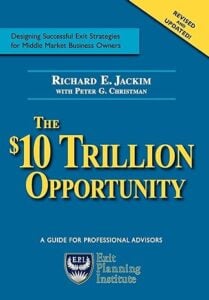 When I wrote the critically acclaimed book, The $10 Trillion Opportunity, this demographic wave was already clearly on the horizon. The math was never complicated: the largest generation of entrepreneurs in American history, the Baby Boomers, would eventually retire, and the buyer infrastructure to acquire these lower-middle-market businesses was not well developed.
That book led me to co-found the Exit Planning Institute, and to create the Certified Exit Planning Advisor (CEPA) designation — a program that has now trained more than 9,000 graduates and helped establish exit planning as a recognized professional discipline. Entire conferences, curricula, and consulting practices have been built around it.
And yet — despite all of that progress — the majority of business owners still exit without a plan in place. The McKinsey data makes that painfully clear: 92% of small business exits or sales today will end in closure. Not sale. Not succession. Closure. Let that sink in.
Profitable companies with real customers, trained employees, and decades of hard-earned reputation — simply shutting their doors because no qualified buyer stepped forward in time.
The Forgotten Core of the American Economy
The businesses most exposed to this risk share a common profile: revenues between $1 million and $10 million, spanning business service providers, regional manufacturers, and B2B specialists. These are owner-operated firms that have quietly powered local economies and supply chains for decades.
They’re too small to attract institutional private equity. Too complex for Main Street business brokers. And too often overlooked by the buyers who could give them a real future. It’s a structural gap hiding in plain sight — and it’s where the closure problem is most acute.
What This Means for Buyers & Sellers
Here’s the other side of the equation that doesn’t get discussed enough.
We talk with a lot of prospective buyers every day. And while well-run businesses with strong fundamentals cross our desk regularly, most buyers aren’t in the market for a good company. They’re searching for the right one — the one that checks all the boxes, including the right combination of timing, fundamentals, and transformative upside.
The challenge is that “right” means different things to different buyers. The right fit depends on the buyer’s background, industry experience, capital structure, growth thesis, and risk tolerance. That means if you are buyer, finding your right acquisition or isn’t a passive exercise. The same applies if you are a seller. It requires extensive, targeted research and outreach — two things we do every day.
The Bottom Line
 This is precisely the space that Jackim Woods & Co. was built to serve. Paul, Jim, and I have spent years developing the relationships, the methodology, and the market intelligence to move these businesses from owner-operated to professionally transitioned — without watching them quietly disappear.The Great Ownership Transfer is not a future event. It’s happening now. Every year that passes without a transaction plan is a year closer to a closure that didn’t have to happen.
If you’re a business owner thinking about your exit — whether in two years or ten — the time to start the conversation is now, before urgency forces your hand.
Contact us at Jackim Woods & Co. We’re happy to help you explore your options, help you develop a plan, and help you find the right buyer for your business. Reach us at jackimwoods.com or contact Rich directly to start the conversation.
