

What Is Your Scale Business Worth? A 2026 Valuation Update on the Private Equity Invasion
New money is entering the industrial scale market, the platforms already in it are buying everything they can reach, and even seasoned private equity buyers can’t agree on what these companies are worth. For owners of scale service and distribution businesses, that uncertainty is very good news.
Even the Buyers Can’t Agree on What Your Scale Business Is Worth
Recently I spent an hour comparing notes with a partner at a prominent, industrial-focused private equity firm. He is seasoned, he is successful, and he is currently researching his firm’s first platform acquisition in the industrial scale and weighing sector — the kind of fragmented, service-heavy market that private equity loves to consolidate.
We compared notes on valuation. And here is what stopped me: his working assumption for what scale companies cost was nearly double what they are actually selling for.
Sit with that for a moment. A sophisticated buyer, preparing to deploy serious capital into this space, carried a price expectation almost twice the real clearing price. Part of his skepticism about the sector came from that very assumption — in his mind, these companies were expensive. In reality, they trade for far less than he believed.
If a seasoned private equity professional — and the new entrants writing checks alongside him — don’t have a fixed read on what scale companies are worth, that pricing uncertainty cuts in the seller’s favor. Buyers are anchoring their internal models high. They are competing for a scarce set of quality targets. And the owner who walks in knowing the real numbers holds the advantage.
This is a 2026 valuation update for owners of industrial-scale service and distribution businesses: what the private equity invasion actually means for the value of your company, and the factors that drive that value up or down.
Is Now a Good Time to Sell a Scale Business?
Yes — and the window is open wider than most owners realize.
Two forces are converging at once. New money is entering the sector: private equity firms that have never owned a scale company are building investment theses and hunting for a platform to anchor a roll-up. At the same time, the platforms that already exist are acquiring everything they can reach — and moving fast to do it.
National dealmaking forecasts back this up. Private-equity-led consolidation in recurring, technology-enabled service businesses is expected to remain strong through 2026, with sponsors focused on professionalizing and expanding the platforms they have already built. Scale service companies — with their recurring revenue from calibration, certification, repair, and preventive maintenance — fit that profile almost perfectly. They are exactly the kind of sticky, fragmented, aftermarket-rich business the smart money is chasing.
For a seller, the math is simple. More buyers, especially more motivated ones, create greater competitive tension. The same recurring service revenue and technician dependence that make your business demanding to run are precisely what make it valuable to an acquirer.
What Is My Scale Business Worth? The 2026 Valuation Update
Here is the number owners actually want. Based on the transactions we have worked on with our seller clients and our independent research, scale companies with EBITDA under $5 million are selling in the 6.5x to 9x EBITDA range.
That is a strong number, and it sits at a premium to the broader industrial service middle market, which generally clears in the mid-single digits of EBITDA. The premium is not an accident. It is the recurring service and calibration revenue, the embedded technician relationships, and the sticky aftermarket that buyers are willing to pay up for. When a business produces predictable, contracted revenue year after year, acquirers underwrite it more like an annuity and less like a one-time equipment sale — and they price it accordingly.
Two further market realities push that range around, and both reward a prepared seller:
- Size is rewarded. Within the same sector, larger businesses command meaningfully higher multiples than smaller ones. The gap between a sub-$2 million and a $5 million EBITDA company can be several turns of EBITDA — which means disciplined growth in the year or two before a sale can pay for itself many times over at closing.
- Process is rewarded. Owners who run a competitive, advisor-led sale process consistently realize materially higher prices than owners who sell quietly to the first buyer who knocks on the door. The difference is routinely a double-digit percentage of the purchase price. Selling to the unsolicited caller is the single most expensive convenience an owner can buy.
The takeaway: the 6.5x to 9x band is real, but where you land inside it — and whether you push beyond it — is largely within your control.
Size of Scale Companies |
2026 Valuation Multiple |
| EBITDA $2M to $5M | 6.5x to 9.0x |
| EBITDA <$2M | 5.0x to 7.0x |
What Factors Affect My Valuation?
Two scale companies with identical EBITDA can sell for very different prices. These are the factors that move the number, in roughly ascending order of importance:
- The scale of the operation — your overall revenue and earnings, and the size premium that comes with them.
- The number of technicians — your field-service capacity, and how much of it stays in place if the owner steps away. Scarce, retained technical talent is an asset; an owner-dependent service operation is a discount.
- The number of locations — your geographic footprint and the regional density a buyer can build on or plug into an existing platform.
- Profit margin — clean, healthy margins signal a well-run business and lower a buyer’s perceived risk.
- Service contracts and recurring revenue as a percentage of total revenue — and this is the big one. The higher and stickier your recurring base, the higher your multiple. No single factor does more to move valuation. If you want to raise the value of your business before a sale, this is where the leverage lives.
Who’s Buying — and Who’s the New Money?
The buyer pool is deepening quickly, which is the single best thing that can happen to a seller.
The clearest example is Michelli Weighing & Measurement, backed by private equity firm Summit Park. Since Summit Park’s investment, Michelli has been acquiring aggressively — buying Greenville Scale, Total Scale Service, Houston-based Industrial Scale & Measurement, and Florida Industrial Scale in just the opening months of 2026, building a service network that now spans roughly 50 service areas across 18 states.
Investcorp’s acquisition of Kanawha Scales & Systems, the Carlton platform, Cross Precision Measurement, and J.A. King round out a field of active, well-capitalized consolidators all competing for the same finite set of quality targets.
And now add the new entrant — the private equity firm I opened with, researching its first scale platform with capital ready to deploy. When a brand-new buyer steps into a market where the incumbents are already buying everything in sight, the owners of quality businesses are the ones who win.
What This Means for You
The most useful thing I took from that hour with the private equity partner was not a number. It was the confirmation that the buyers themselves are still working out what scale companies are worth — and that they are bracing to pay more than today’s sellers are receiving.
If you own a scale service or distribution business, you are sitting in a rare position: a deepening pool of motivated, well-funded buyers, a recurring-revenue model those buyers prize, and a market where the price expectations of the people writing the checks run ahead of where deals are actually clearing. The owners who capture that premium will be the ones who understand their real value — and run a real process — before a buyer ever calls.
We advised the seller of a scale business acquired into the Carlton platform, and we work with scale service and distribution owners across North America on valuation and exit strategy. If you are wondering what your business is worth in today’s market, that is a conversation worth having now, while the buyers are this hungry.
About Jackim Woods & Company
Jackim Woods & Company is a boutique mergers and acquisitions firm specializing in lower-middle-market transactions, with deep experience in the industrial scale and weighing sector. The firm provides valuation, exit planning, targeted buyer outreach, and hands-on advisory throughout the sale process. For more information or a free consultation to explore your options, contact

Paul Fackler, Managing Director; pfackler@jackimwoods.com
OR

Rich Jackim, Managing Partner; rjackim@jackimwoods.com
Read More
Your EBITDA Is Strong. But Is Your Business Sellable?
Strong EBITDA is necessary but not sufficient to sell a business — buyers scrutinize the quality and durability of earnings, not just the headline number.
A company with $13M in revenue and $5M in EBITDA failed to sell after a year on the market because two structural risks — 45% revenue dependence on a single distribution channel and 16% revenue from one customer — triggered valuation disputes, and the deal fell apart during due diligence.
A concentrated revenue base, even at strong margins, creates deal risk that sophisticated buyers will find and price against. Businesses where any single customer accounts for 5% or more of revenue, where revenue flows through a single channel or relationship, or where recurring revenue is minimal , face a high likelihood of a buyer wanting to renegotiate the deal during due diligence. A professional market assessment — reviewing financials, revenue composition, customer concentration, and competitive positioning — is the critical first step before going to market, and is the most reliable way to avoid surprises that kill deals.
— Rich Jackim, Jackim Woods & Co.
Your EBITDA Is Strong. But Is Your Business Sellable?
Every business owner considering selling their business deserves a clear-eyed assessment of one foundational truth: EBITDA is a critical metric, but it does not tell the complete story. Owners who discover this after months of trying to sell their business — or after a deal fails during due diligence — will have wasted a lot of time and money.
The following is a situation we have seen multiple times in our practice. The details have been modified for confidentiality, but the dynamics are real—and offer important insights for any owner thinking about an exit.

A Business That Looked Great on Paper
Last year, we spoke with the owner of a business services company who had spent twenty years building his business. Now 65, he was ready to retire and sell the company. The financial profile was attractive: approximately $13 million in revenue with $5 million in EBITDA – strong margins that would get buyers’ attention.
Early in the process, the owner’s CPA reviewed the financials and told the owner the company was probably worth $25 million – exactly what the owner wanted to hear. The CPA explained that the EBITDA was there, and in his experience, companies like this one sold for 5x EBITDA. The owner felt confident, so he hired an M&A advisor to sell the business. After a year on the market, two buyers had withdrawn their offers during due diligence, and the business was still not sold.
Strong EBITDA opens doors. But what buyers find when they look inside determines whether a deal actually closes.
What the Financial Analysis Revealed
When buyers started their due diligence, they discovered the company’s revenue composition contained concentration risks that ultimately derailed the deal:
45%Revenue from One Distribution Channel |
16%Revenue from a Single Customer |
61%Revenue Concentration Risk |
Revenue channel concentration: 45% of total revenue was generated through a single distribution channel, a key salesperson, who was the same age as the business owner. While that salesperson had performed reliably for years, the fact that the company depended on someone so close to retirement age was a structural dependency that concerned sophisticated buyers.
Customer concentration: 16% of revenue was attributable to one customer, a large manufacturer with multiple locations. This indicated a customer concentration issue that affected lending eligibility and the buyer’s financing options, which in turn affected the overall risk profile of the deal.
These were not deal killing factors individually. But collectively, they represented risks that sophisticated buyers identified in due diligence, and in one case, used to try to negotiate a huge valuation adjustment (50%) — or in the other case, as grounds to exit the process entirely.
When Market Conditions Validated a Buyer’s Analysis
What ultimately killed the deal was during due diligence, an external event occurred that demonstrated precisely why concentration risk demands early attention.
The company received formal notification that its largest customer — representing 16% of annual revenue — had been acquired by a direct competitor. As part of the acquirer’s vendor consolidation strategy, they provided notice that they would be scaling back their purchase orders over the next six months, with the goal of consolidating all purchase orders with the new parent company’s vendors.
The impact was immediate and material. Sixteen percent of the company’s revenue had just disappeared and could not easily be replaced. The seller’s valuation and negotiating position was now fundamentally changed by a single event outside of their control. This is exactly what buyers feared, and it had come true.
The Strategic Lesson for Owners Selling Their Businesses
Advisors who do not earn success fees when a transaction closes have limited incentive to tell clients the hard honest truth about their client’s business. The result is that business owners often try to sell their business without a clear understanding of how buyers will evaluate their company — and without the opportunity to fix those risk factors before they become deal killers.
As the above example demonstrates, EBITDA matters a lot. But experienced buyers will also be looking at the quality and durability of those earnings:
- Does any single customer represent more than 5% of a company’s revenue?
- Is revenue dependent on a single channel, platform, or relationship that could be disrupted?
- Is revenue generated from one product or service, or diversified over a wide range of products and services?
- Is there industry concentration risk with services or products serving only one industry?
- How much of the revenue base is genuinely recurring, contracted, or relationship-protected versus transactional?
- How is the business positioned relative to industry transformation — as an adopter or as a laggard?
- How would EBITDA be affected if the single largest customer or channel relationship were impaired?
These are the questions that determine whether reported EBITDA represents durable, transferable earnings—or a business that will be systematically discounted during the diligence and negotiation process.
 The Question Every Owner Should Ask Before Selling Your Business
It is not simply “What is my EBITDA?”
The more important question is: “Do my revenue and EBITDA accurately reflect the risk-adjusted financial performance of my business?”
That is precisely what a professional market assessment and business valuation is designed to answer. Not to produce an optimistic number, but to give you the honest, complete picture that enables you to maximize transaction value and approach the market from a position of knowledge rather than a host of assumptions.
Why a Free Market Assessment Increases Your Options when Selling Your Business
At Jackim Woods & Co., our complimentary market assessments are designed to give business owners the analytical foundation they need before making one of the most consequential financial decisions of their lives.
We review of your financials, revenue composition, customer and channel concentration, competitive positioning, and provide you with the realistic range of values a qualified buyer would assign to your business. It means identifying the factors that could affect a transaction — and giving you to option to address them before you go to market.
Business owners who understand their true market value make better decisions: about timing, about preparation, about which buyer profiles to target, and how to position the company’s story. They do not spend months pursuing a process that was unlikely to succeed. And they are not surprised by what buyers find.
If you are considering a sale — even if your timeline is one to three years out — an objective assessment of where your business stands today is the most valuable step you can take.
Please note: Because of the time and effort that goes into to preparing a market assessment, free market assessments are only available for businesses generating at least $5 million in revenue or $1 million in EBITDA.
About Jackim Woods & Co.
 Rich Jackim is an investment banker, entrepreneur, and former mergers and acquisitions attorney.
For the last 25 years, Rich has been providing boutique investment banking services to small and lower middle-market companies in a wide range of industries across the United States and Canada.
Rich also founded a successful training and certification company called the Exit Planning Institute, which he sold to a private equity group in 2012.
Rich is also the author of the critically acclaimed book, The $10 Trillion Dollar Opportunity: Designing Successful Exit Strategies for Middle Market Businesses.
Jackim Woods & Co offers skilled mergers and acquisitions advisory services to privately companies in both sell-side and buy-side transactions. Jackim Woods & Co has arranged over 120 successful transactions, ranging from one million to more than eighty million dollars in value.
If you own a business and are interested in exploring your options, I would welcome an opportunity to speak with you.
Feel free to contact me at 224-513-5142 or rjackim@jackimwoods.com.
Read More
2025 M&A Market Overview: What Business Buyers and Sellers Need to Know
The business brokerage landscape in 2025 tells a story of steady growth and selective optimism. After analyzing nearly 10,000 closed transactions representing nearly $8 billion in enterprise value, our research reveals a market that’s maturing with purpose—where buyers are more discerning, and sellers who prepare properly are being well rewarded.
A Market Finding Its Footing
This past year saw 9,586 transactions close, a modest but meaningful 0.4% increase from 2024. While that growth rate might seem incremental, it signals something important: stability, which is crucial amid market disruptions stemming from Trump’s tariffs and immigration enforcement policies, which have caused tremendous uncertainty across our economy.
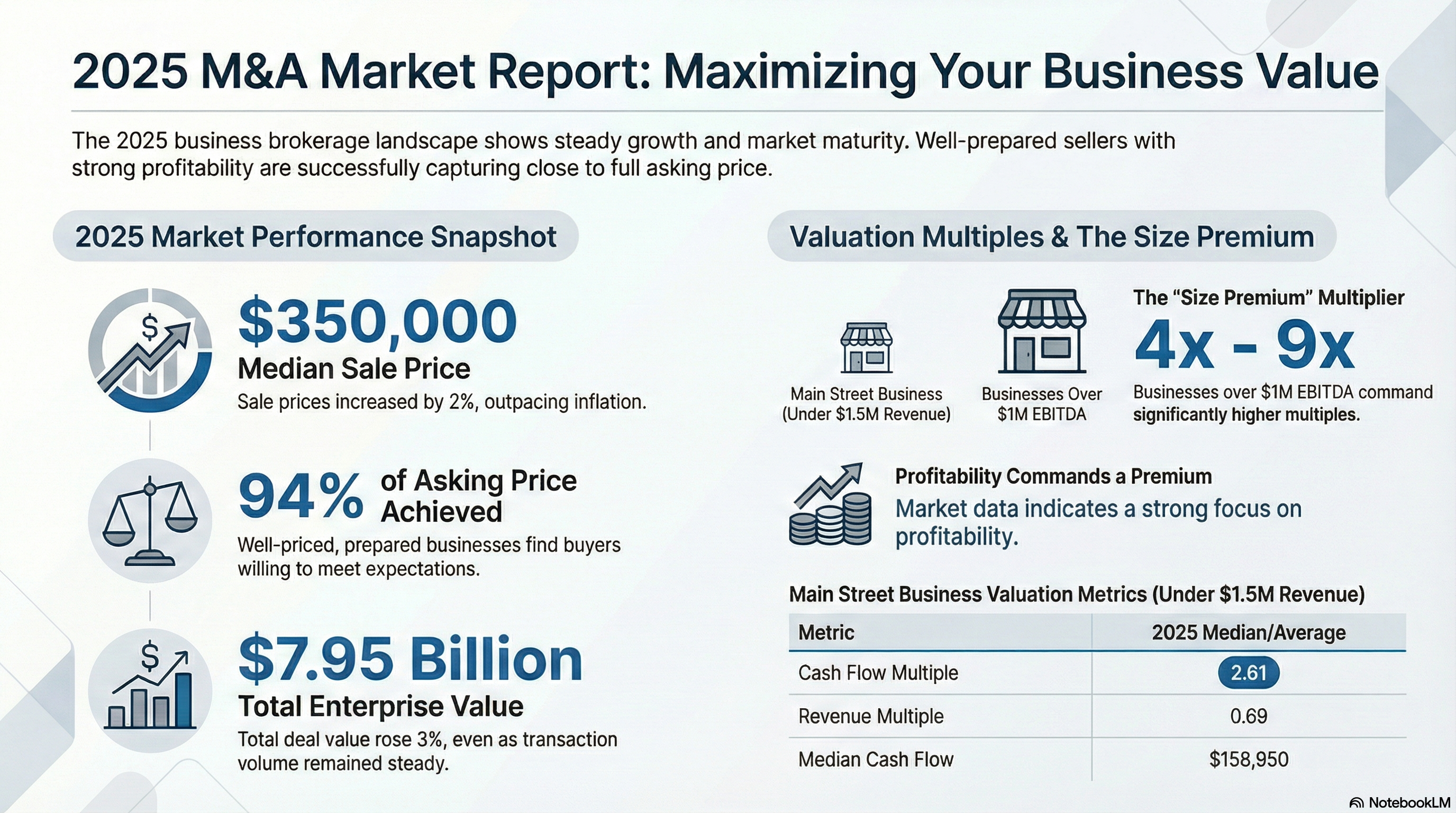
Another important indicator is that the total enterprise value of $7.95 billion is up 3% year-over-year, demonstrating that deal sizes are expanding even as transaction volume holds relatively steady.
For sellers, the headline number is encouraging: the median sale price reached $350,000, a 2% increase that outpaced inflation in many sectors. More telling is that businesses are selling at an average of 94% of their asking price, suggesting that well-priced, well-prepared businesses marketed by professional business brokers are finding buyers willing to meet them close to their expectations.
The Valuation Story: Cash Flow Still Commands a Premium
Our research relies heavily on closed transaction data from the BizBuySell and our own internal database of closed transaction, which tends to focus on smaller, “main street” types of businesses, with revenues of less than $2 million. For these small companies, valuation multiples reveal where buyer confidence truly lies.
The average cash flow multiple climbed to 2.61—a 1% increase that may seem small but represents real dollars when applied to six-figure earnings. With median cash flow of $158,950 (up 3%), sellers with strong, documented profitability are in the driver’s seat.
Revenue multiples also ticked up to 0.69, a 2% gain, while median revenue reached $703,000. This suggests buyers are willing to pay more for top-line growth, but the stronger appreciation in cash flow multiples confirms what savvy sellers already know: profit matters more than revenue when it comes to valuation.
Size Premium: It is important to note that larger companies sell for higher multiples of EBITDA and Revenue due to a size premium. Buyers view larger companies as much less risky then smaller companies so if your business is generating more than $5M in revenue and more than $1M in EBITDA, you can expect your company to be valued at between 4x and 9x EBITDA, depending on the type of business you have and the industry you operate in.
Where the Action Is
Geography continues to play a decisive role in market velocity. Florida led all states in transaction demand, followed by California, Texas, Arizona, and New York.
These aren’t just population centers—they’re business hubs with favorable demographics and diverse economies that create both buyer pools and acquisition targets.
Sector Spotlight: The Reliable and the Rising
Service businesses dominated the closed deal landscape, claiming the top spot ahead of retail, restaurants, and manufacturing. The prevalence of service businesses reflects their scalability, lower capital requirements, and often more predictable cash flows—qualities that resonate in an environment where buyers are prioritizing stability.
But the real story lies in the rising business types that are capturing increasing buyer attention.
- Financial services
- Technology services
- Cafe and coffee retailers
- Beauty and personal care businesses
These sectors share common threads: recurring revenue potential, demographic tailwinds, and business models that have proven resilient through recent economic uncertainty.
What This Means for Sellers
If you’re considering an exit in the next 12 to 24 months, this data offers a roadmap. Buyers are active, valuations are holding, and well-run businesses in the right sectors are commanding strong multiples. The key is preparation: clean financials, documented cash flow, and a clear growth story will position you to capture that 94% (or better) of asking price.
The market rewards businesses that can demonstrate consistent performance, particularly in cash flow. With multiples trending upward, even incremental improvements in profitability can translate to meaningful differences in your final sale price.
What This Means for Buyers
For buyers, the landscape demands strategic discipline. With sale prices hovering near asking prices, there’s less room for bargain hunting, but opportunities exist for those who can move decisively on quality businesses. The rise in cash flow multiples means you’ll need to justify higher purchase prices with clear paths to growth or operational improvements.
The emerging sectors—financial services, technology, specialty retail like coffee shops, and beauty services—represent areas where market momentum may create additional upside beyond the acquisition.
Looking Ahead
The 2025 market isn’t about explosive growth or dramatic shifts. It’s about a maturing marketplace where quality businesses find quality buyers, where valuations reflect realistic expectations, and where the fundamentals—profitability, documentation, and preparation—determine outcomes.
At Jackim Woods & Co., we help clients navigate this landscape with clarity and purpose. Whether you’re building toward an exit or searching for the right acquisition, understanding these market realities is where successful transactions begin.
The data speaks. The question is: are you ready to act on it?
About the Author and Jackim Woods & Co.
 Rich Jackim is an investment banker, entrepreneur, and former mergers and acquisitions attorney.
For the last 25 years, Rich has been providing boutique investment banking services to small and lower middle-market companies in a wide range of industries across the United States and Canada.
Rich also founded a successful training and certification company called the Exit Planning Institute, which he sold to a private equity group in 2012.
Rich is also the author of the critically acclaimed book, The $10 Trillion Dollar Opportunity: Designing Successful Exit Strategies for Middle Market Businesses.
Jackim Woods & Co offers skilled mergers and acquisitions advisory services to privately companies in both sell-side and buy-side transactions. Jackim Woods & Co has arranged over 120 successful transactions, ranging from less than one million to more than eighty million dollars in value.
If you own a business and are interested in exploring your options, I would welcome an opportunity to speak with you.
Feel free to contact me at 224-513-5142 or rjackim@jackimwoods.com.
Read More
How to Value a Janitorial Supply Company in 2025
If you’re considering selling your janitorial supply business, determining its value is the first step. This guide will walk you through the key aspects of valuing a janitorial supply company in 2025, combining expert insights and current market trends to help you understand what your business is worth.
Why is Valuation Important?
Understanding the value of your janitorial supply business is essential for several reasons:
- The Janitorial Supply Sector is experiencing a rapid consolidation as large, national players and regional companies acquire smaller competitors to increase their geographic markets and overall market share. To understand more about this trend, read our article What’s Driving Acquisitions in the Jan-San Sector in 2025.
- Setting a realistic sale price: A proper valuation helps you set a realistic asking price, attracting serious buyers and avoiding wasted time. The number one reason companies don’t sell is that sellers have unrealistic expectations of value. So getting this right from the start is essential.
- Negotiating effectively: Knowing your company’s value empowers you to negotiate favorable terms.
- Making informed decisions: Valuation provides a clear picture of your company’s financial health and potential, guiding your decisions throughout the sale process.
Janitorial Supply Market Overview
The janitorial supply market forms an integral component of the broader facilities management sector, with a global market size valued at USD 31.15 Billion in 2023 and projected to reach USD 40.26 Billion by 2031, exhibiting a Compound Annual Growth Rate (CAGR) of 2.9% during the forecast period of 2024-2031.
In the United States specifically:
- The U.S. Facility Services market was sized at $267.8 billion in 2024 and is projected to grow steadily, reaching $370.7 billion by 2029.
- The U.S. Janitorial Services market alone had a size of $80.4 billion in 2024 and is forecast to increase to $92.3 billion by 2029.
- The Cleaning & Maintenance Supplies Distributors in the US generated approximately $9.9 billion in revenue in 2024, although this segment has experienced a decline at a CAGR of 2.4% over the past five years.
- The Janitorial Equipment Supply Wholesaling in the US reported revenue of $29.3 billion in 2024, with a modest growth of 0.5% CAGR over the previous five years.
Factors That Affect the Sale Price
The ultimate sale price of your janitorial supply company depends on a variety of factors:
- Financial Performance: Strong financial metrics including consistent revenue growth, healthy profit margins (EBITDA and net income), and stable cash flows significantly impact valuation.
- Customer Base: A diversified customer portfolio with low concentration reduces risk and increases value. High customer retention rates and long-term contracts indicate stability and predictable future revenue streams.
- Operational Efficiency: How efficiently your company manages its operations directly impacts profitability and attractiveness. Streamlined supply chain management, effective inventory control, and technology adoption for enhanced productivity all contribute to a higher valuation.
- Market Position and Competitive Landscape: Your company’s standing within the janitorial supply market, including market share, brand recognition, and geographical reach, influences its valuation.
- Management Team and Employee Stability: The experience, expertise, and stability of your management team are critical factors. Low employee turnover and a skilled workforce are positive indicators of a well-run business.
- Risk Profile: Overall risk factors associated with your business significantly impact valuation. These can include customer concentration, reliance on key personnel, financial instability, and potential regulatory challenges.
- Growth Potential: A business with clear growth potential, such as an expanding customer base or entry into emerging market segments, is more valuable.
- Product Mix and Specialization: Companies offering specialized or proprietary products often command higher valuations than those selling only commodity items.
Janitorial Supply Company Valuation Methods
Here are several methods you can use to determine the value of your janitorial supply company:
- Market Approach: This involves analyzing past market transactions of similar janitorial supply companies to establish a valuation basis. However, accessing transaction data for privately owned companies can be challenging.
- Cost-based Valuation: This approach calculates the cost of creating a similar company from the ground up, including tangible and intangible assets.
- Asset Approach: This method determines the net value of a business’s assets minus its liabilities. It’s crucial to use the market value of your equipment and inventory, and factor in goodwill or intangible value.
- EBITDA Multiples: This common approach applies an industry multiple to your company’s EBITDA (Earnings Before Interest, Taxes, Depreciation, and Amortization).
Understanding EBITDA Multiples for Janitorial Supply Companies
EBITDA is a key metric for valuing janitorial supply companies. Here’s how to calculate it:
EBITDA = Net income + Interest + Taxes + Depreciation + Amortization
For privately owned janitorial supply companies, we often use Adjusted EBITDA:
Adjusted EBITDA = Net income + Interest + Taxes + Depreciation + Amortization + Owner Addbacks
Owner addbacks might include owner’s salary above market rate, personal expenses run through the business, one-time expenses, and other discretionary expenses that a new owner might not incur.
To determine your company’s value using EBITDA, you’ll calculate:
Your janitorial supply company’s value = Adjusted EBITDA × EBITDA Multiple
Current EBITDA Multiples for Janitorial Supply Companies in 2025
The valuation multiples for janitorial supply companies vary based on several factors, including company size, profitability, market position, and risk profile. Based on recent transactions and market data, here are the approximate EBITDA multiples:
EBITDA Multiples for Privately Owned Janitorial Supply Companies, Q1 2025
 It is important to note that these multiples are current as of Q1 2025 and are subject to change based on market conditions.
Data from previous years indicated a mean EBITDA multiple of 8.3x and a median of 8.2x for M&A deals in the Janitorial Industry, while publicly-traded comps had higher mean and median multiples of 11.0x and 10.7x, respectively.
Revenue Multiples for Privately Owned Janitorial Supply Companies, Q1 2025
 Data from previous years showed that the mean revenue multiple for Janitorial Industry M&A deals was 0.6x, with a median of 0.5x, while publicly-traded comps showed a mean of 1.4x and a median of 1.0x.
Other Factors Affecting the Value of a Janitorial Supply Company
Several other factors can influence the valuation of your janitorial supply company:
- Customer Type: Companies serving commercial, industrial, or healthcare sectors may be valued differently based on the stability and growth potential of these end markets.
- Recurring Revenue: Businesses with subscription-based models or long-term service contracts typically receive higher valuations due to predictable revenue streams.
- Technological Integration: Companies that have invested in e-commerce platforms, inventory management systems, or other technological solutions often command premium valuations.
- Brand Strength and Reputation: A strong brand with high recognition and positive reputation can significantly enhance company value.
- Geographical Footprint: Companies with a broader geographical presence may be more attractive to buyers looking to expand their market reach.
- Sustainable/Green Product Offerings: Companies focusing on environmentally friendly products may attract premium valuations due to growing market demand for sustainable solutions.
Trends in Janitorial Supply M&A in 2025
Several trends are shaping the M&A landscape for janitorial supply companies in 2025:
- Continued Consolidation: The industry is experiencing significant ongoing M&A activity, with private equity firms playing a prominent role. Companies like Imperial Dade (an Advent portfolio company) and BradyIFS + Envoy Solutions have been particularly active in acquisitions.
- Buy-and-Build Strategies: Private equity firms are implementing “buy-and-build” strategies, acquiring platform companies and then adding on smaller, synergistic businesses to build scale, expand geographic reach, and deepen service capabilities.
- Focus on Technology and E-commerce: Buyers are increasingly valuing companies with strong digital capabilities and efficient operational systems.
- Emphasis on Sustainable Solutions: Companies offering eco-friendly and sustainable cleaning products are attracting premium valuations due to growing market demand.
- Strategic Buyers Seeking Synergies: Larger existing companies are participating in M&A to achieve economies of scale, expand market presence, or gain access to new technologies and customer segments.
The Value of Expert Guidance
Selling a janitorial supply company is a time-intensive and complex undertaking. Engaging an M&A advisor with experience in the janitorial supply sector can significantly increase your chances of a successful sale at the best possible price. An M&A advisor with experience in the janitorial supply sector can:
- Help you accurately value your business
- Prepare necessary offering documents and financial models
- Market your company effectively to financial and strategic buyers
- Negotiate favorable terms
- Manage the due diligence process
- Ensure a smooth closing and transition
By understanding the key valuation methods, market trends, and preparation steps, you can confidently navigate the sale process and achieve the best possible outcome for your janitorial supply business.
About the Author and Jackim Woods & Co.
 Rich Jackim is an investment banker, entrepreneur, and former mergers and acquisitions attorney.
For the last 25 years, Rich has been providing boutique investment banking services to middle-market companies in a wide range of industries, including the janitorial supply sector.
Rich also founded a successful training and certification company called the Exit Planning Institute, which he sold to a private equity group in 2012.
Rich is also the author of the critically acclaimed book, The $10 Trillion Dollar Opportunity: Designing Successful Exit Strategies for Middle Market Businesses.
Jackim Woods & Co offers skilled mergers and acquisitions advisory services to privately owned janitorial supply companies in both sell-side and buy-side transactions. Jackim Woods & Co has arranged over 100 successful transactions, ranging from less than one million to more than eighty million dollars in value.
If you own a janitorial supply company and are interested in exploring your options, I would welcome an opportunity to speak with you.
Feel free to contact me at 224-513-5142 or rjackim@jackimwoods.com.
This article is also available on LinkedIn.
Read More
How to Value Your Cybersecurity Business in 2025
Valuing Your Cybersecurity Business: A Comprehensive Guide for Owners
Understanding Cybersecurity Business Valuations
The complexity and diversity of the cybersecurity industry can cause wide variations in company valuations. While some organizations may be valued at single-digit EBITDA multiples, others command double-digit revenue multiples, reflecting the unique value of cybersecurity companies.
Key Valuation Drivers
Business valuations in the cybersecurity space are influenced by a number of factors, including scale, growth trajectory, profitability metrics, revenue composition, market positioning, and timing. At Jackim Woods & Co., we work with clients to thoroughly understand these elements to determine accurate valuations that reflect each company’s unique characteristics and market potential.
Critical Metrics for Consideration
Recurring Revenue
The stability of recurring revenue streams can significantly impact a cybersecurity company’s value. Cybersecurity firms with a software as a service (SaaS) business model often achieve premium valuations due to their annual recurring revenue models, strong growth rates, and exceptional gross margins. For service-oriented businesses, while contractually recurring revenue may be more challenging to secure, building strong, long-term customer relationships can create valuable recurring revenue streams that enhance company value.
Gross Margins
Gross margins serve as a key indicator of a company’s market positioning and operational efficiency. Top-performing SaaS businesses typically achieve gross margins exceeding 80%, while professional service firms generally target 50% as a benchmark for sustainable operations. These margins not only demonstrate operational effectiveness but also signal to potential buyers the level of service differentiation and market competitiveness.
EBITDA Performance
Market conditions in 2023 and 2024 demonstrated a clear preference for companies combining growth with strong EBITDA margins, reflecting a “flight to quality” among risk-aware buyers seeking established, profitable operations. As we approach 2025, while profitability remains important, we’re seeing renewed market appetite for high-growth businesses, particularly those demonstrating clear paths to profitability.
Market Outlook
The cybersecurity sector continues to evolve rapidly, with valuations reflecting both immediate market conditions and long-term growth potential. At Jackim Woods & Co., we leverage our industry expertise to help clients navigate these complex valuation dynamics, ensuring optimal timing and positioning for market transactions.
Our team’s comprehensive understanding of these valuation drivers enables us to provide strategic guidance that maximizes value for our clients while accounting for current market conditions and industry trends.
Understanding the Current Market Landscape
The cybersecurity sector continues to evolve rapidly, driven by increasingly sophisticated cyber threats and growing digital transformation across industries. As of 2024, privately owned cybersecurity companies typically sell at revenue multiples of around 8.5x, compared to 14.2x for their public counterparts. This difference reflects several key market dynamics that every business owner should understand.
To see an overview of recent transactions in the cybersecurity sector, please read our related article entitled, mergers and acquisitions deals in the cybersecurity sector in 2024.
Why Private Companies Trade at a Discount
If you’re running a private cybersecurity company, you might wonder why there’s such a significant difference between the valuation multiples paid for private and public companies. The 40% discount primarily stems from four key factors:
First, liquidity risk plays a major role. While public company shares can be bought and sold instantly on stock exchanges, private company transactions require complex negotiations and significant time investments. This reduced liquidity naturally commands a lower valuation.
Second, information quality creates another hurdle. Public companies must provide detailed quarterly reports and audited statements, giving investors clear visibility into their operations. As a private company owner, your financial reporting might be less standardized, which can impact buyer confidence and, consequently, valuation.
Third, company size and scale matter significantly. Public cybersecurity companies typically operate at a larger scale with more predictable revenue streams. If you’re running a private company, you might still be in a growth phase, which can introduce more uncertainty into your valuation.
Fourth, management strength and depth affects buyer perception. Public companies usually have established management teams and well-defined processes, while private companies often depend heavily on their founders. This concentration of expertise can be seen as a risk factor in valuations.
Key Methods for Valuing Your Cybersecurity Business
When preparing for a potential sale, understanding different valuation methodologies can help you better position your company. Three primary approaches are commonly used:
Revenue Multiples
In the cybersecurity sector, companies with a SaaS business model are typically valued based on a multiple of revenue rather than the more traditional multiple of EBITDA that is used for traditional businesses like manufacturing or business services companies. This approach is particularly relevant for high-growth companies that might not yet be profitable but show strong revenue trajectory. By multiplying your annual revenue by the appropriate multiple (remember the 8.5x average for private companies in 2024), you can get a baseline valuation for your business. While 8.5x is lower than public cybersecurity firms, this is still a substantial premium over other fast growing, high margins business like other SaaS businesses that sell for between 2.5x and 4.5x annual recurring revenue.
EBITDA Multiples
For cybersecurity companies with a more traditional service-based business model and a record of profitability, EBITDA multiples offer another valuable perspective. These companies sell for between 5x and 9x EBITDA. This method can be especially useful when valuing companies that have been profitable for the last several years.
Discounted Cash Flow Analysis
If you need or want a more detailed and company specific valuation, , a discounted cash flow or DCF analysis can provide deeper insights into your company’s intrinsic value by projecting future cash flows. This method particularly appeals to sophisticated buyers who want to understand your company’s long-term potential.
Understanding Current M&A Trends
The cybersecurity sector continues to see robust M&A activity, driven by several factors that could work in your favor.
Strategic Buyers
Large technology companies and established cybersecurity firms actively seek acquisitions to expand their capabilities and market reach. These strategic buyers often pay premium valuations for companies that fill specific gaps in their product offerings or provide access to new markets.
Private Equity Interest
Private equity firms have shown increasing interest in the cybersecurity sector, recognizing its growth potential. These buyers typically look for companies with strong fundamentals and clear opportunities for value creation through operational improvements or strategic acquisitions.
Technology Evolution
The rapid pace of technological change, particularly in areas like artificial intelligence and machine learning, drives acquisition interest. Companies with advanced capabilities in these areas often command premium valuations.
To see an overview of recent transactions in the cybersecurity sector, please read our related article entitled, mergers and acquisitions deals in the cybersecurity sector in 2024.
Maximizing Your Company’s Value
If you are thinking of selling your cybersecurity firm in the next few years, you can significantly increase your company’s value by focusing on these key value drivers:
Growth Trajectory
Buyers pay premium valuations for companies demonstrating strong, sustainable growth. Document your historical growth rates and, more importantly, develop a credible plan for future expansion. This might include new market opportunities, product development roadmaps, or strategic partnerships.
Innovation Leadership
Your company’s technological capabilities and innovation pipeline significantly impact valuation. Showcase your unique intellectual property, research and development initiatives, and ability to address emerging cyber threats. Patents, proprietary technologies, and innovative solutions can substantially increase your company’s worth.
Market Position and Customer Relationships
Strong market presence and stable customer relationships drive higher valuations. Document your market share, customer retention rates, and long-term contracts. A diverse customer base with high satisfaction rates and low churn demonstrates stability and growth potential.
Management Team Strength
Invest in building a strong management team that can operate independently of founders. This reduces key person risk and makes your company more attractive to potential buyers. Document your team’s experience, track record, and succession planning.
Preparing for a Successful Exit
To maximize your company’s value in a potential sale, consider these preparatory steps:
- Get your financial house in order by ensuring clean, well-documented financial statements and strong financial controls.
- Document your key performance indicators, focusing on metrics that matter to buyers like annual recurring revenue, customer acquisition costs, and lifetime customer value.
- Protect your intellectual property through proper documentation and registration.
- Strengthen your management team and reduce dependency on key individuals.
- Develop a clear growth strategy that can be executed by future owners.
Looking Ahead
The cybersecurity sector’s outlook remains strong, with increasing cyber threats driving demand for advanced solutions. Industry consolidation continues as larger players seek to acquire specialized capabilities and talent. This environment creates opportunities for well-positioned private companies to achieve attractive valuations.
Understanding these valuation dynamics and preparing your company accordingly can help you maximize value in a potential sale. Focus on building sustainable competitive advantages, maintaining strong growth, and developing clear documentation of your company’s value proposition and future potential.
Read our previous article for information about mergers and acquisitions deals in the cybersecurity sector in 2024.
About the Author and Jackim Woods & Co.
 Rich Jackim is an experienced investment banker, education industry entrepreneur, and former mergers and acquisitions attorney.
For the last 25 years, Rich has been providing boutique investment banking services to middle-market companies.
Rich also founded a successful training and certification company called the Exit Planning Institute, which he sold to a private equity group in 2012.
Rich is also the author of the critically acclaimed book, The $10 Trillion Dollar Opportunity: Designing Successful Exit Strategies for Middle Market Businesses.
Jackim Woods & Co offers skilled mergers and acquisitions advisory services to privately owned software, SaaS, tech-enabled, and cybersecurity companies in both sell-side and buy-side transactions. Jackim Woods & Co has arranged over 100 successful transactions, ranging from less than one million to more than eighty million dollars in value.
If you own a cybersecurity-related business and are interested in exploring your options, I would welcome an opportunity to speak with you. Feel free to contact me at 224-513-5142 or rjackim@jackimwoods.com.
Read More
How to Value Your Private SaaS Business in 2025
In today’s dynamic software market, understanding the value of your SaaS business is crucial for making informed decisions about fundraising, M&A opportunities, or strategic planning. While public SaaS companies have transparent market valuations, private companies face unique challenges in determining their value. Here’s a comprehensive guide to help you determine what your SaaS business is worth in 2025.
Understanding SaaS Valuation Fundamentals
Unlike traditional businesses that use earnings or EBITDA-based multiples, SaaS companies are typically valued using a multiple of revenue. This approach is justified because of three unique characteristics of the SaaS business model:
- High growth rates and the ability to scale rapidly through multi-tenant architecture
- The disconnect between cash flow and P&L statements due to upfront annual payments and revenue recognition rules
- Very high net operating margins that are often over 50%
Key Metrics That Drive Your Valuation
In addition to your Annual Recurring Revenue (ARR), there are three primary metrics that are important to determine the value of your SaaS company: Annual Recurring Revenue, Net Revenue Retention, and Market Conditions.
1. Annual Recurring Revenue (ARR) Growth Rate
Your company’s ARR growth rate is the most significant factor affecting valuation. Current data shows that growth rates vary significantly by company size:
| ARR Size | Median Growth Rate |
|---|---|
| < $1M | 50% |
| $1M-$5M | 40% |
| $5M-$10M | 35% |
| $10M-$20M | 30% |
| > $20M | 25% |
2. Net Revenue Retention (NRR)
NRR measures your ability to retain and increase revenue from existing customers. Strong retention rates indicate customer satisfaction and pricing power. Current market data shows typical NRR benchmarks by company revenue:
| ARR Size | Net Revenue Retention |
|---|---|
| < $1M | 100% |
| $1M-$5M | 101% |
| $5M-$20M | 102% |
| > $20M | 104% |
3. Market Conditions
Public market valuations serve as a good indicator for private company valuations. As of the June 2024, the median public SaaS company trades at 6.8x revenue, down significantly from 2021 peaks but stabilized in the 6-7x range.
Keep in mind that private SaaS companies sell roughly 4.1x revenue, a significant discount to their public counterparts. Based on the data and our market experience, but we are seeing private SaaS companies selling at between 3x and 4.7x revenue, approximately a 40% discount to public companies.
Here are the key reasons for this valuation gap:
1. Liquidity Risk
– Public company shares can be bought and sold instantly on stock exchanges
– Private company shares are much harder to sell, often requiring lengthy deal processes
2. Information Quality and Access
– Public companies provide detailed quarterly financial reports, audited statements, and regular disclosures
– Private companies have limited transparency and less standardized reporting
3. Market Size & Scale
– Public companies are generally larger, with more established market positions
– Greater scale typically means more predictable revenue and lower operational risk
4. Professional Management
– Public companies typically have experienced management teams and established processes
– Private companies may be more dependent on founders or key individuals
Current Private SaaS Valuation Multiples
The actual multiple of revenue varies depending on the size of the business. The bigger the business, the higher the multiple. This is called the “Size Premium”. Based on current market data, here are the median valuation multiples for private SaaS companies by size in Q4 2024:
| ARR Size | Q4 2024 Valuation Multiple |
|---|---|
| < $1M | 3.2x |
| $1M-$5M | 3.8x |
| $5M-$10M | 4.1x |
| $10M-$20M | 4.3x |
| > $20M | 4.5x |
How to Calculate Your Company’s Value
Here’s how to estimate your company’s value:
- Start with your current ARR
- Calculate your trailing twelve-month growth rate
- Measure your net revenue retention
- Apply the appropriate multiple to your ARR based on your company’s size
- Adjust the multiple based on company-specific factors. For example, if your NRR is below industry averages, then lower the multiple. If your growth rate is higher than industry average, increase the multiple a bit.
For example, if your company has $5M in ARR, 35% growth rate, and 102% NRR, you would apply a 4.1x multiple, suggesting a valuation of approximately $20.5M.
This type of back of the envelope will give you a ballpark sense of what your business is worth. However, if you need a more precise valuation, contact us to learn about our valuation services.
Market Context and Timing Considerations
Several market factors currently affect private SaaS valuations and will have an impact on valuations in 2025:
- The stock markets have reached all-time highs, but this is primarily driven by large tech companies and AI-related stocks
- Traditional B2B software valuations remain well below 2021 peaks. This suggests that valuations for B2B SaaS companies may increase in 2025.
- IPO activity remains limited, creating a backlog of companies seeking exits, which suggests an increase in the number of companies looking to exit via a private sale rather than an IPO.
- There is a significant gap between seller value expectations and buyer valuations. We expect this gap to lessen as buyers re-assess what it will take to get a deal done.
- Private companies are showing stronger growth compared to public counterparts, which will continue to attract both public strategic buyers and private equity groups.
Maximizing Your Company’s Value
If you are still a year or two away from a liquidity event, there are several things you can work on to maximize the value of your SaaS business. Our advise is to focus on:
- Sustainable Growth
- Prioritize consistent, profitable growth over unsustainable rapid expansion
- Maintain clear paths to market leadership in your niche
- Document your growth strategy and market opportunity
- Revenue Quality
- Improve net revenue retention through customer success initiatives
- Focus on annual contracts or subscriptions plans with some upfront payments
- Build predictable, recurring revenue streams
- Operating Metrics
- Track and improve key SaaS metrics like CAC, LTV, and gross margins
- Maintain strong unit economics
- Demonstrate operational efficiency and scaling capabilities
Current Market Dynamics
The 2024 market presents unique considerations:
- Valuations have stabilized but remain well below recent peaks
- Investors are increasingly focused on profitability and efficient growth
- The bid-ask spread between buyers and sellers remains wide
- Market uncertainty continues to impact transaction volumes
- Smaller companies show resilience in growth rates compared to larger peers
Looking Ahead
As we wrap up 2024 and look forward to 2025, several factors could impact valuations:
- Interest rate changes. We expect interest rates to continue to drop slowly over the next 12 months.
- Macroeconomic conditions and their impact on tech spending.
- Disconnect between a seller’s value expectations and what buyers are willing to pay
- Evolution of AI’s impact on software valuations.
Understanding these valuation fundamentals will help you make informed decisions about your company’s future. While this framework provides a starting point, remember that company-specific factors, market conditions, and strategic value to potential acquirers can significantly impact your final valuation. To learn more about what your business may be worth, contact us for a free, no obligation consultation.
About the Author and Jackim Woods & Co
Rich Jackim is an attorney, investment banker, and entrepreneur. For the last 30 years, Rich and his team have been providing boutique investment banking services to small and middle-market companies in over 30 industries.
In addition to running a successful M&A advisory firm, Rich founded a successful training and certification company called the Exit Planning Institute, which he sold to a private family office in 2012.
Rich is also the author of the critically acclaimed book, The $10 Trillion Dollar Opportunity: Designing Successful Exit Strategies for Middle Market Businesses. It became an Amazon best-seller in the business consulting category the year it was published.
If you own a SaaS business and are interested in exploring your options, I would welcome an opportunity to speak with you. There is no cost or obligation to you and all discussions are completely confidential.
Feel free to contact me at 224-513-5142 or rjackim@jackimwoods.com.
Read More
Expert M&A Advisors: Flexible Solutions for Complex Transactions
In today’s dynamic mergers and acquisitions landscape, businesses need experienced advisors who can provide targeted expertise without the rigid structure of traditional full-service engagements. Our boutique M&A advisory firm offers flexible, hourly consulting services that give you access to senior-level expertise precisely when you need them.
Strategic Advisory Services Tailored to Your Transaction
Whether you’re preparing for a sale, evaluating an acquisition opportunity, or navigating complex negotiations, our experienced team provides comprehensive support across all critical aspects of M&A transactions. Our hourly consulting model allows you to leverage our expertise efficiently while maintaining control of your process and budget.
While we still offer clients the option of working with us under the traditional retainer and success fee or commission model, more and more clients are opting for the hourly consulting approach. Here’s why.
Strategic Financial Planning and Analysis
Our seasoned advisors work alongside your executive team to strengthen your financial narrative and strategic positioning. We assist CEOs and CFOs in developing compelling financial presentations that highlight your company’s value drivers and growth potential. Our services include:
- Strategic financial analysis and report preparation
- Custom financial modeling and projections
- Valuation analysis and benchmarking
- Scenario planning and sensitivity analysis
Professional Transaction Management
Successfully navigating an M&A transaction requires meticulous attention to detail and deep market knowledge. Our team provides comprehensive support throughout the entire process:
- Data room preparation and management
- Professional presentation development
- Process mapping and milestone planning
- Timeline management and coordination
Expert Transaction Guidance and Negotiation Support
Leverage our extensive transaction experience to optimize your outcomes. Our advisors provide:
- Market intelligence on current terms and conditions
- Strategic negotiation support
- Term sheet and LOI guidance
- Deal structure optimization
- Purchase agreement consultation
Our Expert Team
Our firm brings together a diverse team of M&A professionals, each contributing specialized expertise to your transaction. Our team includes:
- Investment Bankers with decades of deal experience across various industries
- Financial Analysts who excel at modeling, valuation, and detailed financial analysis
- Project Managers who ensure smooth process execution and milestone achievement
Every team member is carefully selected for their transaction expertise and commitment to client success. This combination of skills ensures you receive comprehensive, professional support throughout your M&A journey.
Cost-Effective Advisory Services
Our innovative hourly consulting model represents a significant departure from traditional M&A advisory fee structures. By eliminating the standard success fee that most investment banks and M&A advisors charge, we can deliver substantial cost savings to our clients while providing the same high-quality expertise and service.
Significant Cost Savings
Traditional M&A advisory fees typically include a substantial success fee ranging from 1% to 5% or more of the transaction value. For mid-market transactions, this can translate to fees between $100,000 and $500,000 or more. Our hourly model eliminates these success fees, potentially saving clients hundreds of thousands of dollars while still maintaining access to top-tier advisory services.
| Fee Component | Retainer & Success Fee | Hourly Approach |
|---|---|---|
| Non-refundable Retainer | $20,000 | $5,000 |
| Success Fee | $300,000 | $0 |
| Professional Hours | 250 | 250 |
| Average Hourly Rate | $0 | $400 |
| Total Advisory Fees | $320,000 | $105,000 |
Flexible Engagement Model
Our hourly consulting approach allows you to access senior-level expertise without committing to a full-service engagement. This approach provides:
- Cost-effective access to expert guidance
- Flexibility to scale services up or down as needed
- Ability to supplement internal resources strategically
- Professional support throughout the transaction lifecycle
Senior-Level Expertise
Every engagement is staffed with experienced M&A professionals who bring:
- Decades of transaction experience
- Deep industry knowledge
- Proven negotiation expertise
- Strategic insight and practical guidance
Client-Centric Approach
We focus on delivering value through:
- Tailored solutions for your specific needs
- Direct access to senior advisors
- Clear, actionable guidance
- Efficient resource utilization
- Avoidance of any conflict of interest that is possible when a success fee is involved
To see if an hourly consulting or success fee engagement is best for you, please read our related article about the pros and cons of each approach.
Partner with Experienced M&A Advisors
In today’s complex M&A environment, having the right advisor can make the difference between a good deal and a great one. Our hourly consulting services provide the flexibility and expertise you need to navigate your transaction successfully while potentially saving hundreds of thousands in traditional success fees.
Contact us today to learn how our experienced M&A advisors can help you achieve your transaction objectives.
About the Author and Jackim Woods & Co
Rich Jackim is an attorney, investment banker, and entrepreneur. For the last 30 years, Rich and his team have been providing boutique investment banking services to small and middle-market companies in over 30 industries.
In addition to running a successful M&A advisory firm, Rich founded a successful training and certification company called the Exit Planning Institute, which he sold to a private family office in 2012.
Rich is also the author of the critically acclaimed book, The $10 Trillion Dollar Opportunity: Designing Successful Exit Strategies for Middle Market Businesses. It became an Amazon best-seller in the business consulting category the year it was published.
If you own a business and are interested in exploring your options, I would welcome an opportunity to speak with you. There is no cost or obligation to you and all discussions are completely confidential.
Feel free to contact me at 224-513-5142 or rjackim@jackimwoods.com.
Read More
Funding for EdTech Companies Hits a 10-year Low in Q1 2024
Funding for EdTech companies is down 90% from the 2021 high and is down 50% from this time last year, according to a study published by HolonIQ.
In addition, Q1 2024 saw a significant decline in demand in the core and ‘nice to have’ EdTech categories.
Overall, EdTech startups are cutting their headcount (shrinking), and global VC funding continues to wane, driven in part by high interest rates and cost of capital, as well as a lack of confidence in growth projections over the next 3-5 years.
The EdTech sector is in a holding pattern as investors try to understand the impact that AI will have on their product and service offerings. At the same time, many leading established EdTech companies are experiencing strong organic growth in international education, education finance, ‘brick and mortar’ schools, and K12 market segments. This makes it much more difficult for a startup to compete and gain market share.
Financial investors and strategic buyers look at VC funding rates as a leading indicator of trends in M&A valuations. As a result, we expect that the valuation multiples for EdTech companies will decline over the next 12 months.
Update: In June 2024, investment giant Prosus wrote off its $2.1 billion investment in Byju, saying that it thinks it is currently worthless, though officials also say they hope the value of Byju can be restored.
About the Author and Jackim Woods & Co
Rich Jackim is an attorney, investment banker, and entrepreneur. For the last 25 years, Rich has been providing boutique investment banking services to small and middle-market companies in over 30 industries.
In addition to running a successful M&A advisory firm, Rich founded a successful training and certification company called the Exit Planning Institute, which he sold to a private family office in 2012.
Rich is also the author of the critically acclaimed book, The $10 Trillion Dollar Opportunity: Designing Successful Exit Strategies for Middle Market Businesses. It became an Amazon best-seller in the business consulting category the year it was published.
If you own an education or EdTech business and are interested in exploring your options, I would welcome an opportunity to speak with you. There is no cost or obligation to you and all discussions are completely confidential.
Feel free to contact me at 224-513-5142 or rjackim@jackimwoods.com.
Read More
How To Guide to Selling Your Court Reporting Firm for Top Dollar
I’m pleased to announce that I just published a free 17-page guide to Selling your Court Reporting Firm for Top Dollar. This comprehensive guide provides a lot of useful information as you begin to think about selling your court reporting firm, so I thought it would be helpful to provide an outline of the topics covered.
The Ultimate Guide to Selling Your Court Reporting Firm for Top Dollar

Introduction
- Overview of the complexities and rewards of selling a court reporting firm.
- Importance of understanding the sale process and strategizing your exit for a profitable transition.
Understanding the Value of Your Court Reporting Firm
- Critical first step: Determine your firm’s fair market value.
- Unique and valuable aspects of your business in the marketplace.
- Importance of working with an experienced business broker in the court reporting sector.
Key Non-Financial Factors Affecting Firm Value
- Client Base:
- A diverse and loyal client base as a primary asset and value driver.
- Contractors/Reporters:
- The significance of the experience and tenure of court reporters or contractors.
- Technology:
- Adoption of cutting-edge technologies as a value enhancer.
- Administrative Staff:
- The expertise and experience of administrative staff in maintaining service quality.
Valuation Rules of Thumb
- The role of EBITDA and SDE in business valuation.
- Importance of accounting for unique value drivers and detractors for accurate valuation.
The Sales Process
- Steps and timeline for selling a court reporting firm.
- Importance of preparation for a smooth and successful sale.
Preparing Your Firm for Sale
- Financial statement organization and operational process documentation.
- Emphasizing the necessity of up-to-date accounting and efficient operational processes.
Marketing Your Court Reporting Firm
- The need for creating a compelling offering package and contacting potential buyers.
- Utilizing digital marketing and leveraging the expertise of business brokers.
The Role of Professional Advisors
- Advantages of working with a business broker specialized in court reporting firms.
- Mitigating risks such as low-ball offers, due diligence failures, and distractions during the sales process.
Navigating Negotiations
- Understanding buyer motivations and maintaining flexibility.
- The importance of negotiating with multiple buyers simultaneously to secure the best deal.
Choosing the Right Buyer
- Balancing financial offers with cultural and operational fit.
- Evaluating different types of buyers: big box firms, regional firms, and individual entrepreneurs.
The Closing Process
- Steps involved in closing the sale, including due diligence and finalizing financial terms.
- The significance of definitive legal documents at closing.
Embracing the Future Post-Sale
- The emotional and practical aspects of life after selling your business.
- Opportunities for new ventures and personal growth.
Conclusion
- Summarizing the journey of selling a court reporting firm.
- Encouragement to contact a professional advisor for guidance and valuation.
Download Your Copy Here
Download your free copy of this useful white paper here.
About the Author and Jackim Woods & Co.
Rich Jackim is an attorney, investment banker, and entrepreneur. For the last 25 years, Rich has been providing boutique investment banking services to small and middle-market companies in the court reporting and litigation support sector.
In addition to running a successful M&A advisory firm, Rich founded a successful training and certification company called the Exit Planning Institute, which he sold to a private family office in 2012.
Rich is also the author of the critically acclaimed book, The $10 Trillion Dollar Opportunity: Designing Successful Exit Strategies for Middle Market Businesses. It became an Amazon best-seller in the business consulting category the year it was published.
Jackim Woods & Co offers skilled mergers and acquisitions advisory services to court reporting firms, digital reporting and videography firms, court reporting schools, eDiscovery companies, and legal contract staffing companies in both sell-side and buy-side transactions. Jackim Woods & Co has arranged over 100 successful transactions, ranging in value from less than one million to more than eighty million dollars.
If you own an court reporting firm or litigation support company and are interested in exploring your options, I would welcome an opportunity to speak with you. There is no cost or obligation to you and all discussions are completely confidential.
Feel free to contact me at 224-513-5142 or rjackim@jackimwoods.com.
Read More
How to Value an EdTech Company: Multiples & Example
One of the hardest things to do when building an EdTech business is determining its value. Whether you are seeking growth capital or looking to exit, you need to have a basic idea of what your business is worth. If you value your business too high, investors won’t be willing to speak with you. If you value it too low, you leave money on the table or end up giving away too much equity to raise the growth capital you need. So, how do you calculate a reasonable value for your EdTech company?
Well, the valuation methodology outlined below applies to all EdTech companies, regardless of when you are pre-revenue, established, or looking to exit.
How to Value an Edtech Company: Multiples & Example
The global Edtech industry is expected to reach a market value of over $340 billion by 2025. Because of strong underlying market trends, the Edtech sector has received some of the highest tech valuations, with publicly traded EdTech companies trading at 5.0x to 18x next twelve months’ revenue (NTM)! These valuations dropped significantly in late 2021 and early 2022, but are expected to rebound. See our article on EdTech multiples.
If you are the founder of an EdTech company and are thinking of raising a round of growth capital, you’re at the right place. In this article, I’ll provide a step-by-step guide on valuing any Edtech company.
First and foremost, it’s important to understand that EdTech companies are not valued like traditional businesses. Valuations of conventional businesses are based on the company’s free cash flow. With EdTech companies, the most common valuation method is what’s referred to as the Venture Capital approach, which values companies based on a multiple of revenues.
In this article, we’ll use publicly-traded companies in the Edtech industry for comps so you can follow along and use them to value your EdTech business.
Note: If you need help preparing a pitch book for investors, contact us to learn how we can help you prepare a solid Edtech pitch book that will significantly increase the odds of a successful capital raise.
Venture Capital Edtech Valuation Method
There are several startup and early-stage valuation methodologies. While none of them is perfect, they all try to estimate a valuation for a business based on several qualitative and quantitative factors. The Venture Capital Valuation Method is the most common method investors use to value Edtech companies.
The VC method considers business fundaments, market demand, and investor return on investment factors.
Why Do Investors Use the Venture Capital Method to Value an EdTech Company?
The VC method is a relatively simple and straightforward way to value an early-stage EdTech company because it is driven by several factors that can be grouped into 4 categories.
1. Market Demand
Your EdTech company will be more valuable if you demonstrate that it is part of a large, highly fragmented market that is growing at double or triple digits.
2. Market Fit & Adoption
Your EdTech company will be more valuable to investors if you prove that the business has early adopters or users (market-fit) and that people are willing to pay for your service (adoption.)
3. Management Team & Track Record
Your Edtech company will be more valuable to investors if you demonstrate that your management team has relevant sector experience and a successful track record of growing similar businesses.
4. Investor’s Expectations & Founder’s Negotiating Power
Last but not least, keep in mind that investors are willing to back EdTech startups and early-stage companies because they can earn a substantial return on their investment. If a startup is deemed too expensive, it reduces an investor’s return on investment, and they won’t invest.
At the same time, the more investors you can pitch to and the more term sheets you receive, the better your negotiating position and the higher the valuation.
The Three Value Drivers When Valuing an EdTech Company
The VC method allows founders and investors to estimate an EdTech company’s value by inputting three main variables:
1. Projected Revenues
Projected revenues are usually based on an integrated financial model that includes projected revenue for the next five years. Keep in mind that unless your financial model, and the assumptions that drive it, are supported by facts and hard data, investors will take them with a grain of salt. So it’s important to work with an independent, objective financial advisor who can help you develop a rock-solid set of projections.
2. Comparable Industry Valuation Multiples
Investors rely heavily on valuation multiples from comparable companies within the same industry and sector. The most common multiple used is EV/Revenue, which stands for Enterprise Value as a multiple of Revenue. See below for 2022 public Edtech company valuation multiples.
These multiples change daily and are sensitive to many variables, including interest rates, stock market performance, IPO results, M&A activity, market demand, etc.
3. Investors’ Required IRR
The other important variable is the rate of return investors are looking for. An investor’s required IRR (“Internal Rate of Return”) depends on the type of investor, the EdTech company’s stage, and the investment’s perceived risk. The higher the perceived risk, the higher the required IRR. For example, an investor would need a higher IRR for a seed money investment in an EdTech startup than for an investment in an early-stage EdTech company looking for a Series A or Series B round of financing.
Edtech Valuation Example
Now that we’ve covered how the Venture Capital valuation method works let’s see how to use it to value an early-stage Edtech company looking to do a Series A capital raise.
Prove Market Fit & Adoption
The first thing to do is create a detailed, integrated financial model that includes historical financial data and operating metrics. This is important because your historical performance will prove market fit & adoption and support the assumptions you use to create your projections.
Expected Revenues
The next step is to create detailed revenue and expense projections for five years. While the valuation is based on a multiple of revenues, it’s also important to know your operating and growth assumptions to determine how much capital you need to raise to hit your revenue targets.
Need help building an integrated financial model and projections? Contact us for a free, no-obligation consultation.
So, for this example, let’s assume your EdTech company is in the K12 reading sector. You’ve been in business for three years and have been funded by personal funds and friends and family investors. Your business now has 450 subscribers and is generating $250,000 in revenue, and your subscriber base grew by 100% last year. You built an integrated financial model with historical results and projected revenue for the next 5 years. The projections show that next year you expect revenues to be $625K and grow to $4.1 million in Year 5.
Below is a very basic example of projected revenues for the next five years.
|
Period |
Revenue | Growth Rate |
| Base |
250,000 |
|
| Year 1 |
625,000 |
250% |
| Year 2 |
1,250,000 |
200% |
| Year 3 |
2,187,500 |
175% |
| Year 4 |
3,281,250 |
150% |
| Year 5 |
4,101,563 |
125% |
| Total |
11,445,313 |
Public EdTech Valuation Multiples
The next step is determining the right multiple to use to value your business.
Investors track over a dozen publicly traded Edtech companies to gauge the market’s appetite for EdTech investments.
While the multiples vary a lot from company to company, each is based on investors’ assessments of the company’s market demand, business model, management team, growth rate, and profitability.
Below is a sample of some of the public EdTech companies we track. Be sure to read this excellent article from the venture capital group, GSV Ventures regarding the valuation of publicly traded EdTech companies.
|
Public EdTech Valuation Multiples |
||||||
| K-12 & Higher Ed | ||||||
| Company | Enterprise Value (MM)* | Revenue | EBITDA | Margin | 3-Yr CAGR | EV/Revenue |
| Chegg |
$5,060 |
$776 | $158 | 20.4% | -34% | 6.5 |
| Blackbaud |
$4,160 |
$928 | $46 | 5.0% | 3% |
4.5 |
| PowerSchool |
$4,060 |
$559 | $81 | 14.5% | 19% |
7.3 |
| John Wiley & Sons |
$4,000 |
$2,070 | $345 | 16.7% | 3% |
1.9 |
| Instructure |
$3,170 |
$405 | $112 | 27.7% | 25% |
7.8 |
| Graham Holdings |
$3,170 |
$3,190 | $349 | 10.9% | 6% |
1.0 |
| Adtalem Global Education |
$2,900 |
$1,320 | $270 | 20.5% | -3% |
2.2 |
| Coursera |
$2,380 |
$415 | -$139 | -33.5% | 50% |
5.7 |
| Stride |
$1,880 |
$1,600 | $166 | 10.4% | 19% |
1.2 |
| 2U |
$1,760 |
$946 | -$34 | -3.6% | 32% |
1.9 |
| Scholastic |
$1,210 |
$1,530 | $106 | 6.9% | -7% |
0.8 |
| D2L |
$563 |
$152 | -$73 | -48.0% | 12% |
3.7 |
| Perdoceo Education |
$361 |
$693 | $166 | 24.0% | 6% |
0.5 |
| Janison Education |
$224 |
$34 | -$7 | -20.6% | 20% |
6.6 |
| Tribal Global |
$185 |
$81 | $11 | 13.6% | -5% |
2.3 |
|
Zovio |
$38 | $301 | -$8 | -2.7% | -6% |
0.1 |
| Median |
$2,130 |
$735 | $94 | 11% | 6% |
2.2 |
| Average |
$2,195 |
$938 | $97 | 4% | 9% |
3.4 |
| Corporate & B2C | ||||||
| Company | Enterprise Value (M)* | Revenue | EBITDA | Margin | 3-Yr CAGR | EV/Revenue |
| Duolingo |
$3,220 |
$251 | -$54 | -21.5% | 55% |
12.8 |
| Learning Technologies |
$1,290 |
$151 | $37 | 24.5% | 37% |
8.5 |
| Franklin Covey |
$673 |
$237 | $25 | 10.5% | 2% |
2.8 |
| HealthStream |
$608 |
$257 | $29 | 11.3% | 4% |
2.4 |
| Median |
$982 |
$244 | $27 | 11% | 20% |
5.7 |
| Average |
$1,448 |
$224 | $9 | 6% | 24% |
6.6 |
| Sector Overview | ||||||
| Median |
$1,820 |
$487 | $42 | 11% | 6% |
2.6 |
| Average |
$2,046 |
$795 | $79 | 4% | 12% |
4.0 |
|
*Data and Enterprise Values |
||||||
In our example of the VC valuation method, we will use the Sector Average EV/Revenue multiple of 4.0.
Keep in mind that when preparing a valuation of your EdTech company, it’s important to select the comparable companies that are the most like the company you are trying to value. That won’t always be possible, but to support your valuation, you’ll need to explain to investors why you selected the comparable companies you picked rather than others.
Adjusting the Multiple for a Private EdTech Company
Because we started with valuation multiples from public companies, we need to adjust that multiple to reflect that your EdTech company is privately owned. Privately owned companies are less valuable than publicly traded companies because they are much more difficult, time-consuming, and expensive to sell. As a result, investors apply an Illiquidity Discount, also referred to as a Discount for Lack of Marketability, of between 20% and 30%.
Let’s use a 25% discount, which results in an adjusted EV/Revenue multiple of 3.0x.
Determining Your Exit Value
The next step in the VC Method is to calculate your EdTech company’s value when your investors exit. In this example, we assumed the exit would be after five years. This is called the Exit Value.
Exit Value = EV/Revenue x Revenue at exit (Year 5)
Year 5 Revenue = $4.1 million
EV/Revenue Multiple = 3.0x
Exit Value = 3.0x x $4.1 million
Exit Value = $12.3 million
Investors’ Required Rate of Return (IRR)
The next step is determining the return on investment your investors will seek. The internal rate of return (IRR) required by investors will vary depending on the investor, the stage of the EdTech company they’re investing in (early-stage deals require higher returns than later-stage deals), and the industry trends.
Based on our experience, VCs typically look for a 40-60% IRR on the companies they invest in. Over the last few years, venture capital firms, on average, have generated a 19.8% IRR. Keep in mind that this is an average, so it includes their failed deals (the ones that went wrong) as well as their success stories. They look for a 40%-60% IRR because providing venture capital is a high-risk business, and an estimated 80% of the deals they invest in are unsuccessful or don’t live up to expectations.
In this example, I’ll use 40%IRR as a low-end and 60% IRR at the high-end expected rate of return.
Keep in mind that as your EdTech venture becomes more proven and successful, the perceived risk of the investment goes down, so investors will be willing to accept a lower IRR.
Calculating Your Post-Money Valuation
The next step is to calculate your Post-Money value. Let’s assume you are looking to do a Series A capital raise, so we will also assume investors will require a 40-60% IRR over the next five years.
Using these IRR assumptions, we discount the Exit Value back to its present-day value to estimate the post-money valuation of your business. The post-money valuation is your EdTech company’s value after receiving the infusion of capital. In contrast, a pre-money valuation is the value of your EdTech company as it is today, without the injection of capital.
Post-money valuation = Exit Value / (1 + IRR)^5
Post-Money Value = $12.3 million/(1 + 40%)^5 = $2,287,865
This is the high end of the post-money valuation range, based on the lowest expected rate of return.
To calculate the low end of the post-money valuation range, use the highest expected rate of return.
Post-Money Value = $12.3 million/(1 + 60%)^5 = $1,173,466
This means the post money value of your early-stage EdTech company is between $2.3 million to $1.2 million.
It’s interesting to note that while we calculated the Exit Value using a 4.6x multiple (from the publicly traded EdTech companies), the EV/Revenue multiple for your early-stage EdTech company is much higher and between 4.7 and 9.2 times your current revenues of $250,000.
Getting the Best Terms
Finally, remember that the post-money valuation arrived at above is for 100% of your business. When doing a capital raise, it’s important to raise as much capital as possible while giving up as little equity as possible in exchange.
To get the best terms from potential investors without giving up all your equity, your integrated financial model must include an accurate estimate of your operating expenses so you can figure out exactly how much capital you need.
If your projections show that you need $1 million in growth capital, you may be able to raise the capital you need and only give up 44% of the equity in your company ($1M/$2.3M=44%) in exchange.
The other important this you can do to limit the amount of equity you give to investors is to work with an experienced investment banker. An investment banker who knows the education space can help you build a compelling investment deck, create an integrated financial model backed by solid assumptions, and introduce you to more investors. The more investors you speak with and the more term sheets you receive, the better terms you’ll get.
About the Author and Jackim Woods & Co.
 Rich Jackim is an education industry investment banker and educational industry entrepreneur, and former mergers and acquisitions attorney.
For the last 25 years, Rich has been providing boutique investment banking services to middle-market companies in the education sector.
Rich also founded a successful training and certification company called the Exit Planning Institute which he sold to a private equity group in 2012.
Rich is also the author of the critically acclaimed book, The $10 Trillion Dollar Opportunity: Designing Successful Exit Strategies for Middle Market Businesses.
Jackim Woods & Co offers skilled mergers and acquisitions advisory services to privately owned schools, colleges, and EdTech companies in both sell-side and buy-side transactions. Jackim Woods & Co has arranged over 100 successful transactions, ranging from less than one million to more than eighty million dollars in value.
If you own an education-related business and are interested in exploring your options, I would welcome an opportunity to speak with you. Feel free to contact me at 224-513-5142 or rjackim@jackimwoods.com.
Read More