
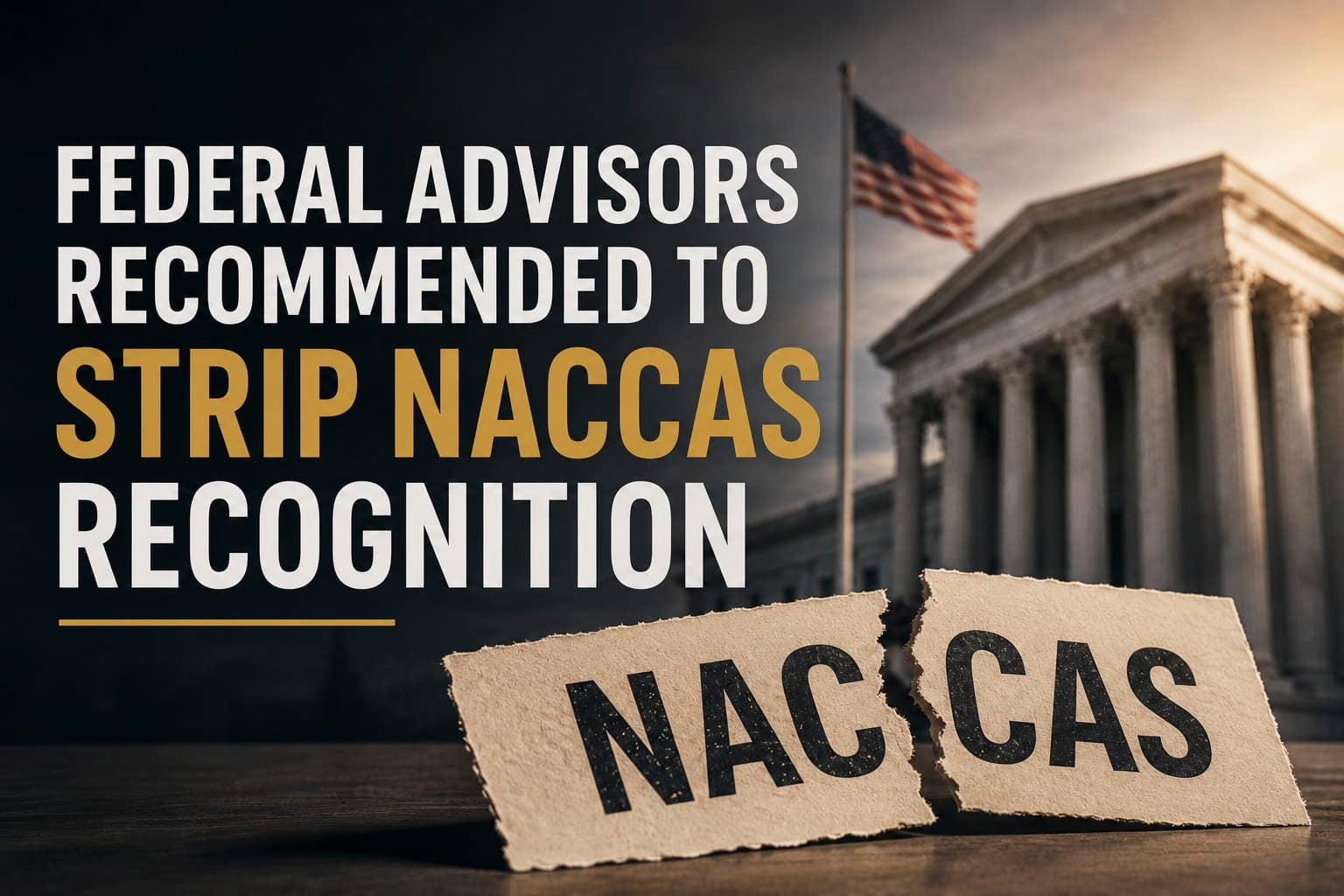
The Accreditation Reckoning: Why NACCAS’s Fight for Survival Should Worry Every Beauty School Owner
Federal advisors just voted to strip recognition from NACCAS, the accreditor overseeing more than 1,000 cosmetology and beauty schools nationwide — and if the Department of Education agrees, hundreds of school owners could be scrambling within months.
On July 23, 2026, the National Advisory Committee on Institutional Quality and Integrity (NACIQI) voted 9-to-3 to recommend that the Department of Education deny renewed federal recognition to the National Accrediting Commission of Career Arts and Sciences (NACCAS), citing failures on 17 federal accreditation standards. The final call rests with Education Under Secretary Nicholas Kent.
Insight: If NACCAS loses recognition, its schools will need a new accreditor within a compressed window or lose access to Title IV federal aid. NACCAS isn’t alone — three other accreditors just walked away from federal recognition entirely, a sign the accreditation landscape is shifting faster than many owners realize.
What Did the Federal Panel Recommend?
Based on the latest iteration of the Gainful Employment regulations, NACIQI cited a pattern of concerns: high probation rates among member schools, weak disclosure of accreditation status to students, and poor outcomes — roughly two-thirds of NACCAS schools have graduates earning less than adults with only a high school diploma four years after graduating. Reviewers also flagged high debt relative to earnings and a practice of letting schools “restart the clock” on compliance each time a new violation surfaced. NACCAS argued that the earnings data does not take into account tip income. Three of twelve committee members agreed that the vote was premature; however, the majority disagreed and voted to recommend that NACCAS lose its recognition as a national accreditor.
The vote is only a recommendation. Under Secretary Kent can accept it and terminate NACCAS’s recognition outright, or fall back to a softer option that keeps NACCAS recognized but bars it from taking new client schools.
NACCAS Isn’t the Only Accreditor Under Pressure
At the same meeting, three programmatic accreditors — the Midwifery Education Accreditation Council, the Council on Education for Public Health, and the Council on Chiropractic Education — voluntarily withdrew their federal recognition petitions rather than go through renewal process. Kent framed the withdrawals as accreditors dodging tougher standards; at least one accreditor disputed that, calling the process “increasingly political.” Two vocational accreditors, the Council on Occupational Education (COE) and the Accrediting Commission of Career Schools and Colleges (ACCSC), were also flagged for additional compliance reporting, though neither faces denial. Together, these moves point to a broader tightening of federal accreditation oversight — not an isolated NACCAS problem. This means it may prove difficult for schools with these issues to find another accreditor willing to accredit them.
The Numbers and the Precedent
NACCAS accredits almost 1,300 schools covering 30+ programs — cosmetology, barbering, esthetics, nail technology, massage therapy being the biggest — and has held federal recognition since 1970. Because Title IV aid requires accreditation, its status determines whether member schools can keep enrolling federal-aid-dependent students.
This isn’t unprecedented. The Accrediting Council for Independent Colleges and Schools (ACICS), once the largest for-profit college accreditor, lost recognition in 2016, briefly regained it in 2018, then lost it for good in 2022. Its remaining schools had just 18 months to find a new accreditor or lose Title IV funding — and were barred from enrolling new students in the meantime. ACICS dissolved in 2024. An 18-month accreditation transition is a heavy lift even under ideal conditions; schools that miss the window lose federal aid, and some simply be forced to close.
What Are a School Owner’s Options?
If NACCAS loses recognition, owners generally face three paths:
- Find a new accreditor — time-consuming, costly, and no guarantee of approval.
- Operate without Title IV funding — viable only for schools with strong cash-pay or state-funded enrollment.
- Sell the business — under distress because buyers will highly discount a school who is being forced to change accreditors in the middle of a sale process.
The right path depends on financials, outcomes data, and how much runway an owner wants to spend fighting the compliance clock. Changing accreditors under duress consumes time, capital, and management bandwidth while the school’s enrollment and revenue hang in question. Owners who come out ahead typically start exploring options early — before deadline pressure and enrollment uncertainty set in.
Frequently Asked Questions
Is NACCAS accreditation already gone? No. NACIQI’s vote is a recommendation; the Department of Education will make the final call.
How long would schools have to find a new accreditor? Not yet announced for NACCAS. Based on the ACICS precedent, affected schools have historically gotten around 18 months.
Does losing NACCAS accreditation mean a school has to close? Not necessarily, but the transition is demanding and not every school will complete it successfully.
Is this just about NACCAS? No — three accreditors withdrew from federal recognition and two more were flagged for compliance review at the same meeting. Oversight is tightening broadly, not just for cosmetology.
If you are a school owner considering selling rather than changing accreditors, please call us for a free, confidential discussion of your options.
Jackim Woods & Co. is a boutique M&A advisory firm based in Libertyville, Illinois, with deep experience advising owners in vocational and career education, including cosmetology and beauty school transactions.
Rich Jackim (rjackim@jackimwoods.com) or Paul Fackler (pfackler@jackimwoods.com).
Read More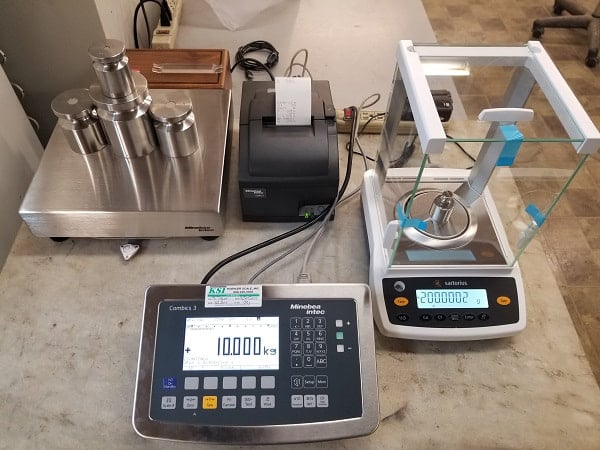
What Is Your Scale Business Worth? A 2026 Valuation Update on the Private Equity Invasion
New money is entering the industrial scale market, the platforms already in it are buying everything they can reach, and even seasoned private equity buyers can’t agree on what these companies are worth. For owners of scale service and distribution businesses, that uncertainty is very good news.
Even the Buyers Can’t Agree on What Your Scale Business Is Worth
Recently I spent an hour comparing notes with a partner at a prominent, industrial-focused private equity firm. He is seasoned, he is successful, and he is currently researching his firm’s first platform acquisition in the industrial scale and weighing sector — the kind of fragmented, service-heavy market that private equity loves to consolidate.
We compared notes on valuation. And here is what stopped me: his working assumption for what scale companies cost was nearly double what they are actually selling for.
Sit with that for a moment. A sophisticated buyer, preparing to deploy serious capital into this space, carried a price expectation almost twice the real clearing price. Part of his skepticism about the sector came from that very assumption — in his mind, these companies were expensive. In reality, they trade for far less than he believed.
If a seasoned private equity professional — and the new entrants writing checks alongside him — don’t have a fixed read on what scale companies are worth, that pricing uncertainty cuts in the seller’s favor. Buyers are anchoring their internal models high. They are competing for a scarce set of quality targets. And the owner who walks in knowing the real numbers holds the advantage.
This is a 2026 valuation update for owners of industrial-scale service and distribution businesses: what the private equity invasion actually means for the value of your company, and the factors that drive that value up or down.
Is Now a Good Time to Sell a Scale Business?
Yes — and the window is open wider than most owners realize.
Two forces are converging at once. New money is entering the sector: private equity firms that have never owned a scale company are building investment theses and hunting for a platform to anchor a roll-up. At the same time, the platforms that already exist are acquiring everything they can reach — and moving fast to do it.
National dealmaking forecasts back this up. Private-equity-led consolidation in recurring, technology-enabled service businesses is expected to remain strong through 2026, with sponsors focused on professionalizing and expanding the platforms they have already built. Scale service companies — with their recurring revenue from calibration, certification, repair, and preventive maintenance — fit that profile almost perfectly. They are exactly the kind of sticky, fragmented, aftermarket-rich business the smart money is chasing.
For a seller, the math is simple. More buyers, especially more motivated ones, create greater competitive tension. The same recurring service revenue and technician dependence that make your business demanding to run are precisely what make it valuable to an acquirer.
What Is My Scale Business Worth? The 2026 Valuation Update
Here is the number owners actually want. Based on the transactions we have worked on with our seller clients and our independent research, scale companies with EBITDA under $5 million are selling in the 6.5x to 9x EBITDA range.
That is a strong number, and it sits at a premium to the broader industrial service middle market, which generally clears in the mid-single digits of EBITDA. The premium is not an accident. It is the recurring service and calibration revenue, the embedded technician relationships, and the sticky aftermarket that buyers are willing to pay up for. When a business produces predictable, contracted revenue year after year, acquirers underwrite it more like an annuity and less like a one-time equipment sale — and they price it accordingly.
Two further market realities push that range around, and both reward a prepared seller:
- Size is rewarded. Within the same sector, larger businesses command meaningfully higher multiples than smaller ones. The gap between a sub-$2 million and a $5 million EBITDA company can be several turns of EBITDA — which means disciplined growth in the year or two before a sale can pay for itself many times over at closing.
- Process is rewarded. Owners who run a competitive, advisor-led sale process consistently realize materially higher prices than owners who sell quietly to the first buyer who knocks on the door. The difference is routinely a double-digit percentage of the purchase price. Selling to the unsolicited caller is the single most expensive convenience an owner can buy.
The takeaway: the 6.5x to 9x band is real, but where you land inside it — and whether you push beyond it — is largely within your control.
Size of Scale Companies |
2026 Valuation Multiple |
| EBITDA $2M to $5M | 6.5x to 9.0x |
| EBITDA <$2M | 5.0x to 7.0x |
What Factors Affect My Valuation?
Two scale companies with identical EBITDA can sell for very different prices. These are the factors that move the number, in roughly ascending order of importance:
- The scale of the operation — your overall revenue and earnings, and the size premium that comes with them.
- The number of technicians — your field-service capacity, and how much of it stays in place if the owner steps away. Scarce, retained technical talent is an asset; an owner-dependent service operation is a discount.
- The number of locations — your geographic footprint and the regional density a buyer can build on or plug into an existing platform.
- Profit margin — clean, healthy margins signal a well-run business and lower a buyer’s perceived risk.
- Service contracts and recurring revenue as a percentage of total revenue — and this is the big one. The higher and stickier your recurring base, the higher your multiple. No single factor does more to move valuation. If you want to raise the value of your business before a sale, this is where the leverage lives.
Who’s Buying — and Who’s the New Money?
The buyer pool is deepening quickly, which is the single best thing that can happen to a seller.
The clearest example is Michelli Weighing & Measurement, backed by private equity firm Summit Park. Since Summit Park’s investment, Michelli has been acquiring aggressively — buying Greenville Scale, Total Scale Service, Houston-based Industrial Scale & Measurement, and Florida Industrial Scale in just the opening months of 2026, building a service network that now spans roughly 50 service areas across 18 states.
Investcorp’s acquisition of Kanawha Scales & Systems, the Carlton platform, Cross Precision Measurement, and J.A. King round out a field of active, well-capitalized consolidators all competing for the same finite set of quality targets.
And now add the new entrant — the private equity firm I opened with, researching its first scale platform with capital ready to deploy. When a brand-new buyer steps into a market where the incumbents are already buying everything in sight, the owners of quality businesses are the ones who win.
What This Means for You
The most useful thing I took from that hour with the private equity partner was not a number. It was the confirmation that the buyers themselves are still working out what scale companies are worth — and that they are bracing to pay more than today’s sellers are receiving.
If you own a scale service or distribution business, you are sitting in a rare position: a deepening pool of motivated, well-funded buyers, a recurring-revenue model those buyers prize, and a market where the price expectations of the people writing the checks run ahead of where deals are actually clearing. The owners who capture that premium will be the ones who understand their real value — and run a real process — before a buyer ever calls.
We advised the seller of a scale business acquired into the Carlton platform, and we work with scale service and distribution owners across North America on valuation and exit strategy. If you are wondering what your business is worth in today’s market, that is a conversation worth having now, while the buyers are this hungry.
About Jackim Woods & Company
Jackim Woods & Company is a boutique mergers and acquisitions firm specializing in lower-middle-market transactions, with deep experience in the industrial scale and weighing sector. The firm provides valuation, exit planning, targeted buyer outreach, and hands-on advisory throughout the sale process. For more information or a free consultation to explore your options, contact

Paul Fackler, Managing Director; pfackler@jackimwoods.com
OR

Rich Jackim, Managing Partner; rjackim@jackimwoods.com
Read More
How Jackim Woods & Co. Protects Your Confidentiality When You Sell Your Business
When you decide to sell your business, you face an immediate and uncomfortable paradox: to attract the right buyer and command a premium price, you must share sensitive information about your company — but doing so too early, or with the wrong people, can destabilize the very asset you’re trying to sell.
Employees may start updating their résumés. Key customers may test alternatives. Competitors may use the news to poach your best people or approach your top accounts. And a buyer who senses urgency or disruption will use it to negotiate a lower price.
Confidentiality isn’t an afterthought in a business sale. It’s a core value-protection strategy — and managing it requires both process discipline and legal sophistication.
At Jackim Woods, we bring both. I spent years as an M&A attorney at White & Case before founding this firm, so I understand confidentiality not just as a deal management practice but as a legal and contractual discipline. Here’s exactly how we protect you throughout the sale process.
Why Confidentiality is So Important
Before getting into our process, it helps to understand what’s actually at risk when confidential information gets out during the sale process.
Employees react fast.
A rumor that the business is for sale can trigger voluntary departures — particularly among your key managers, sales people, and technical specialists — before you have a retention plan or a transition story in place. Buyers pay close attention to team stability. One unexpected resignation during due diligence can reduce the value of your business or create deal conditions you didn’t anticipate.
Customers may hedge.
Relationship-driven businesses are especially exposed. If a major account hears that your company may be for sale that could delay a big order, a contract renewal, or simply ask questions you’re not yet in a position to answer. Any disruption to your revenue during a sale process is one of the fastest ways to lose negotiating leverage.
Competitors and suppliers will act on the information.
A competitor doesn’t need to know the buyer, the price, or the timeline to move against you. They only need to know you’re distracted. They may bring in up when meeting with your customers in an attempt to get a foot in the door. Suppliers may tighten payment terms. Channel partners may revisit exclusivity arrangements. All of that creates noise in your financials and your story at exactly the wrong moment.
Buyers will discount the value of your business.
If any of the above occurs, a serious buyer will notice — and will use it. Lower purchase price, larger escrow holdbacks, more seller financing, stricter non-compete terms. Confidentiality failures have direct, quantifiable financial consequences.
How Jackim Woods Protects Your Confidentiality — Step by Step
Step 1: Anonymous Marketing with a Blind Teaser
We never identify your company during the initial phase of buyer outreach. Instead, we prepare a blind teaser — a one-page anonymous profile that describes the opportunity in terms of industry, geography, revenue range, EBITDA, business model, and key strengths — without revealing your company name, exact location, employee identities, or any detail that would allow a competitor or supplier to reverse-engineer your identity.
This gives us broad market exposure to identify the right buyers while keeping your identity fully protected until a buyer earns access through our screening process. A poorly constructed teaser can inadvertently identify a company through a combination of niche service descriptions, unusual geography, and recognizable customer patterns. We draft teasers carefully to prevent this.
Step 2: Buyer Screening and Financial Qualification
A confidentiality leak almost always traces back to the wrong party getting access too early. Before any identifying information is shared, we screen every prospective buyer for financial capability, strategic fit, acquisition intent, and deal timeline.
We build a targeted buyer universe of 150 to 200 potential acquirers using a structured framework based on Porter’s Five Forces — covering direct competitors, customers who might want to vertically integrate, suppliers who might want to move downstream, adjacent businesses, and financial buyers including private equity groups. From that universe, we identify the highest-probability acquirers before any contact is made.
Screened buyers register through us — not directly with you — which creates a documented, traceable record of who has received what information and when. This protects you legally if a breach of confidentiality issue arises later.
Step 3: A Professionally Drafted NDA — Before Anything Identifiable Is Shared
No buyer receives your company name, financial details, or any identifying information until they have signed a mutual non-disclosure agreement. Having drafted and negotiated hundreds of these agreements as an M&A attorney, I know where standard NDAs fall short.
A well-drafted NDA should do several things that generic templates often miss:
- Define confidential information broadly — financials, customer lists, employee information, pricing, and proprietary processes
- Restrict use of shared information to deal evaluation only
- Prohibit the buyer from contacting your employees, customers, suppliers, or landlord without your authorization
- Require return or destruction of materials if discussions end
- Bind the buyer’s advisors — lenders, accountants, attorneys — to the same obligations
An NDA is not a complete solution on its own. Enforcement is reactive — by the time you’re pursuing a legal remedy, the damage to your business relationships may already be done. That’s why we pair every NDA with the staged disclosure process described below.
Step 4: Staged Disclosure Tied to Buyer Seriousness
Information is released in layers as buyer credibility increases. This is the most reliable way to maintain confidentiality while still allowing a serious buyer to conduct a meaningful evaluation.
| STAGE | WHAT WE SHARE |
|---|---|
| Blind Teaser | Industry, geography, revenue and EBITDA range, business model summary — no identifying information |
| Post-NDA Overview | Business name, high-level financials, service mix, customer profile, management structure |
| Confidential Information Memorandum (CIM) | Comprehensive 12–20 page deal book covering operations, financial performance, growth opportunities, and transaction structure — customer names and employee identities withheld |
| Management Meetings / LOI Stage | Detailed financials, lease terms, add-back support, contract summaries, working capital expectations |
| Due Diligence | Tax returns, payroll detail, customer concentration reports, vendor agreements, insurance, and legal records — managed through a structured virtual data room with tracked access |
Our CIMs are deliberately more comprehensive than what most M&A advisors produce — typically 12 to 20 pages rather than a thin broker summary. This means serious buyers get the depth they need to move forward confidently, while casual or unqualified parties are screened out before reaching this stage.
Step 5: Controlled Due Diligence Through a Virtual Data Room
Due diligence is when the most sensitive information about your business is shared — and when confidentiality discipline matters most. We manage this through a structured virtual data room where we control who has access, which documents are available at each stage, and when access is granted or revoked.
This prevents the common problem of an overeager buyer or their advisor pulling documents that shouldn’t be released until later in the process — and ensures that if a deal falls apart, sensitive materials aren’t sitting unsecured in someone’s inbox.
Step 6: Planning Your Employee and Customer Communications
We help you think through the right timing and messaging for internal disclosures before you need to make them. In most transactions, broad employee notification happens after major deal terms are agreed upon — not at the start of the process. But planning that communication early prevents improvisation under pressure, which is where messaging mistakes happen.
We help you identify which employees are critical to notify early (and with what message), which key customers may need reassurance before closing, and how to frame the ownership transition in a way that preserves relationships and morale.
Common Confidentiality Mistakes to Avoid
Even sophisticated sellers can undermine their own confidentiality protections. The most common mistakes we see:
- Sharing financial details before screening a buyer. Sending tax returns or customer concentration reports to anyone who expresses interest — without verifying their identity, financial capacity, and intent — is the single most common source of leaks.
- Relying on the NDA alone. An NDA creates legal exposure for a buyer who misuses your information. It does not prevent them from misusing it in the first place. Process discipline is the real protection.
- Including too much identifying detail in the teaser. A teaser that mentions a rare niche service, a specific headcount, and a recognizable local customer base may effectively announce the sale without using your name.
- Telling employees too early and without a plan. Well-intentioned transparency before you have a transition message, a retention plan, and a closing timeline creates anxiety you can’t walk back.
- Not tracking data room access during due diligence. If you can’t document who saw what and when, you have no basis for a confidentiality claim if information is misused.
Frequently Asked Questions
How do you keep the sale of my business confidential?
We use a staged process: anonymous marketing through a blind teaser, rigorous buyer screening, a professionally drafted NDA before any identifying information is shared, and controlled disclosure through a structured virtual data room. At every stage, information access is tied to buyer credibility and deal progress — not to curiosity.
When should I tell my employees the business is for sale?
In most cases, broad employee disclosure happens after major deal terms are agreed upon and you are approaching closing — not at the beginning of the process. We help you plan that communication in advance so you’re not improvising it under deal pressure.
What information does a buyer receive, and when?
Buyers receive information in layers. Early-stage materials are anonymous. After signing an NDA, a buyer receives a comprehensive CIM. More detailed financial and operational materials come at the LOI stage. The most sensitive documents — tax returns, customer data, payroll records, contracts — are shared only during a controlled due diligence process.
Does an NDA fully protect me?
No. An NDA is an important legal safeguard, but it’s a reactive remedy once the damage has been done. The real protection comes from process discipline: careful buyer screening, staged disclosure, and controlled data room access that limits unnecessary exposure in the first place.
Can a breach of confidentiality actually reduce my sale price?
Yes, directly. If a leak creates employee turnover, customer hesitation, or supplier disruption, a buyer will price that instability into the deal — through a lower purchase price, larger escrow holdbacks, more seller financing, or stricter deal conditions. Confidentiality is not just about privacy. It’s about maintaining the negotiating leverage you need to close at the best possible terms.
Why does it matter that you’re an M&A attorney?
Most M&A advisors treat the NDA as a standard form. Because I practiced M&A law at White & Case, we draft and negotiate NDAs the way an attorney would — with specific attention to the provisions that matter most in a real dispute: scope of confidential information, no-contact clauses, advisor obligations, and remedies for breach. You get both deal expertise and legal precision in the same engagement.
Ready to Explore a Confidential Sale?
If you’re considering selling your business — even if a transaction is still 12 to 24 months away — the time to think about confidentiality is before your first buyer conversation, not after. Jackim Woods & Co. offers confidential consultations for business owners who want to understand their options, assess their company’s value, and develop a sale strategy that protects what they’ve built.
About Jackim Woods & Co.
Rich Jackim is an investment banker, entrepreneur, and former mergers and acquisitions attorney.
For the last 25 years, Rich has been providing boutique investment banking services to small and lower middle-market companies in a wide range of industries across the United States and Canada.
Rich is also the author of the critically acclaimed book, The $10 Trillion Dollar Opportunity: Designing Successful Exit Strategies for Middle Market Businesses.
In his spare time, Rich founded a successful training and certification company called the Exit Planning Institute, which he sold to a private family office in 2012. He created the Certified Exit Planning Advisor or CEPA program that has taught over 8,000 students how to incorporate exit planning into their practices. As a result, he is often referred to as the father of the exit planning profession.
Jackim Woods & Co offers skilled mergers and acquisitions advisory services to privately companies in both sell-side and buy-side transactions. Jackim Woods & Co has arranged over 120 successful transactions, ranging from one million to more than eighty million dollars in value.
If you own a business and are interested in exploring your options, I would welcome an opportunity to speak with you.
Feel free to contact me at 224-513-5142 or rjackim@jackimwoods.com.
Your EBITDA Is Strong. But Is Your Business Sellable?
Strong EBITDA is necessary but not sufficient to sell a business — buyers scrutinize the quality and durability of earnings, not just the headline number.
A company with $13M in revenue and $5M in EBITDA failed to sell after a year on the market because two structural risks — 45% revenue dependence on a single distribution channel and 16% revenue from one customer — triggered valuation disputes, and the deal fell apart during due diligence.
A concentrated revenue base, even at strong margins, creates deal risk that sophisticated buyers will find and price against. Businesses where any single customer accounts for 5% or more of revenue, where revenue flows through a single channel or relationship, or where recurring revenue is minimal , face a high likelihood of a buyer wanting to renegotiate the deal during due diligence. A professional market assessment — reviewing financials, revenue composition, customer concentration, and competitive positioning — is the critical first step before going to market, and is the most reliable way to avoid surprises that kill deals.
— Rich Jackim, Jackim Woods & Co.
Your EBITDA Is Strong. But Is Your Business Sellable?
Every business owner considering selling their business deserves a clear-eyed assessment of one foundational truth: EBITDA is a critical metric, but it does not tell the complete story. Owners who discover this after months of trying to sell their business — or after a deal fails during due diligence — will have wasted a lot of time and money.
The following is a situation we have seen multiple times in our practice. The details have been modified for confidentiality, but the dynamics are real—and offer important insights for any owner thinking about an exit.

A Business That Looked Great on Paper
Last year, we spoke with the owner of a business services company who had spent twenty years building his business. Now 65, he was ready to retire and sell the company. The financial profile was attractive: approximately $13 million in revenue with $5 million in EBITDA – strong margins that would get buyers’ attention.
Early in the process, the owner’s CPA reviewed the financials and told the owner the company was probably worth $25 million – exactly what the owner wanted to hear. The CPA explained that the EBITDA was there, and in his experience, companies like this one sold for 5x EBITDA. The owner felt confident, so he hired an M&A advisor to sell the business. After a year on the market, two buyers had withdrawn their offers during due diligence, and the business was still not sold.
Strong EBITDA opens doors. But what buyers find when they look inside determines whether a deal actually closes.
What the Financial Analysis Revealed
When buyers started their due diligence, they discovered the company’s revenue composition contained concentration risks that ultimately derailed the deal:
45%Revenue from One Distribution Channel |
16%Revenue from a Single Customer |
61%Revenue Concentration Risk |
Revenue channel concentration: 45% of total revenue was generated through a single distribution channel, a key salesperson, who was the same age as the business owner. While that salesperson had performed reliably for years, the fact that the company depended on someone so close to retirement age was a structural dependency that concerned sophisticated buyers.
Customer concentration: 16% of revenue was attributable to one customer, a large manufacturer with multiple locations. This indicated a customer concentration issue that affected lending eligibility and the buyer’s financing options, which in turn affected the overall risk profile of the deal.
These were not deal killing factors individually. But collectively, they represented risks that sophisticated buyers identified in due diligence, and in one case, used to try to negotiate a huge valuation adjustment (50%) — or in the other case, as grounds to exit the process entirely.
When Market Conditions Validated a Buyer’s Analysis
What ultimately killed the deal was during due diligence, an external event occurred that demonstrated precisely why concentration risk demands early attention.
The company received formal notification that its largest customer — representing 16% of annual revenue — had been acquired by a direct competitor. As part of the acquirer’s vendor consolidation strategy, they provided notice that they would be scaling back their purchase orders over the next six months, with the goal of consolidating all purchase orders with the new parent company’s vendors.
The impact was immediate and material. Sixteen percent of the company’s revenue had just disappeared and could not easily be replaced. The seller’s valuation and negotiating position was now fundamentally changed by a single event outside of their control. This is exactly what buyers feared, and it had come true.
The Strategic Lesson for Owners Selling Their Businesses
Advisors who do not earn success fees when a transaction closes have limited incentive to tell clients the hard honest truth about their client’s business. The result is that business owners often try to sell their business without a clear understanding of how buyers will evaluate their company — and without the opportunity to fix those risk factors before they become deal killers.
As the above example demonstrates, EBITDA matters a lot. But experienced buyers will also be looking at the quality and durability of those earnings:
- Does any single customer represent more than 5% of a company’s revenue?
- Is revenue dependent on a single channel, platform, or relationship that could be disrupted?
- Is revenue generated from one product or service, or diversified over a wide range of products and services?
- Is there industry concentration risk with services or products serving only one industry?
- How much of the revenue base is genuinely recurring, contracted, or relationship-protected versus transactional?
- How is the business positioned relative to industry transformation — as an adopter or as a laggard?
- How would EBITDA be affected if the single largest customer or channel relationship were impaired?
These are the questions that determine whether reported EBITDA represents durable, transferable earnings—or a business that will be systematically discounted during the diligence and negotiation process.
 The Question Every Owner Should Ask Before Selling Your Business
It is not simply “What is my EBITDA?”
The more important question is: “Do my revenue and EBITDA accurately reflect the risk-adjusted financial performance of my business?”
That is precisely what a professional market assessment and business valuation is designed to answer. Not to produce an optimistic number, but to give you the honest, complete picture that enables you to maximize transaction value and approach the market from a position of knowledge rather than a host of assumptions.
Why a Free Market Assessment Increases Your Options when Selling Your Business
At Jackim Woods & Co., our complimentary market assessments are designed to give business owners the analytical foundation they need before making one of the most consequential financial decisions of their lives.
We review of your financials, revenue composition, customer and channel concentration, competitive positioning, and provide you with the realistic range of values a qualified buyer would assign to your business. It means identifying the factors that could affect a transaction — and giving you to option to address them before you go to market.
Business owners who understand their true market value make better decisions: about timing, about preparation, about which buyer profiles to target, and how to position the company’s story. They do not spend months pursuing a process that was unlikely to succeed. And they are not surprised by what buyers find.
If you are considering a sale — even if your timeline is one to three years out — an objective assessment of where your business stands today is the most valuable step you can take.
Please note: Because of the time and effort that goes into to preparing a market assessment, free market assessments are only available for businesses generating at least $5 million in revenue or $1 million in EBITDA.
About Jackim Woods & Co.
 Rich Jackim is an investment banker, entrepreneur, and former mergers and acquisitions attorney.
For the last 25 years, Rich has been providing boutique investment banking services to small and lower middle-market companies in a wide range of industries across the United States and Canada.
Rich also founded a successful training and certification company called the Exit Planning Institute, which he sold to a private equity group in 2012.
Rich is also the author of the critically acclaimed book, The $10 Trillion Dollar Opportunity: Designing Successful Exit Strategies for Middle Market Businesses.
Jackim Woods & Co offers skilled mergers and acquisitions advisory services to privately companies in both sell-side and buy-side transactions. Jackim Woods & Co has arranged over 120 successful transactions, ranging from one million to more than eighty million dollars in value.
If you own a business and are interested in exploring your options, I would welcome an opportunity to speak with you.
Feel free to contact me at 224-513-5142 or rjackim@jackimwoods.com.
Read More
America’s $5 Trillion Business Ownership Crisis
America is facing a business ownership crisis: 6 million small businesses will need new owners by 2035, and according to a McKinsey study titled The Great Ownership Transfer, 92% will simply close rather than sell.
The businesses most at risk have revenues between $1 million and $10 million — owner-operated firms spanning business services, regional manufacturing, and B2B specialties that are too small for institutional private equity and too complex for Main Street brokers. Together, they represent up to $5 trillion in enterprise value that will largely disappear unless buyers and sellers find each other in time. Rich Jackim predicted this wave in 2007 and co-founded the Exit Planning Institute to address it, training over 9,000 Certified Exit Planning Advisors — yet the majority of business owners still exit without a plan. For sellers, the window to transact at full value is narrowing every year; for buyers, the opportunity to acquire profitable, established businesses at reasonable prices has never been larger.
— Rich Jackim, Jackim Woods & Co.
McKinsey & Company just published a study that deserves attention from every business owner and serious business buyer in the country. The study, titled The Great Ownership Transfer, puts hard numbers to something I’ve been saying for nearly two decades: America is approaching a massive, largely unaddressed transition of business ownership — and most business owners aren’t ready for it.
The headline finding: 6 million small businesses will need new owners by 2035 as Baby Boomers retire. The sad news is that, according to McKinsey, 92% of these will not be sold and will simply shut their doors. The good news is that this means at least 1 million are viable acquisition targets, representing up to $5 trillion in enterprise value.
I Saw This Coming in 2007
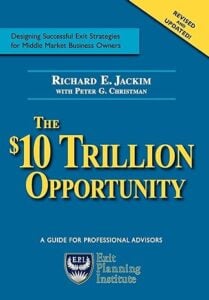 When I wrote the critically acclaimed book, The $10 Trillion Opportunity, this demographic wave was already clearly on the horizon. The math was never complicated: the largest generation of entrepreneurs in American history, the Baby Boomers, would eventually retire, and the buyer infrastructure to acquire these lower-middle-market businesses was not well developed.
That book led me to co-found the Exit Planning Institute, and to create the Certified Exit Planning Advisor (CEPA) designation — a program that has now trained more than 9,000 graduates and helped establish exit planning as a recognized professional discipline. Entire conferences, curricula, and consulting practices have been built around it.
And yet — despite all of that progress — the majority of business owners still exit without a plan in place. The McKinsey data makes that painfully clear: 92% of small business exits or sales today will end in closure. Not sale. Not succession. Closure. Let that sink in.
Profitable companies with real customers, trained employees, and decades of hard-earned reputation — simply shutting their doors because no qualified buyer stepped forward in time.
The Forgotten Core of the American Economy
The businesses most exposed to this risk share a common profile: revenues between $1 million and $10 million, spanning business service providers, regional manufacturers, and B2B specialists. These are owner-operated firms that have quietly powered local economies and supply chains for decades.
They’re too small to attract institutional private equity. Too complex for Main Street business brokers. And too often overlooked by the buyers who could give them a real future. It’s a structural gap hiding in plain sight — and it’s where the closure problem is most acute.
What This Means for Buyers & Sellers
Here’s the other side of the equation that doesn’t get discussed enough.
We talk with a lot of prospective buyers every day. And while well-run businesses with strong fundamentals cross our desk regularly, most buyers aren’t in the market for a good company. They’re searching for the right one — the one that checks all the boxes, including the right combination of timing, fundamentals, and transformative upside.
The challenge is that “right” means different things to different buyers. The right fit depends on the buyer’s background, industry experience, capital structure, growth thesis, and risk tolerance. That means if you are buyer, finding your right acquisition or isn’t a passive exercise. The same applies if you are a seller. It requires extensive, targeted research and outreach — two things we do every day.
The Bottom Line
This is precisely the space that Jackim Woods & Co. was built to serve. Paul, Jim, and I have spent years developing the relationships, the methodology, and the market intelligence to move these businesses from owner-operated to professionally transitioned — without watching them quietly disappear.The Great Ownership Transfer is not a future event. It’s happening now. Every year that passes without a transaction plan is a year closer to a closure that didn’t have to happen.
If you’re a business owner thinking about your exit — whether in two years or ten — the time to start the conversation is now, before urgency forces your hand.
Contact us at Jackim Woods & Co. We’re happy to help you explore your options, help you develop a plan, and help you find the right buyer for your business. Reach us at jackimwoods.com or contact Rich directly to start the conversation.
Read More
The CDL Mill Crackdown: What It Means for the Industry’s Future
The CDL Mill Crackdown: What It Means for Trucking, Safety, and the Industry’s Future
In February 2026, federal investigators fanned out across all 50 states in one of the most aggressive enforcement actions the trucking industry has ever seen. Over the course of just five days, the Federal Motor Carrier Safety Administration deployed more than 300 investigators and conducted over 1,400 on-site sting operations targeting commercial driver’s license (CDL) training schools. The results were striking: 448 schools received formal notices of removal for failing to meet basic safety standards, and 109 others voluntarily withdrew from FMCSA’s national Training Provider Registry the moment they learned investigators were on their way. Another 97 remain under active investigation.
 Combined with earlier enforcement waves — including the removal of nearly 3,000 providers in December 2025 and another 3,800 in January 2026 — FMCSA has now purged more than 7,000 CDL schools from its registry since 2025. To put that in context, the registry listed roughly 40,000 training providers before the crackdown began, meaning the purge has touched nearly one in five listed schools. It’s worth noting that many of the first wave of removals were inactive operators — school districts, community colleges, and small fleets that had registered but hadn’t trained a driver in years. The February 2026 sting was more significant precisely because it targeted active operators who were actively credentialing drivers. Transportation Secretary Sean Duffy framed it plainly: “For too long, the trucking industry has operated like the Wild, Wild West.”
He’s not wrong. And from an investment banker’s perspective, the scale of the problem these actions are addressing is even larger than the headlines suggest.
What CDL Mills Actually Are
A CDL mill is a training provider that collects tuition fees, issues completion certificates, and does little else of value. Investigators found schools operating out of fake addresses, using unqualified instructors, training students on vehicles that didn’t match the license class being sought, and in many cases simply selling passing scores to anyone who could pay.
The documented fraud runs deep. Between 2001 and 2025, DOT Office of Inspector General investigations conservatively estimated that over 6,000 fraudulent licenses were issued to drivers who couldn’t operate the vehicles they were credentialed to drive. In Massachusetts, a former State Police sergeant ran a scheme for years, arranging passing scores for dozens of applicants he privately described as “brain dead” and people who “should have failed about 10 times already” — and the scheme continued operating for more than a year after federal Entry-Level Driver Training rules went into effect in 2022. In Louisiana, a federal grand jury indicted multiple state motor vehicle employees for bribery. In Florida, a Russian-language trucking school charged students up to $5,000 for guaranteed CDLs, complete with covert cameras and wireless earpieces to feed answers during tests.
These weren’t isolated incidents. They represent a market that grew precisely because it was profitable and, for years, essentially unpoliced. From 2022 through 2024, despite widespread complaints, FMCSA removed only four providers from the registry under routine enforcement — three of those for emergency-level violations. The self-certification model that governed CDL training was, in practice, an honor system with no honor.
The Economic Damage Is Real and Measurable
For those of us who work in transportation M&A, the downstream consequences of this fraud show up directly in deal economics — and they are not small.

Experior Logistics
Insurance costs have spiraled industry-wide. The trucking sector has absorbed dramatic liability premium increases over the past decade, driven in significant part by large jury verdicts tied to crashes involving undertrained drivers. Primary liability insurance for owner-operators running under their own authority now reaches $14,000 to $22,000 annually per truck — a cost structure that pressures margins and makes capital formation harder for smaller carriers. When a carrier unknowingly hires a driver whose credentials were purchased rather than earned, it inherits catastrophic liability exposure that may not surface until a fatal accident triggers litigation.
The accident data is damning. In 2023, over 153,000 highway truck accidents resulted in more than 5,400 fatalities — a 40% increase from 2014 levels. The odds of being killed by a commercial truck are now roughly 20 times greater than dying in a commercial airline crash, a disparity that reflects the vast difference in training standards between the two industries. In Fort Pierce, Florida, a driver who could neither speak nor read English obtained a fraudulent CDL and subsequently killed a family of three. In California, a driver whose license was obtained through a bribery scheme triggered a 74-vehicle pileup that killed two people and injured 51 others.
The “driver shortage” narrative was partly manufactured. The Owner-Operator Independent Drivers Association has argued forcefully that CDL mills fueled a “destructive churn” built on a false narrative of a nationwide truck driver shortage. Rather than addressing retention problems and working conditions, some carriers and training operators chose to flood the market with undertrained, low-cost labor — depressing wages for qualified professional drivers and distorting the supply-demand dynamics that buyers and sellers need to accurately price risk. For anyone underwriting a trucking acquisition, a workforce seeded with paper drivers represents unquantified liability hiding in plain sight on the balance sheet.
Valuation integrity was compromised. When a carrier’s safety rating, claims history, and insurance profile reflect the consequences of fraudulent driver credentialing, it directly impairs enterprise value — often in ways sellers themselves don’t fully understand until a buyer’s diligence team starts pulling driver qualification files.
Why the Enforcement Action Is Genuinely Good News
The federal crackdown is disruptive in the short term. Some legitimate drivers trained at now-decertified schools face credentialing complications. Some carriers will need to requalify portions of their workforce. These are real costs.

But the long-term benefits are substantial — and they flow to every honest participant in the industry.
For consumers and the public, the benefit is direct: fewer undertrained drivers on the road means fewer preventable deaths. Enforcement finally aligns regulatory action with a decade of worsening accident statistics.
For employers and carriers, a cleaner training registry reduces the risk of unknowingly inheriting fraudulent credentials. It also strengthens the defensibility of hiring decisions in litigation — a factor that matters enormously when nuclear verdicts can exceed policy limits by multiples. Carriers that have invested in rigorous training pipelines will find those investments increasingly rewarded in both insurance pricing and competitive differentiation.
For the industry’s investment profile, regulatory clarity and improved safety metrics will gradually reduce the liability discount that buyers and insurers apply to trucking assets. Lower accident frequencies, cleaner CSA scores, and a more professionalized driver workforce all improve the risk-adjusted attractiveness of transportation businesses. A cleaner registry should also help normalize insurance markets distorted by years of adverse loss experience — ultimately lowering the cost of capital across the sector.
For legitimate training providers, the removal of competitors who were undercutting the market on price while externalizing costs onto the public restores competitive balance. Schools that invested in qualified instructors, proper equipment, and genuine curricula can now compete on a level playing field.
The Bottom Line
CDL mills are fraud enterprises that monetized a regulatory blind spot while transferring enormous costs onto the public, onto legitimate industry participants, and onto the victims of preventable crashes. The scale of the federal response — more than 7,000 schools removed or flagged out of roughly 40,000 registered providers — reflects how thoroughly that blind spot was exploited.
For investors, buyers, and sellers in the trucking space, the era of treating driver credentialing quality as a back-office compliance matter is over. The cleanup is long overdue. And while the short-term disruption is real, the foundation being laid is one that serious operators, acquirers, and lenders should welcome.
Thinking About Buying or Selling a CDL Training Business?
 The regulatory reset underway in the CDL training sector is creating real M&A opportunity — but navigating it requires an advisor who understands both the industry dynamics and the deal mechanics.
At Jackim Woods & Co., we bring deep expertise in transportation services M&A to every engagement. We understand how FMCSA compliance history, Training Provider Registry status, student completion rates, and instructor credentialing translate into enterprise value — and how buyers and lenders are pricing those variables right now. For sellers, that knowledge means positioning your business to command the best possible outcome in a market that is actively rewarding well-run, compliant operators. For buyers, it means identifying acquisition targets with clean regulatory profiles and durable competitive advantages before the broader market catches on.
The shakeout created by federal enforcement is far from over. Owners of legitimate, compliant CDL training businesses may find that this is an exceptional time to explore a sale, recapitalization, or strategic partnership. Acquirers looking to build scale in a consolidating market have a narrowing window to act before valuations fully reflect the new competitive landscape.
Whether you are a CDL school owner weighing your exit options or a strategic buyer looking to enter or expand in the training sector, we would welcome the opportunity to discuss what your business is worth and what the market looks like today.
Contact us for a free, no-obligation conversation.
Rich Jackim, Managing Director Jackim Woods & Co. www.jackimwoods.com
Rich Jackim is Managing Director of Jackim Woods & Co., a lower middle market M&A advisory firm, and author of The $10 Trillion Opportunity. The firm advises owners and acquirers across transportation, distribution, and business services.
Read More
2025 M&A Market Overview: What Business Buyers and Sellers Need to Know
The business brokerage landscape in 2025 tells a story of steady growth and selective optimism. After analyzing nearly 10,000 closed transactions representing nearly $8 billion in enterprise value, our research reveals a market that’s maturing with purpose—where buyers are more discerning, and sellers who prepare properly are being well rewarded.
A Market Finding Its Footing
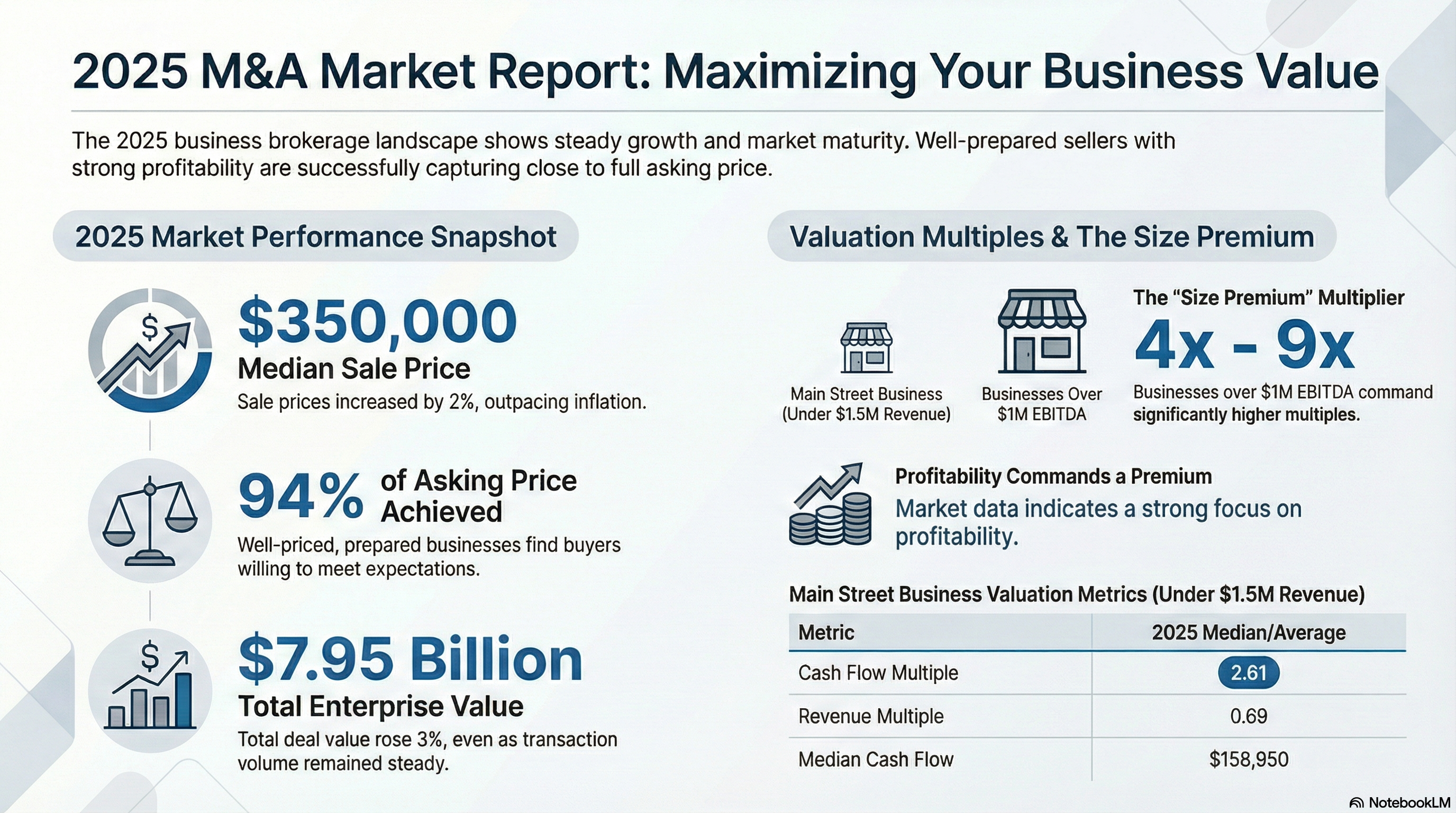
This past year saw 9,586 transactions close, a modest but meaningful 0.4% increase from 2024. While that growth rate might seem incremental, it signals something important: stability, which is crucial amid market disruptions stemming from Trump’s tariffs and immigration enforcement policies, which have caused tremendous uncertainty across our economy.
Another important indicator is that the total enterprise value of $7.95 billion is up 3% year-over-year, demonstrating that deal sizes are expanding even as transaction volume holds relatively steady.
For sellers, the headline number is encouraging: the median sale price reached $350,000, a 2% increase that outpaced inflation in many sectors. More telling is that businesses are selling at an average of 94% of their asking price, suggesting that well-priced, well-prepared businesses marketed by professional business brokers are finding buyers willing to meet them close to their expectations.
The Valuation Story: Cash Flow Still Commands a Premium
Our research relies heavily on closed transaction data from the BizBuySell and our own internal database of closed transaction, which tends to focus on smaller, “main street” types of businesses, with revenues of less than $2 million. For these small companies, valuation multiples reveal where buyer confidence truly lies.
The average cash flow multiple climbed to 2.61—a 1% increase that may seem small but represents real dollars when applied to six-figure earnings. With median cash flow of $158,950 (up 3%), sellers with strong, documented profitability are in the driver’s seat.
Revenue multiples also ticked up to 0.69, a 2% gain, while median revenue reached $703,000. This suggests buyers are willing to pay more for top-line growth, but the stronger appreciation in cash flow multiples confirms what savvy sellers already know: profit matters more than revenue when it comes to valuation.
Size Premium: It is important to note that larger companies sell for higher multiples of EBITDA and Revenue due to a size premium. Buyers view larger companies as much less risky then smaller companies so if your business is generating more than $5M in revenue and more than $1M in EBITDA, you can expect your company to be valued at between 4x and 9x EBITDA, depending on the type of business you have and the industry you operate in.
Where the Action Is
Geography continues to play a decisive role in market velocity. Florida led all states in transaction demand, followed by California, Texas, Arizona, and New York.
These aren’t just population centers—they’re business hubs with favorable demographics and diverse economies that create both buyer pools and acquisition targets.
Sector Spotlight: The Reliable and the Rising
Service businesses dominated the closed deal landscape, claiming the top spot ahead of retail, restaurants, and manufacturing. The prevalence of service businesses reflects their scalability, lower capital requirements, and often more predictable cash flows—qualities that resonate in an environment where buyers are prioritizing stability.
But the real story lies in the rising business types that are capturing increasing buyer attention.
- Financial services
- Technology services
- Cafe and coffee retailers
- Beauty and personal care businesses
These sectors share common threads: recurring revenue potential, demographic tailwinds, and business models that have proven resilient through recent economic uncertainty.
What This Means for Sellers
If you’re considering an exit in the next 12 to 24 months, this data offers a roadmap. Buyers are active, valuations are holding, and well-run businesses in the right sectors are commanding strong multiples. The key is preparation: clean financials, documented cash flow, and a clear growth story will position you to capture that 94% (or better) of asking price.
The market rewards businesses that can demonstrate consistent performance, particularly in cash flow. With multiples trending upward, even incremental improvements in profitability can translate to meaningful differences in your final sale price.
What This Means for Buyers
For buyers, the landscape demands strategic discipline. With sale prices hovering near asking prices, there’s less room for bargain hunting, but opportunities exist for those who can move decisively on quality businesses. The rise in cash flow multiples means you’ll need to justify higher purchase prices with clear paths to growth or operational improvements.
The emerging sectors—financial services, technology, specialty retail like coffee shops, and beauty services—represent areas where market momentum may create additional upside beyond the acquisition.
Looking Ahead
The 2025 market isn’t about explosive growth or dramatic shifts. It’s about a maturing marketplace where quality businesses find quality buyers, where valuations reflect realistic expectations, and where the fundamentals—profitability, documentation, and preparation—determine outcomes.
At Jackim Woods & Co., we help clients navigate this landscape with clarity and purpose. Whether you’re building toward an exit or searching for the right acquisition, understanding these market realities is where successful transactions begin.
The data speaks. The question is: are you ready to act on it?
About the Author and Jackim Woods & Co.
Rich Jackim is an investment banker, entrepreneur, and former mergers and acquisitions attorney.
For the last 25 years, Rich has been providing boutique investment banking services to small and lower middle-market companies in a wide range of industries across the United States and Canada.
Rich also founded a successful training and certification company called the Exit Planning Institute, which he sold to a private equity group in 2012.
Rich is also the author of the critically acclaimed book, The $10 Trillion Dollar Opportunity: Designing Successful Exit Strategies for Middle Market Businesses.
Jackim Woods & Co offers skilled mergers and acquisitions advisory services to privately companies in both sell-side and buy-side transactions. Jackim Woods & Co has arranged over 120 successful transactions, ranging from less than one million to more than eighty million dollars in value.
If you own a business and are interested in exploring your options, I would welcome an opportunity to speak with you.
Feel free to contact me at 224-513-5142 or rjackim@jackimwoods.com.
Read More