
Your EBITDA Is Strong. But Is Your Business Sellable?
Strong EBITDA is necessary but not sufficient to sell a business — buyers scrutinize the quality and durability of earnings, not just the headline number.
A company with $13M in revenue and $5M in EBITDA failed to sell after a year on the market because two structural risks — 45% revenue dependence on a single distribution channel and 16% revenue from one customer — triggered valuation disputes, and the deal fell apart during due diligence.
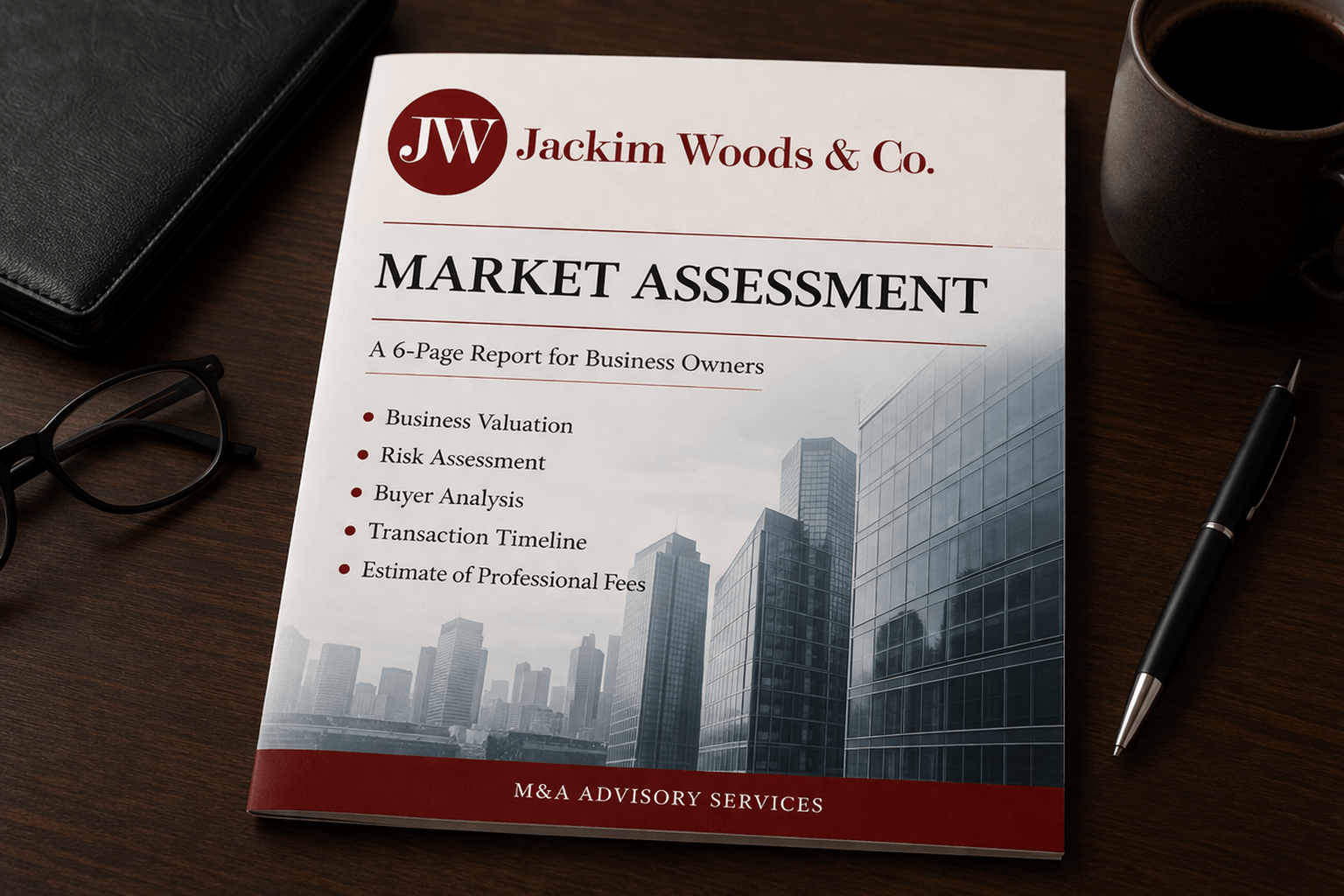
A concentrated revenue base, even at strong margins, creates deal risk that sophisticated buyers will find and price against. Businesses where any single customer accounts for 5% or more of revenue, where revenue flows through a single channel or relationship, or where recurring revenue is minimal , face a high likelihood of a buyer wanting to renegotiate the deal during due diligence. A professional market assessment — reviewing financials, revenue composition, customer concentration, and competitive positioning — is the critical first step before going to market, and is the most reliable way to avoid surprises that kill deals.
— Rich Jackim, Jackim Woods & Co.
Your EBITDA Is Strong. But Is Your Business Sellable?
Every business owner considering selling their business deserves a clear-eyed assessment of one foundational truth: EBITDA is a critical metric, but it does not tell the complete story. Owners who discover this after months of trying to sell their business — or after a deal fails during due diligence — will have wasted a lot of time and money.
The following is a situation we have seen multiple times in our practice. The details have been modified for confidentiality, but the dynamics are real—and offer important insights for any owner thinking about an exit.

A Business That Looked Great on Paper
Last year, we spoke with the owner of a business services company who had spent twenty years building his business. Now 65, he was ready to retire and sell the company. The financial profile was attractive: approximately $13 million in revenue with $5 million in EBITDA – strong margins that would get buyers’ attention.
Early in the process, the owner’s CPA reviewed the financials and told the owner the company was probably worth $25 million – exactly what the owner wanted to hear. The CPA explained that the EBITDA was there, and in his experience, companies like this one sold for 5x EBITDA. The owner felt confident, so he hired an M&A advisor to sell the business. After a year on the market, two buyers had withdrawn their offers during due diligence, and the business was still not sold.
Strong EBITDA opens doors. But what buyers find when they look inside determines whether a deal actually closes.
What the Financial Analysis Revealed
When buyers started their due diligence, they discovered the company’s revenue composition contained concentration risks that ultimately derailed the deal:
45%Revenue from One Distribution Channel |
16%Revenue from a Single Customer |
61%Revenue Concentration Risk |
Revenue channel concentration: 45% of total revenue was generated through a single distribution channel, a key salesperson, who was the same age as the business owner. While that salesperson had performed reliably for years, the fact that the company depended on someone so close to retirement age was a structural dependency that concerned sophisticated buyers.
Customer concentration: 16% of revenue was attributable to one customer, a large manufacturer with multiple locations. This indicated a customer concentration issue that affected lending eligibility and the buyer’s financing options, which in turn affected the overall risk profile of the deal.
These were not deal killing factors individually. But collectively, they represented risks that sophisticated buyers identified in due diligence, and in one case, used to try to negotiate a huge valuation adjustment (50%) — or in the other case, as grounds to exit the process entirely.
When Market Conditions Validated a Buyer’s Analysis
What ultimately killed the deal was during due diligence, an external event occurred that demonstrated precisely why concentration risk demands early attention.
The company received formal notification that its largest customer — representing 16% of annual revenue — had been acquired by a direct competitor. As part of the acquirer’s vendor consolidation strategy, they provided notice that they would be scaling back their purchase orders over the next six months, with the goal of consolidating all purchase orders with the new parent company’s vendors.
The impact was immediate and material. Sixteen percent of the company’s revenue had just disappeared and could not easily be replaced. The seller’s valuation and negotiating position was now fundamentally changed by a single event outside of their control. This is exactly what buyers feared, and it had come true.
The Strategic Lesson for Owners Selling Their Businesses
Advisors who do not earn success fees when a transaction closes have limited incentive to tell clients the hard honest truth about their client’s business. The result is that business owners often try to sell their business without a clear understanding of how buyers will evaluate their company — and without the opportunity to fix those risk factors before they become deal killers.
As the above example demonstrates, EBITDA matters a lot. But experienced buyers will also be looking at the quality and durability of those earnings:
- Does any single customer represent more than 5% of a company’s revenue?
- Is revenue dependent on a single channel, platform, or relationship that could be disrupted?
- Is revenue generated from one product or service, or diversified over a wide range of products and services?
- Is there industry concentration risk with services or products serving only one industry?
- How much of the revenue base is genuinely recurring, contracted, or relationship-protected versus transactional?
- How is the business positioned relative to industry transformation — as an adopter or as a laggard?
- How would EBITDA be affected if the single largest customer or channel relationship were impaired?
These are the questions that determine whether reported EBITDA represents durable, transferable earnings—or a business that will be systematically discounted during the diligence and negotiation process.
 The Question Every Owner Should Ask Before Selling Your Business
It is not simply “What is my EBITDA?”
The more important question is: “Do my revenue and EBITDA accurately reflect the risk-adjusted financial performance of my business?”
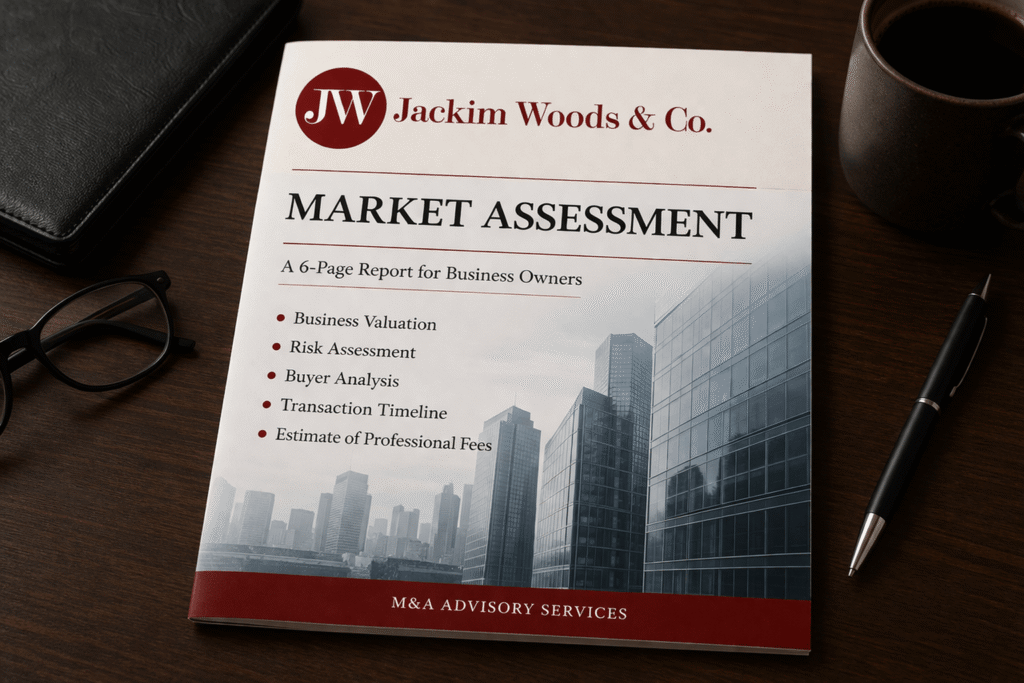
That is precisely what a professional market assessment and business valuation is designed to answer. Not to produce an optimistic number, but to give you the honest, complete picture that enables you to maximize transaction value and approach the market from a position of knowledge rather than a host of assumptions.
Why a Free Market Assessment Increases Your Options when Selling Your Business
At Jackim Woods & Co., our complimentary market assessments are designed to give business owners the analytical foundation they need before making one of the most consequential financial decisions of their lives.
We review of your financials, revenue composition, customer and channel concentration, competitive positioning, and provide you with the realistic range of values a qualified buyer would assign to your business. It means identifying the factors that could affect a transaction — and giving you to option to address them before you go to market.
Business owners who understand their true market value make better decisions: about timing, about preparation, about which buyer profiles to target, and how to position the company’s story. They do not spend months pursuing a process that was unlikely to succeed. And they are not surprised by what buyers find.
If you are considering a sale — even if your timeline is one to three years out — an objective assessment of where your business stands today is the most valuable step you can take.
Please note: Because of the time and effort that goes into to preparing a market assessment, free market assessments are only available for businesses generating at least $5 million in revenue or $1 million in EBITDA.
About Jackim Woods & Co.
 Rich Jackim is an investment banker, entrepreneur, and former mergers and acquisitions attorney.
For the last 25 years, Rich has been providing boutique investment banking services to small and lower middle-market companies in a wide range of industries across the United States and Canada.
Rich also founded a successful training and certification company called the Exit Planning Institute, which he sold to a private equity group in 2012.
Rich is also the author of the critically acclaimed book, The $10 Trillion Dollar Opportunity: Designing Successful Exit Strategies for Middle Market Businesses.
Jackim Woods & Co offers skilled mergers and acquisitions advisory services to privately companies in both sell-side and buy-side transactions. Jackim Woods & Co has arranged over 120 successful transactions, ranging from one million to more than eighty million dollars in value.
If you own a business and are interested in exploring your options, I would welcome an opportunity to speak with you.
Feel free to contact me at 224-513-5142 or rjackim@jackimwoods.com.
Read More
What’s My Court Reporting Firm Worth? – Simple Rules of Thumb
This post from 2018 has been updated with 2025 market data.
Thinking of selling your court reporting or litigation support firm? The first question most business owners ask is, “What’s my business worth?”
Most businesses, including court reporting agencies and litigation support firms, are valued based on a multiple of their cash flow. This cash flow is often referred to as earnings before interest, taxes, depreciation, and amortization or “EBITDA.”
The following multiples are used by business brokers, buyers, and lenders to get a ballpark estimate of a business’s value.
EBITDA SELLING PRICE MULTIPLES
$0 – $50,000 1.0 times EBITDA
$50,000 – $150,000 1.0-1.5 times EBITDA
$150,000 – $250,000 1.5-3.0 times EBITDA
$250,000 – $500,000 2.5-3.0 times EBITDA
$500,000 – $1,000,000 3.0-5.0 times EBITDA
Over $1,000,000 4.0-6.0 times EBITDA
The multiples can vary widely depending on a number of factors, including the size of your business, historical trends in revenue and profit, the range of services you offer, trends in client and reporter retention, client concentration, and other factors that might impact your business’s future cash flow.
How to Calculate the EBITDA of Your Court Reporting Firm
To calculate your court reporting company’s EBITDA, or earnings before interest, taxes, depreciation, and amortization, start with the profit shown on your P&L statement or tax return, then add back interest, depreciation, and amortization. EBITDA is the starting point for any business valuation so it’s a good number to track on an annual basis.
In addition, it is important to calculate your EBITDA correctly. EBITDA should reflect a market-based salary for the firm’s owner. However, if you own your own firm you can pay yourself an above market salary and offer yourself perks that a buyer will not incur. These “excess” expenses can often be added back to your EBITDA resulting in a higher valuation. As a result, it is important to work with an objective third party to evaluate what adjustments can be made to your EBITDA to truly reflect the operating cash flow of your business.
Don’t Leave Money on the Table When Selling Your Court Reporting Firm
While rules of thumb and valuation multiples are easy to use, they are notoriously inaccurate because they don’t consider the unique value drivers or value detractors of your business. Using valuation rules of thumb will give you a rough idea of what your business is worth, but to get a more accurate idea, the valuation should account for things like your agency’s past trends in performance, type of clients, recurring revenue, use of technology, management depth, projected growth, and other things.
To get an accurate valuation talk with a business broker or M&A advisor who specializes in representing professional services companies, including court reporting and litigation support firms. They will work with you to make the appropriate adjustments to your EBITDA, evaluate your business and client base, and value your firm properly so you don’t leave any money on the table when you sell.
At Jackim Woods & Co. we use the discounted cash flow and comparable transactions valuation methods to provide clients with an accurate, market based, idea of what their court reporting and litigation support firms are worth.
Interested in Learning More?
While understanding the value of your court reporting firm is a good place to start, there are many other issues and factors that can affect the overall outcome of a sale. To learn more, download our free 17-page white paper “How to Sell Your Court Reporting Firm for Top Dollar“.
Get a Free, No Obligation Market Assessment of your Court Reporting Firm
If you’d like to begin exploring your options, contact Rich Jackim, Managing Partner at Jackim Woods & Co. (847-682-4997 or rjackim@jackimwoods.com) to get a FREE Valuation and Market Assessment. There is no cost or obligation and all conversations are strictly confidential.
Read More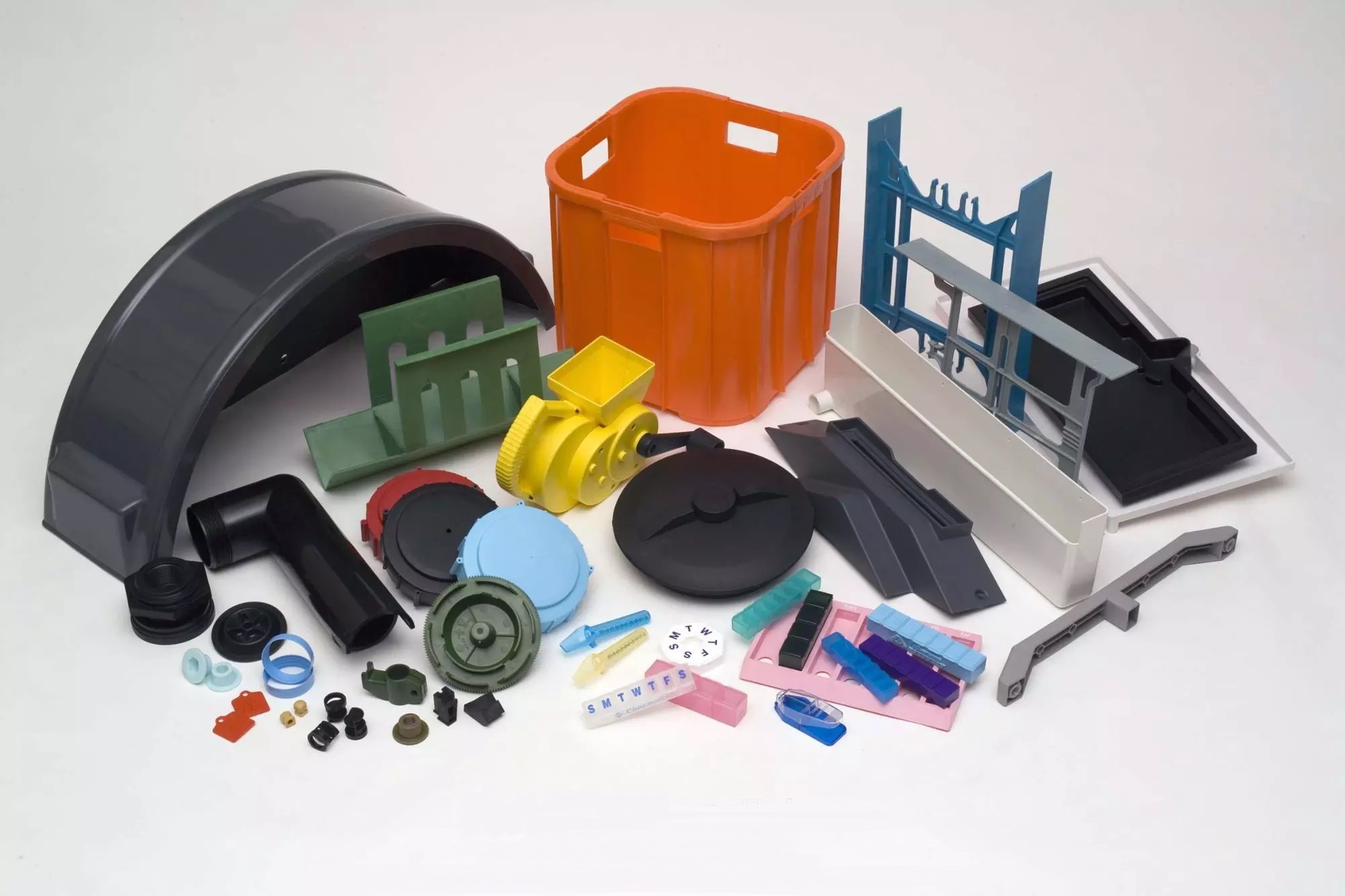
How to Maximize the Value of Your Injection Molding Business
The best way to maximize the value of your injection molding business is to start at least 3-5 years before you want to sell.
The following nine steps will make a big difference in how many buyers will be interested in your molding operation and how much they will be willing to pay you for it.
Focus on Profits, Not Revenue
Focus on increasing profits, not revenue. The value of your business is a function of how much profit it generates, not on its revenue. So do whatever you can to focus on adding profits to the bottom line. That could mean turning away low-margin business and making time on your equipment for more profitable work. You might also take a look at the equipment that isn’t being fully utilized to take on some low-margin work to keep that equipment working. If your fixed costs are covered, that incremental revenue will fall straight to the bottom line. Finally, do whatever you can to eliminate unnecessary expenses. This takes time and effort, which is why it’s important to start 3 to 5 years before you want to exit.
Work With a Good CPA
Having accurate financial statements is crucial. It’s not necessary to have audited financial statements, but you should have them reviewed, not simply compiled, by a reputable accounting firm. This will cost extra money, but it will pay off during the sale process.
Prepare Forecasts
Buyers are buying the future performance of your business. As a result, it is important to have a clear vision of what the future of your business looks like and to be able to share that with potential buyers. This means understanding, to the extent possible, the future needs of your customers, any major new projects in your pipeline, as well as any capital expenditures that may be required.
Eliminate Any Unneeded “Stuff”
If you have obsolete or non-operating assets in your business, get rid of them. Sell or dispose of any old, unusable raw materials, or damaged finished goods inventory. This includes old, broken-down molds, old equipment, etc. Getting rid of this stuff will clean up your production area and make it look more spacious and efficient. Once you’ve disposed of unneeded inventory and equipment, be sure to remove it from your balance sheet as well. The cleaner and more accurate your financial statements are, the better.
Make the Place Look Good
If you want to sell your home, you fix it up and keep it clean. Do the same with your injection molding operation. Look at your business through the eyes of a buyer. Are the windows clean and all the lights working? Are your office and production areas clean and well organized? What do the floors look like in your plant? Are they clean or are they covered in oil, solvents, and stains? If there are any deferred maintenance issues, take care of them before buyers tour your operations.
Be Prepared
You only get one chance to make a good first impression, so anticipate what buyers will ask for and have all the information ready for them when they ask for it. Work with an experienced mergers & acquisitions advisor to help you prepare an offering memorandum that provides an overview of your company. Work with your M&A advisor to set up and maintain a secure, online data room where you can upload all the information a buyer will need to review. This will save you a lot of time and minimize your stress when you decide it’s time to sell.
Make Yourself Obsolete
The more your injection molding business can operate without your direct involvement, the better. Buyers will discount the value of your business if it is heavily reliant on you. If you are heavily involved in day-to-day operations, put together a plan to develop your second layer of management and begin delegating some of your responsibilities to them. If you can take a two-week vacation without the business suffering, you will have succeeded in developing a business that is not reliant on you.
Talk with Multiple Buyers at the Same Time
It is very important to be talking to more than one buyer when you finally decide to sell your injection molding operation. It significantly increases your bargaining position and will motivate interested parties to submit strong offers. Work with an experienced M&A advisor to run a competitive process for you. A good M&A advisor will be able to generate multiple simultaneous offers and provide you with the negotiating leverage you need to get the best combination of price and terms.
Get Professional Advice
Selling your injection molding business may be one of the most important transactions in your lifetime. It is definitely not a “do it yourself” project, particularly if you have never bought or sold a business before. Build a team including a good attorney with M&A experience, your accountant, and an M&A advisor with experience in the injection molding sector.
If you follow these nine steps, you will be able to maximize the value of your injection molding business when you decide to sell.
Conclusion
If you’re interested in getting a ballpark idea of what your injection molding business is worth, check out the article entitled What’s My Injection Molding Business Worth? – Simple Rules of Thumb
If you’d like some help valuing your injection molding business, or would like to explore your options, I would welcome an opportunity to talk with you.
 By Rich Jackim, Managing Partner at Jackim Woods & Co.
Jackim Woods & Co. is a leading mergers & acquisitions advisor focused on providing senior-level attention and flawless execution to clients in the injection molding industry.
Rich Jackim is an experienced mergers and acquisitions advisor and a retired mergers and acquisitions attorney. Rich has over 20 years of experience advising owners of middle-market companies and their boards of directors on mergers, acquisitions, and divestitures. During his career, Rich has been involved in over 70 mergers or acquisitions of middle-market companies worth over $2 billion. Rich is also the author of the critically acclaimed book, The $10 Trillion Opportunity: Designing Successful Exit Strategies for Middle Market Business Owners.
To arrange a confidential conversation to explore your options, please contact Rich Jackim at (224) 513-5142 or rjackim@jackimwoods.com.
Read More